
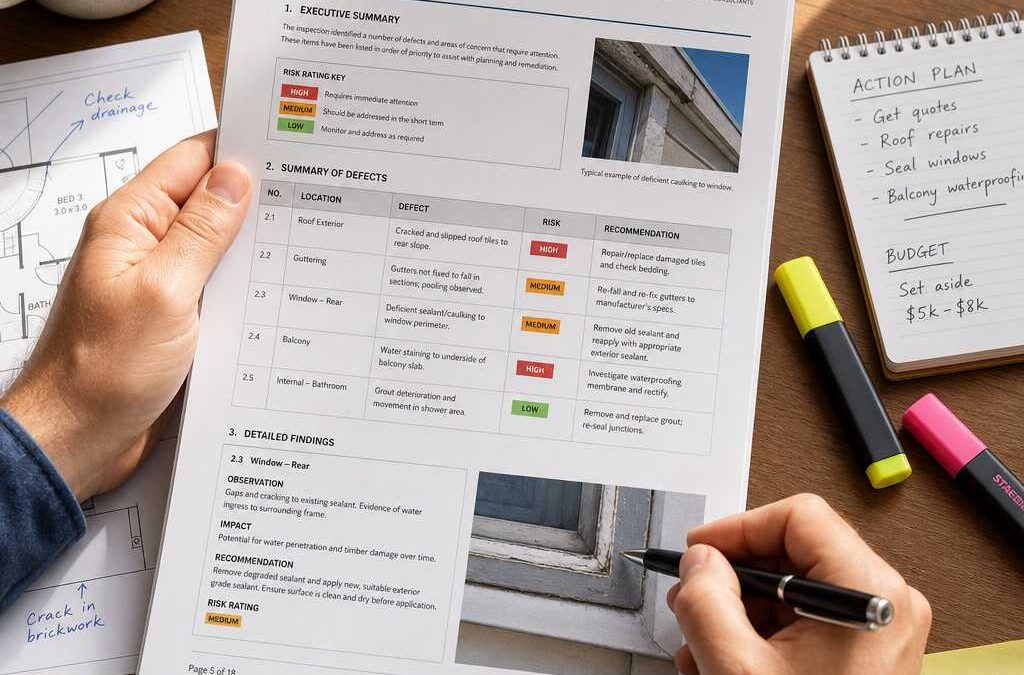
Most homeowners receive their new home defect report, flip through the pages, and have no idea what to do next. The report lands in your inbox days before handover, packed with technical language, trade references, and defect codes that mean nothing without context. If you walk into your builder meeting without knowing how to read inspection report findings properly, you risk accepting a home with unresolved defects that become your problem the moment you sign. This guide breaks down exactly how to interpret every section of your report and turn those findings into clear, enforceable actions with your builder.
Table of Contents
- Quick Takeaways
- What a New Home Defect Report Contains
- How Defects Are Classified and Why It Matters
- Reading Trade Assignments in Your Report
- Comparing Report Formats: What Makes a Good Inspection Report
- Taking Action With Your Builder After Your Handover Inspection
- Common Mistakes Homeowners Make When Using Their Report
- Frequently Asked Questions
- References
Quick Takeaways
| Key Insight | Explanation |
|---|---|
| Defects are grouped by trade, not by room | Builders action defects through trade-specific subcontractors. A report organised by trade, not by location, gets rectified faster because responsibility is unambiguous. |
| Photo evidence is non-negotiable | A written description without a photo is easy for a builder to dispute. Photo-enhanced reports like those from GoInspect remove that ambiguity entirely. |
| Priority classifications carry legal weight | Critical defects that affect structural integrity or health and safety are treated differently under Australian Consumer Law and the Queensland Building Act than cosmetic items. |
| Your report is a legal document | A signed inspection report from a licensed inspector can be submitted to the Queensland Building and Construction Commission (QBCC) if a builder refuses to rectify. |
| Same-day reports change your negotiating position | Receiving your report on inspection day means you can raise defects with your builder before handover paperwork is signed, not after. |
| Builder-facing reports work differently than buyer-facing ones | GoInspect produces reports formatted so builders can assign tasks directly to trades. Generic reports require builders to reinterpret findings, creating delays. |
| Not all defects require delaying settlement | Minor cosmetic defects can be documented and scheduled post-settlement. Structural and waterproofing defects must be resolved before you sign. |
What a New Home Defect Report Contains
A professional new home defect report is not a pass-or-fail certificate. It is a systematic record of every observable construction issue found during the inspection, organised to make rectification actionable. Understanding its structure is the first step in using it effectively.
Most quality reports from services like GoInspect contain four core components: a property summary, a defect log with photographic evidence, trade responsibility assignments, and a priority classification for each item. Some reports also include a cover page confirming the inspector’s licence number and the scope of the inspection, which matters if you ever need to escalate to the QBCC.
The Defect Log Section
The defect log is the body of your report. Each entry typically includes a description of the defect, its location within the property, a photograph taken on the day, the trade responsible, and a priority rating. In practice, this section can run anywhere from 10 items to over 100 in larger or more complex builds.
Read every entry individually rather than skimming to a total count. A report with 40 minor items and 2 critical ones needs urgent attention on those 2 critical defects, regardless of how the overall tally looks. Do not let volume distract you from severity.
Property Summary and Inspection Scope
The summary page tells you what was inspected and what was excluded. Roof voids, subfloor spaces, and areas that were inaccessible on inspection day are typically noted here. If something was not inspected, it is not covered by the report, and you need to ask your builder separately about those areas.


How Defects Are Classified and Why It Matters
Classification systems vary between inspection companies, but most professional reports use a three-tier system. Understanding which tier a defect sits in tells you how urgently it needs to be resolved and what your rights are if the builder pushes back.
Critical Defects
Critical defects are construction faults that affect structural integrity, waterproofing, essential services, or health and safety. Examples include cracked roof trusses, incomplete waterproofing in wet areas, and missing fire-rated materials. These items must be rectified before settlement. If your builder resists, you have grounds to delay practical completion under the Queensland Building Act 1975.
In practice, a builder who refuses to address a critical defect before handover is exposing themselves to significant liability. A licensed inspector’s report documenting that defect is exactly the kind of evidence the QBCC acts on.
Major Defects
Major defects are significant quality failures that affect the function or habitability of the home without necessarily posing immediate safety risks. Poorly fitted windows that allow water ingress, cracked render across a large surface area, and doors that do not seal properly fall into this category.
Most builders will agree to rectify major defects before handover if they are clearly documented. The problem is that verbal agreements mean nothing. Your report, combined with a written defect schedule submitted to the builder, is what creates an enforceable record.
Minor and Cosmetic Defects
Minor defects include paint touch-ups, small cracks in non-structural surfaces, and finish inconsistencies. These are often negotiated as post-settlement items. There is nothing wrong with accepting handover with minor cosmetic defects on the books, as long as they are documented and the builder has committed to a rectification date in writing.
“A defect without documentation is just an opinion. A defect with a photo, a location reference, and a trade assignment is a rectification order.” – GoInspect Inspector Briefing Notes, 2024
Reading Trade Assignments in Your Report
One feature that separates professional pre-handover inspection reports from basic property reports is trade assignment. Each defect is attributed to a specific trade, such as the plasterer, tiler, painter, plumber, or electrician. This structure exists because builders operate through subcontractors. When a defect is assigned to a specific trade, the builder’s site supervisor can send that report section directly to the relevant subcontractor without interpreting or rewriting anything.
When you read your report, check that every defect has a clearly named trade assignment. If a defect is vaguely attributed to the builder or listed without a trade, follow up with your inspector. Ambiguity in trade assignment is the most common cause of defects falling through the cracks during the rectification process.
Why Trade Assignment Speeds Up Rectification
A GoInspect report is formatted so a site supervisor can distribute defect lists to each subcontractor the morning after receiving the report. Compare this to a generic report where defects are listed by room, requiring the builder’s team to manually sort and reassign items. The difference in response speed is significant, often several weeks on larger builds.
Pro tip: When you submit your defect list to your builder, ask them to confirm which subcontractor has been assigned each critical and major defect, and request a rectification date for each item. This creates a documented paper trail that protects you if disputes arise later.
Comparing Report Formats: What Makes a Good Inspection Report
Not all pre-handover inspection reports are built the same way. The format and structure of a report directly affects how quickly and completely defects get resolved. Below is a comparison of the three main report styles used by inspection companies across Brisbane and South East Queensland.
| Report Format | Key Features | Practical Limitation |
|---|---|---|
| Room-by-room narrative report | Easy for homeowners to read, structured like a walkthrough | Builder must manually extract and reassign defects to trades. Increases rectification time and risk of items being missed. |
| Trade-assigned, photo-enhanced report (GoInspect format) | Each defect linked to a trade, photographed, and prioritised. Same-day delivery available. Builder-ready format. | Can appear technical to first-time buyers unfamiliar with trade terminology, but this is resolved by reading the classification guide included in the report. |
| Checklist-based digital report | Fast to produce, easily shared digitally, consistent structure across builds | Often lacks detailed photographic documentation and trade specificity. Difficult to use as a legal document if disputes escalate. |
The GoInspect format is designed to serve both the homeowner and the builder. Homeowners can see exactly what is wrong and where. Builders receive a document they can act on without interpretation. This dual-purpose design is what makes it effective for the defect rectification process from day one.

Taking Action With Your Builder After Your Handover Inspection
Reading your report is step one. Converting it into builder action is step two, and it is where most homeowners lose ground. Builders manage multiple projects simultaneously and respond to documentation, not conversations. Your approach to presenting defects determines how quickly they get fixed.
Creating a Defect Schedule From Your Report
A defect schedule is a simplified summary document you extract from your inspection report. It lists each defect, its priority classification, the responsible trade, and a blank column for the builder to record rectification dates. Most builders prefer this format over being handed a 40-page report in a meeting.
If your inspection company provides this as part of the report package, use their version. GoInspect’s reports are structured to support this kind of builder communication directly. If you are working from a report that does not include a schedule, create a simple table in a word processor and send it via email so the communication is time-stamped.
What to Say in Your Builder Meeting
Keep the conversation focused on the report rather than on frustrations. State each critical and major defect, reference its item number in the report, and ask for a specific rectification date. Avoid general statements like “there are a lot of problems.” That invites a defensive response. Specific item references, such as “Item 14 in the report shows an incomplete waterproofing membrane in the ensuite shower,” force a concrete response.
If the builder disputes a defect finding, your licensed inspector can be contacted to provide clarification. This is another reason to use a report from a fully licensed inspector rather than an unlicensed consultant. A licensed inspector’s findings carry formal weight under Queensland building regulations.
Following the QBCC Pathway If Builders Do Not Respond
If a builder refuses to rectify defects within a reasonable timeframe, the Queensland Building and Construction Commission (QBCC) accepts formal complaints supported by inspection documentation. Your GoInspect report, including the inspector’s licence number and the photographic evidence, is exactly the type of documentation the QBCC requires.
Pro tip: Always submit your defect schedule to your builder in writing via email, not verbally in person. An email creates a timestamp and a delivery record. If the matter escalates to the QBCC or a tribunal, that paper trail is your strongest asset.
Common Mistakes Homeowners Make When Using Their Report
A common mistake is treating the inspection report as a document to file rather than a tool to use actively. Homeowners who receive their report, note the number of defects, and then wait to hear back from the builder are giving away their negotiating position. The report needs to drive communication, not follow it.
Signing Handover Documents Before Defects Are Documented
Some homeowners sign practical completion paperwork while planning to “sort out the defects later.” This is one of the most costly mistakes in the new home process. Once practical completion is signed, your leverage over the builder on pre-existing defects changes significantly. The statutory warranty under the Queensland Building Act still applies, but the conversation becomes much more difficult when the builder can argue you accepted the property in its current state.
Getting a handover inspection Brisbane from a licensed inspector before you sign anything is the standard recommended by industry bodies and consumer protection advocates alike. GoInspect’s same-day reporting capability was specifically designed to solve this timing problem.
Accepting Verbal Promises Instead of Written Commitments
Builders and site supervisors often manage relationships warmly and communicate verbally on site. A supervisor who promises “we will get the painter back next week” is making a commitment that has no enforceability unless you record it in writing. After every conversation about defects, follow up with a brief email summarising what was agreed and by when.
Overlooking Minor Defects That Hide Larger Issues
A single crack in a wall finish may be a cosmetic defect. Multiple cracks across a wall system, or cracks appearing at specific stress points like window corners, may indicate a structural or movement issue. Your inspector will note this distinction, but homeowners sometimes skim past minor-classified items without reading the description. Read every defect entry, regardless of its priority classification, because the context within the description tells you things the classification alone does not.
Frequently Asked Questions
What is the difference between a pre-handover inspection and a practical completion inspection?
Both terms refer to inspections conducted before you formally accept the home from the builder. In Queensland, practical completion is the contractual stage at which the builder declares the home is substantially complete. A pre-handover or practical completion inspection, like those conducted by GoInspect, is carried out at this stage to identify defects before you sign off. The two terms are used interchangeably in practice, though your building contract may use one specific term over the other.
How long does a builder have to fix defects identified in an inspection report?
There is no single mandated timeframe for defect rectification in Queensland, but the QBCC and most building contracts require rectification within a reasonable period. For critical defects affecting safety or habitability, this is typically treated as urgent, often within days. For major and minor defects, a schedule of 30 to 90 days is common. Whatever timeframe your builder agrees to, get it in writing and reference specific defect items from the report.
Can I use my GoInspect report to make a formal QBCC complaint?
Yes. A report prepared by a licensed inspector, which GoInspect inspectors are, meets the documentation standard the QBCC requires for formal complaints about defective residential construction work. The report must include the inspector’s licence details, dated photographic evidence, and clear descriptions of each defect. GoInspect reports are structured to meet this standard from the outset.
What if my builder says the inspector is wrong about a defect?
This is a common pushback tactic. Your inspector has the right to defend their findings, and you should ask your builder to provide written technical justification for why they believe the defect finding is incorrect. In most cases, a builder who disputes a licensed inspector’s finding will need to commission their own inspection or engage the relevant trade to provide a written assessment. Verbal disagreement is not a valid response to a documented inspection finding.
Is it worth getting an inspection report for a high-rise apartment as well as a house?
Absolutely, and the inspection scope for a high-rise apartment is often more demanding than for a standalone home. Common defect categories in high-rise developments include waterproofing failures on balconies, fire door compliance issues, incorrect installation of mechanical services, and finish defects across multiple units. GoInspect provides customised inspection reports for high-rise developments specifically because the defect profile and trade accountability structure differs significantly from a single-dwelling house.
How quickly can I get my inspection report after the inspection?
GoInspect provides same-day reporting, which means you receive your completed defect report on the day of the inspection. This is significant because it allows you to raise defects with your builder before the handover meeting rather than days later when you may have already signed documents. Same-day reporting is not the industry standard, but it should be, given how often handover timelines compress at the final stage.
If you have recently received a pre-handover or practical completion inspection report and are unsure how to interpret a specific section or take the next step with your builder, share your experience in the comments below. What part of the report process gave you the most trouble, and how did you resolve it?
References
- Queensland Building and Construction Commission: Official guidance on defect complaints, contractor obligations, and homeowner rights under the Queensland Building Act
- Queensland Legislation Online: Full text of the Queensland Building and Construction Commission Act and related residential construction standards
- Australian Competition and Consumer Commission: Consumer rights under Australian Consumer Law applicable to new home construction defects and builder obligations
- Forbes Real Estate: Analysis and commentary on property inspection best practices, homeowner protections, and construction accountability
- Statista: Data and statistics on Australian residential construction activity, defect rates, and new home completions