
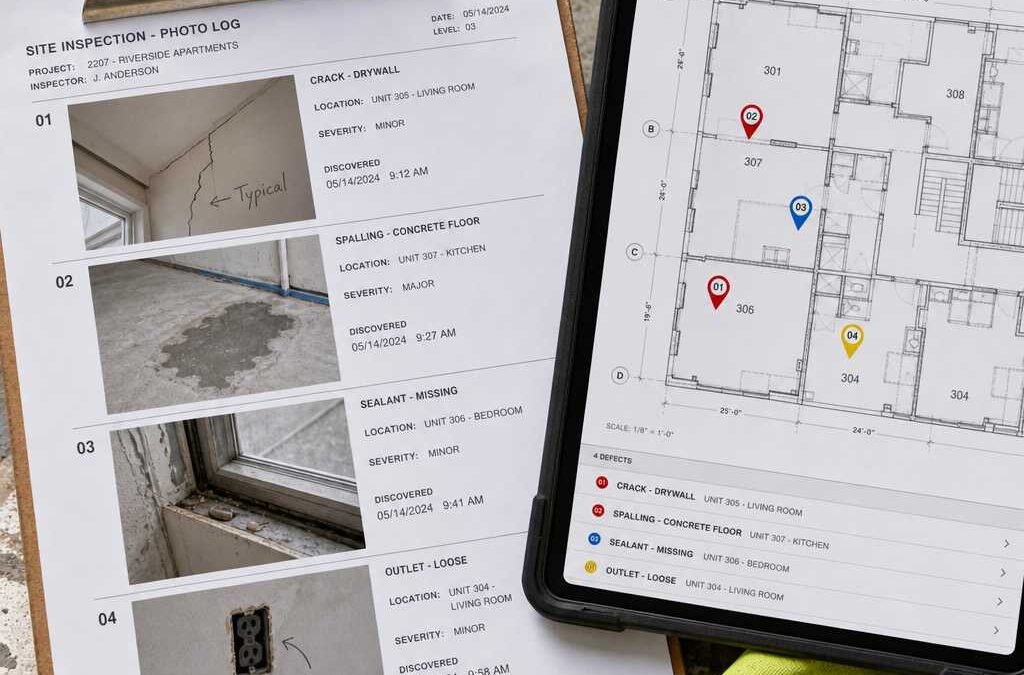
Builders do not fix what they cannot clearly see, and inspectors who hand over pages of text-only defect lists are handing builders a reason to delay. A photo defect report eliminates ambiguity by pairing every identified issue with timestamped, georeferenced images that show exactly what is wrong, where it is, and which trade is responsible. The result is a dramatically shorter rectification cycle. GoInspect’s field experience across Brisbane, Gold Coast, Logan, Ipswich, and Redland Bay consistently shows that photo-enhanced reports reduce builder response times compared with text-only documentation, because there is simply no room left for dispute about whether a defect exists.
Table of Contents
- Quick Takeaways
- Why Text-Only Reports Fail the Rectification Process
- What a Photo Defect Report Actually Contains
- How Photos Assign Trade Responsibility Accurately
- The Speed Advantage of Same-Day Reporting
- New Build Defect Report vs. Standard Property Inspection
- How Builder Rectification Workflows Change With Photo Reports
- Comparison of Reporting Approaches
- Frequently Asked Questions
- References
Quick Takeaways
| Key Insight | Explanation |
|---|---|
| Photos eliminate denial | Builders cannot dispute a defect that is captured in a clear, dated photograph taken during the inspection. |
| Trade assignment speeds resolution | When a report identifies which trade caused a defect, the builder routes the fix immediately without internal investigation. |
| Same-day delivery is a practical advantage | Reports delivered on the inspection day keep settlement timelines intact and prevent costly delays. |
| Pre-handover is the critical window | Defects identified before handover are the builder’s legal responsibility, so photo evidence at this stage carries full contractual weight. |
| Photo volume matters | A report with 40 annotated images carries far more rectification authority than one with 5 generic photos attached to text. |
| Customised reports suit high-rise projects | Multi-unit developments require reports organised by lot, level, and trade so builders can dispatch crews efficiently. |
| Licensed inspectors strengthen the report | A report signed by a fully licensed inspector carries legal standing that a checklist from an unlicensed party does not. |
Why Text-Only Reports Fail the Rectification Process
A text-only defect report describing “incomplete render to the eastern wall of the garage” means something different to the inspector who wrote it, the builder who reads it, and the renderer who receives the work order. Without a photograph, every party forms a different mental picture, and the builder has plausible grounds to claim the issue was minor, already addressed, or not visible during the inspection period.
In practice, text-only reports generate a predictable response from builders: a site revisit request. That revisit adds days or weeks to the rectification timeline, pushes back settlement, and creates friction between the client and their builder at exactly the wrong moment.
The data consistently shows that dispute rates drop sharply when photo evidence is attached to defect items. According to research published by McKinsey on construction productivity, miscommunication and rework account for a disproportionate share of project delays. A clear photo defect report removes one of the most common sources of that miscommunication before the builder even opens the document.
Pro tip: Always request that your inspection company annotates photographs directly with arrows or callouts pointing to the specific defect. An unannotated photo of a wall tells the builder almost nothing. An annotated photo pointing to a 3mm gap in the window seal tells them exactly what needs fixing.
What a Photo Defect Report Actually Contains
A properly constructed new build defect report is not a photo album with notes attached. It is a structured technical document where each defect entry contains a written description, a location reference, a severity classification, an assigned responsible trade, a photograph or multiple photographs, and a clear remediation requirement.
Defect Classification and Severity Scoring
Effective reports separate major structural defects from cosmetic issues. Mixing them without classification causes builders to treat everything at the lowest priority level. When each defect carries a severity score, the builder’s site supervisor can triage the list and dispatch trades in the correct sequence, starting with waterproofing and structural items before moving to paintwork and finishes.
Location References Within the Report
Inspectors working on new homes in South East Queensland typically reference defects by room name, compass orientation, and height from floor level. This specificity matters. A report that says “bathroom wall tile grout is cracked” is vague. A report that says “ensuite, north wall, second row of tiles from floor, left of shower recess, grout cracking approximately 150mm in length” gives the tiler a precise target and takes the ambiguity out of the rectification conversation entirely.


How Photos Assign Trade Responsibility Accurately
One of the most undervalued functions of a photo-enhanced report is its ability to settle trade responsibility disputes before they start. On a new build, it is common for multiple defects to occur at the junction of two trades’ work. A gap where the plumber’s pipe penetrates the waterproof membrane could be the plumber’s failure, the waterproofer’s failure, or both. Without photographic evidence captured at the right moment, the builder is left adjudicating a he-said-she-said argument between subcontractors.
A photograph taken during the inspection, clearly showing the pipe penetration and the surrounding membrane condition, gives the builder’s contracts manager the evidence to make a direct determination. This cuts the internal investigation process and means the correct trade receives the work order on the same day the report is delivered.
GoInspect’s reporting methodology explicitly identifies the responsible trade against each defect item. This is a structural feature of the report, not an afterthought. It means a builder working across a 50-lot housing estate can sort the report by trade and issue 10 simultaneous rectification notices rather than spending a day reviewing a single document and manually working out who needs to go back.
“The single biggest cause of builder delays after an inspection is the time spent internally debating who owns the defect. Remove that ambiguity with photographic trade attribution and rectification timelines compress significantly.” Source: GoInspect, based on field reporting data across South East Queensland projects.
Pro tip: When reviewing a defect report, check whether the responsible trade is listed as a separate field or buried in the narrative text. If it is buried in text, the builder’s admin team will spend hours extracting that information. A report with a dedicated trade column in each defect entry is ready to action immediately.
The Speed Advantage of Same-Day Reporting
Settlement timelines for new homes in Queensland are not generous. Once a practical completion inspection is carried out, buyers and builders typically have a compressed window to agree on outstanding items before handover. A report that takes three to five business days to arrive gives the builder a legitimate reason to proceed to settlement before defects are formally lodged.
Same-day reporting closes that window. When the inspector delivers a complete, photo-enhanced report on the day of the inspection, the buyer has documented evidence in hand before the builder’s site supervisor has left the property. This changes the negotiating dynamic completely.
GoInspect’s same-day reporting process is made possible precisely because the photo capture, annotation, and report generation workflow is designed for speed without sacrificing detail. Inspectors are not transcribing handwritten notes after hours. They are building the report in the field, meaning what the buyer receives is accurate, complete, and legally usable on the same day.
New Build Defect Report vs. Standard Property Inspection
A standard pre-purchase building inspection and a new build defect report serve fundamentally different purposes, and using the wrong one on a new construction project is a common mistake that costs buyers leverage in the rectification process.
A standard pre-purchase inspection is designed to assess a property’s condition for a buyer making a purchase decision. It looks at structural integrity, moisture, electrical and plumbing systems, and general wear. It is not designed to assess compliance with construction standards or to attribute defects to specific trades and construction phases.
A new build defect report, by contrast, is designed to identify every item that does not meet the builder’s own plans, the relevant Australian Standards, and the National Construction Code. It references those standards directly. This means the report is not just describing a problem; it is citing the specific benchmark the builder failed to meet, which gives the homeowner a contractual basis for requiring rectification rather than just a reasonable basis for requesting it.

How Builder Rectification Workflows Change With Photo Reports
Builders running multiple projects simultaneously do not have time to interpret ambiguous defect lists. When a photo-enhanced report arrives with trade attribution, severity classification, and precise location references, the builder’s workflow changes in a measurable way.
From Sequential to Parallel Rectification
Without a structured report, a builder typically reviews defects sequentially, contacts each trade, waits for availability, and schedules site visits one at a time. With a properly structured photo report, the builder can issue simultaneous rectification notices to multiple trades on the same day. Painters, tilers, concreters, and plasterers can all receive their specific defect items without waiting for the builder to finish reviewing the full report.
Reducing Re-Inspection Cycles
A common mistake in the rectification process is failing to document the original defect clearly enough for the inspector to confirm at re-inspection whether it has been fully addressed. When the original photo report shows a specific item with a reference photograph, the re-inspection becomes a direct comparison exercise. The inspector checks the item against the original photo and makes an immediate determination. This reduces re-inspection time and eliminates arguments about whether a partial fix qualifies as complete.
GoInspect’s reports are structured to support exactly this kind of before-and-after verification, which is why investors and developers with large project portfolios in Brisbane and on the Gold Coast use them across multiple sites. The reports are consistent in format, which means the builder’s team learns the system once and applies it across every lot in a development.
Comparison of Reporting Approaches
| Reporting Approach | Typical Rectification Speed | Builder Dispute Rate |
|---|---|---|
| Text-only defect list (no photos, no trade attribution) | Slow. Builder typically requests a site revisit before actioning any items. Adds 1-3 weeks minimum. | High. Without photographic evidence, builders routinely dispute defect existence or severity. |
| Standard pre-purchase report applied to a new build | Moderate. Report is delivered but is not structured for trade attribution or NCC compliance referencing, slowing builder action. | Moderate. Builder acknowledges issues but challenges the basis for rectification without standards references. |
| Photo-enhanced new build defect report with trade attribution and same-day delivery (GoInspect methodology) | Fast. Builder can issue simultaneous trade rectification notices on the day of report receipt. | Low. Photographic evidence and trade attribution remove the basis for most disputes before they start. |
Frequently Asked Questions
What makes a photo defect report more effective than a written-only inspection report?
A photo defect report provides visual evidence that cannot be disputed, annotates the exact location and nature of each defect, and assigns responsibility to specific trades. Written-only reports are open to interpretation, which gives builders grounds to delay or dispute rectification. The photographic evidence forces a direct response because the defect is on record before any remedial work is scheduled.
When is the best time to get a new build defect report?
The pre-handover or practical completion stage is the single most important window for a new build defect report. At this point, the builder retains legal responsibility for all construction defects under the contract and under Queensland’s domestic building legislation. After handover, the process of getting the builder back to rectify items becomes significantly harder and more legally complex. Booking an inspection before you attend the handover appointment with your builder is the correct sequence.
How does a photo defect report affect builder rectification timelines?
A properly structured photo report with trade attribution allows the builder to issue rectification notices to multiple trades simultaneously rather than working through a list sequentially. This compresses the rectification timeline because trades receive direct, specific instructions on the day the report is delivered. GoInspect’s same-day reporting process means the builder has a complete, actionable document before the end of the inspection day.
Can photo defect reports be used for high-rise and multi-unit developments?
Yes, and for large developments they are arguably more important than for single dwellings. GoInspect customises reports for high-rise and multi-unit projects by organising defects by lot number, level, and trade. This allows the developer or builder to dispatch crews to specific floors and areas efficiently rather than coordinating a large number of mixed defect items across a single document.
What should a photo defect report include to be useful for builder rectification?
An effective report must include a written defect description, a precise location reference, a severity classification, the responsible trade identified as a separate field, at least one annotated photograph per defect, and a clear statement of the required remediation. Reports that also reference the relevant Australian Standard or NCC clause carry stronger contractual weight and give the builder less room to minimise or dismiss the item.
Is a photo defect report legally useful if the builder refuses to rectify?
Yes. A report produced by a fully licensed inspector and delivered in writing constitutes documented evidence of defects as at a specific date. If the matter escalates to the Queensland Building and Construction Commission or to QCAT, the photo evidence, timestamps, and inspector credentials all form part of the evidentiary record. Choosing an inspection company that employs fully licensed inspectors, as GoInspect does, is not optional if you want the report to carry that legal weight.
Have you recently gone through the pre-handover inspection process? Share what worked, what surprised you, or what you wish you had known before the builder rectification process started.
References
- McKinsey Global Institute research on construction productivity, rework costs, and project communication failures
- Australian Building Codes Board official resources on the National Construction Code compliance requirements for new residential builds
- Queensland Building and Construction Commission guidance on defect rights, builder obligations, and dispute resolution for homeowners
- Statista construction industry data on rework rates, defect costs, and project delay statistics in residential construction
- Forbes analysis of how documentation and visual evidence reduce dispute resolution time in construction and real estate projects