
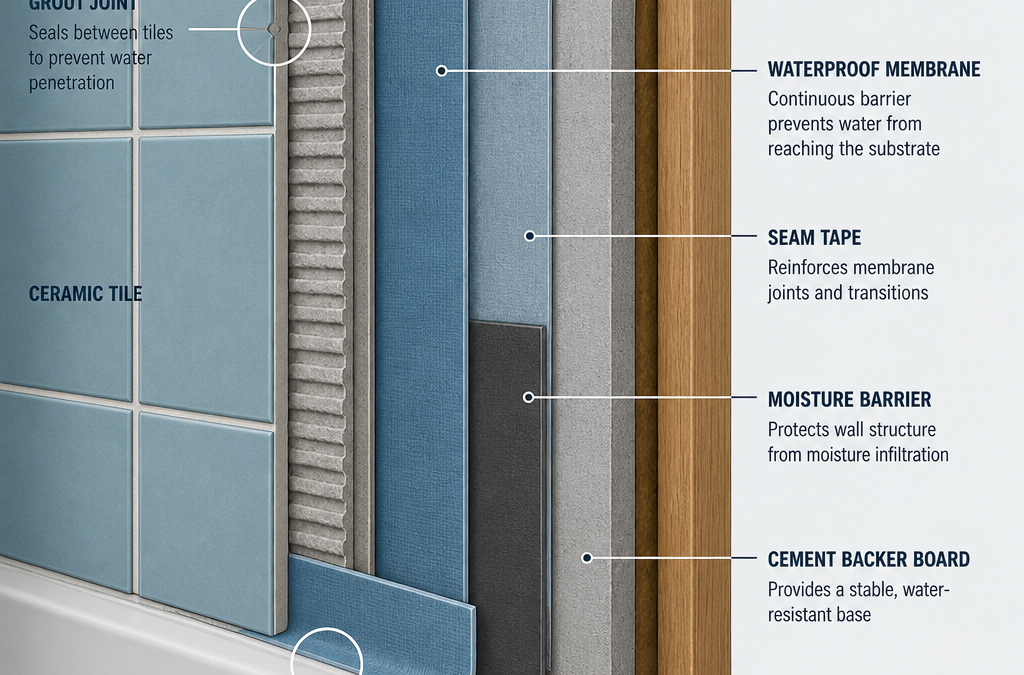
Waterproofing defects in new homes are the single most expensive category of building failure a Queensland homeowner can encounter after settlement. According to the Queensland Building and Construction Commission (QBCC), waterproofing issues consistently rank among the top ten most common defective work complaints received by the regulator, and each residential bathroom claim finalised under the Queensland Home Warranty Scheme during the 2024-25 financial year averaged almost $25,000 in rectification costs. That figure does not include damaged cabinetry, flooring, or the weeks of disruption that follow. The brutal reality is that waterproofing defects new home owners discover are almost always invisible at handover and entirely preventable when a licensed inspector assesses the build before keys are handed over.
Table of Contents
- Quick Takeaways
- Why Waterproofing Fails in Queensland Builds
- What the Standards Actually Require
- The Six Areas Inspectors Examine First
- How a Photo-Enhanced Defect Report Changes the Rectification Process
- Comparison of Inspection Approaches
- Frequently Asked Questions
- References
Quick Takeaways
| Key Insight | Explanation |
|---|---|
| $25,000 average rectification cost | Each residential bathroom waterproofing claim finalised under the Queensland Home Warranty Scheme in 2024-25 averaged almost $25,000. Catching the defect before handover costs a fraction of that. |
| Waterproofing is all-or-nothing | A membrane correctly applied everywhere except one floor-to-wall junction will still leak at that junction. There is no partial credit for waterproofing work. |
| Shower walls must reach 1800 mm | Under NCC 2022 requirements adopted in Queensland, shower wall waterproofing must extend to a minimum height of 1800 mm above the finished floor level, or 50 mm above the showerhead, whichever is higher. |
| Balconies are high-risk in Queensland | The combination of UV exposure, heavy rainfall, and thermal movement makes balcony membrane failures a consistent problem in South East Queensland new builds. Mandatory slopes are now required under NCC proposals to prevent water pooling. |
| Defects are hidden once tiling starts | Once tiles are laid, the waterproofing membrane is permanently concealed. The only practical window to assess it is before practical completion, not after settlement. |
| In Queensland, waterproofing is regulated work | Waterproofing must be carried out by a QBCC-licensed professional. An unlicensed installation is both a defect and a compliance failure that can void insurance claims. |
| Junction and penetration points fail most often | QBCC inspections consistently identify floor-to-wall junctions, pipe penetrations, and shower hob transitions as the locations where membrane coverage is inadequate or skipped entirely. |
Why Waterproofing Fails in Queensland Builds
The reason waterproofing defects in new homes remain so persistent in Queensland is not primarily about bad materials. It is about timing, trade sequencing, and the absence of independent verification before surfaces are covered. Waterproofing sits in the middle of a construction programme, sandwiched between substrate preparation and tiling. Every subcontractor who follows wants to keep their schedule moving, which creates pressure to tile over a membrane before it has properly cured, or to skip reinforcement at corners because the tiler is already on site.
Queensland’s climate compounds the risk. High ambient temperatures in Brisbane, the Gold Coast, and Ipswich can cause liquid membranes to cure unevenly if applied in direct sun without adequate control. Heavy rainfall events and the humidity that follows create substrate moisture issues that lead to adhesion failures under the membrane. These are not edge cases. They are the normal operating conditions for every new build in South East Queensland.
Get waterproofing 99 per cent right and you still have a failure. There is no partial credit. A membrane that is correctly applied across an entire wet area but missed at one floor-to-wall junction will leak at that junction. Water finds the one path that was not closed.
The QBCC’s own analysis confirms that substrate preparation, junction detailing, and inadequate membrane coverage are the recurring issues seen during inspections. A finished bathroom can look completely normal on a builder walkthrough while a membrane failure sits beneath the tiles, waiting for the first extended shower to push water through a gap at the hob or behind the bath frame.
What the Standards Actually Require
The primary technical reference for wet-area waterproofing in Queensland new homes is AS 3740:2021, referenced by the National Construction Code (NCC) and adopted in Queensland as the compliance pathway for Class 1 buildings. Understanding what the standard actually requires is essential for knowing what a licensed inspector is checking against.
Shower recesses
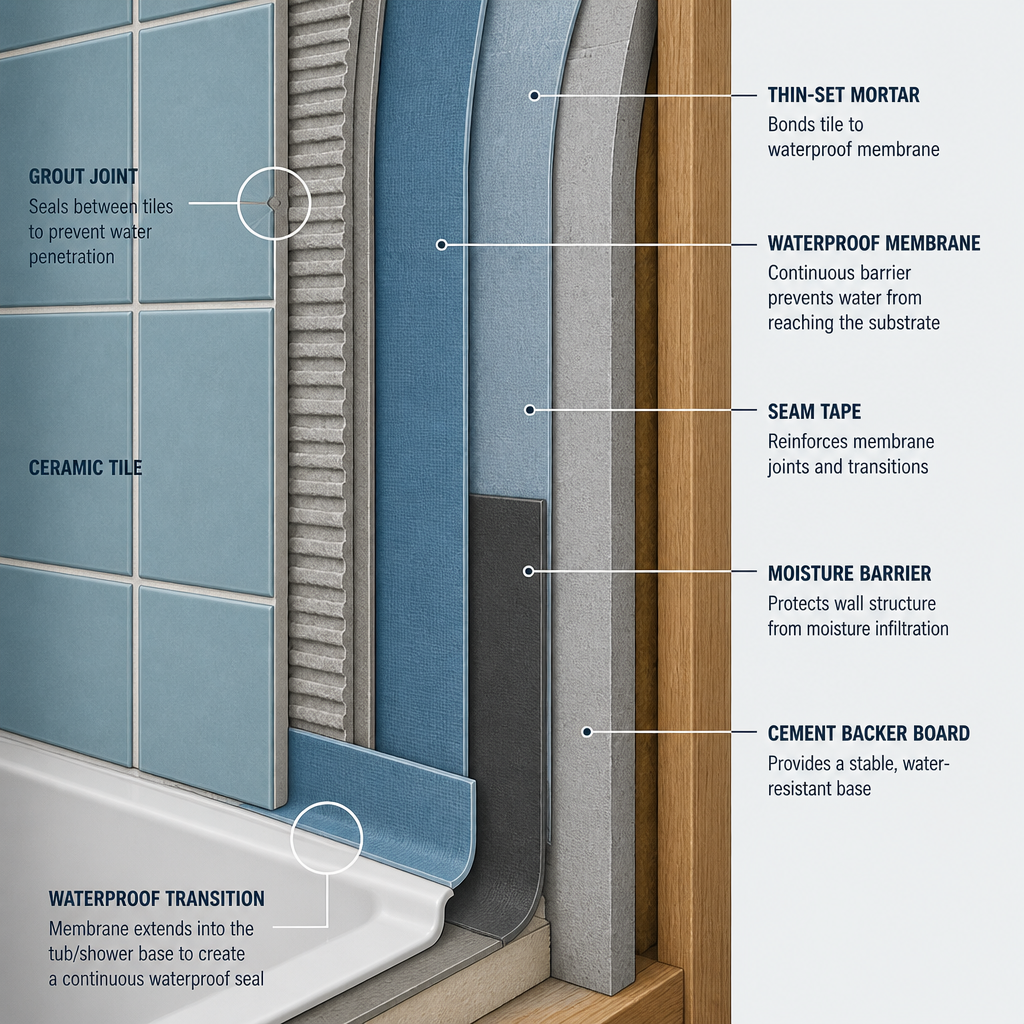
Under the NCC 2022 amendments adopted in Queensland, the entire water-resistant wall lining of a shower must be waterproofed to a minimum height of 1800 mm above the finished floor level, or 50 mm above the showerhead, whichever is the higher. This was a strengthened requirement compared to earlier provisions. In practice, this means inspectors now look specifically at whether the membrane terminates at or above that 1800 mm line on all four shower walls, not just on the wet wall behind the showerhead.
Floor falls are equally critical. An enclosed shower must have a graded floor that drains toward the waste, and the waterproofing membrane must be installed under the screed, not on top of it. Recent NCC proposed amendments specify that waterproofing membranes must now be applied directly to the structural substrate, not over screeds or toppings. When an inspector sees a shower floor that has been built with the membrane over the screed layer, that is a documented defect regardless of how well the tiles look on top.
Wet areas beyond the shower
AS 3740 covers all internal wet areas: bathrooms, laundries, ensuites, and any room with a floor waste or water-using fixture. For a standard bathroom layout, the floor requires a continuous waterproof membrane, and walls must be waterproofed to a minimum height of 150 mm around baths and behind vanities where splash is expected. Inspectors also check for a properly installed hob at the shower entry, with the membrane turned up and over the hob before the tile is set.
For external wet areas, including balconies, decks, and terraces on new Queensland homes, AS 3740 and NCC provisions require that horizontal surfaces have proper falls to drain points to prevent water ponding. NCC proposed amendments now make mandatory slopes for balconies a formal requirement across new builds.
Pro tip: If you are buying a new home off-the-plan in Brisbane or on the Gold Coast, request a copy of the waterproofing compliance certificate before practical completion. In Queensland, this is a Form 16 (Inspection Certificate) issued by a licensed inspector. If the builder cannot produce it, that absence is itself a significant red flag for your pre-handover building inspection.
The Six Areas Inspectors Examine First
A licensed building inspection waterproofing Queensland assessment does not begin with a checklist ticked in sequence. It begins with the areas statistically most likely to have been done incorrectly, so that the most consequential defects are documented first.
1. Floor-to-wall junctions in wet areas
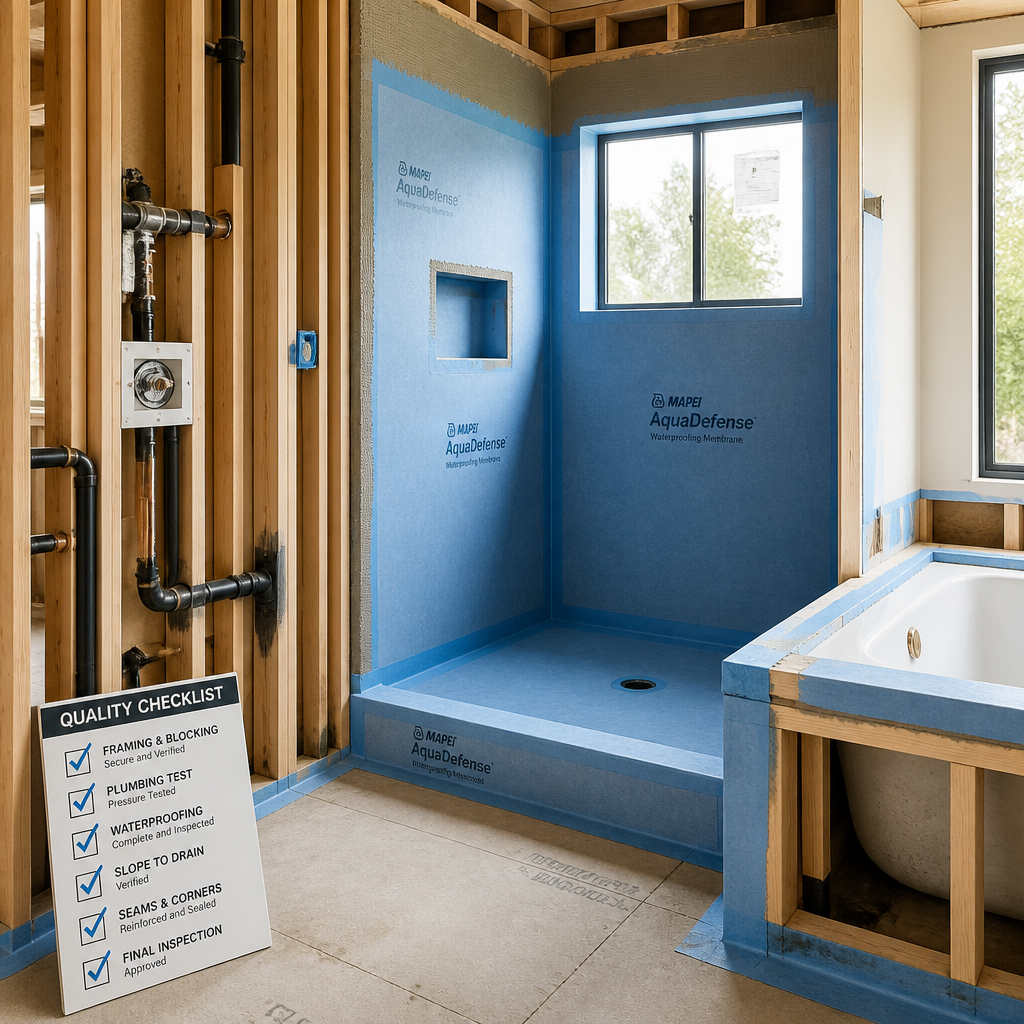
This is where failures concentrate. The junction between a shower floor and its wall is a movement point, and liquid membranes that are correctly applied to the flat surfaces are frequently missed or under-applied at this turn. An inspector looks for continuous, full-thickness membrane coverage running up the wall and across the floor, with reinforcement fabric embedded in the junction where required by the manufacturer’s specification.
2. Pipe penetrations and floor wastes
Every pipe that passes through a waterproofed substrate is a potential breach. A correctly detailed penetration has the membrane collar sealed around the pipe fitting, not simply painted over after installation. Inspectors check whether the floor waste has a puddle flange installed at the correct level, with the membrane bonded to the flange, not sitting above or below it.
3. Shower hob transitions
The shower hob, or threshold, is the barrier between the shower recess and the rest of the bathroom floor. The waterproofing membrane must be turned up and over the hob, with a waterstop installed at the base. In hobless shower designs, the membrane must extend beyond the screen track line and the floor must have adequate fall toward the drain to prevent overflow to adjacent floor areas. Inspectors see hob waterproofing omitted or left as a thin brush coat on the face of the hob more often than in any other location.
4. Bath frames and built-in bath surrounds
Baths recessed into tile surrounds are a consistent leak source in new Queensland homes. The membrane must be turned up behind the bath rim and sealed to the bath edge before tiling. When this step is skipped or performed as a surface application after the bath is set, the silicone joint at the bath-to-tile interface carries all the waterproofing load, and silicone joints fail. An inspector checks the grout and silicone condition at the bath perimeter and looks for any signs of early disbondment.
5. Balconies and external decks
Balcony waterproofing failures are disproportionately expensive to rectify because they typically involve both structural damage to the deck substrate and water ingress into the room below. Inspectors check membrane falls across the entire balcony surface, termination details at the door threshold, upstand heights at walls, and the condition of any visible flashings at wall-to-deck junctions. In high-rise developments across Brisbane and the Gold Coast, balcony waterproofing is one of the most common items documented in detailed defect reports.
6. Laundry wet areas
The laundry is the wet area most frequently under-inspected in a builder walkthrough, and the one where installation shortcuts are most common. AS 3740 requires waterproofing to the floor and lower wall sections around the trough and washing machine connection point. Inspectors often find that laundry waterproofing has been applied to the shower recess area only, with the floor and wall areas around the trough left unprotected beneath the tiles.
How a Photo-Enhanced Defect Report Changes the Rectification Process
The difference between a basic inspection report and a photo-enhanced defect report is not cosmetic. It determines whether a waterproofing defect gets rectified before settlement or becomes a years-long dispute after it. When a builder receives a written description of “inadequate waterproofing at shower hob,” the responsible subcontractor has room to argue. When they receive a photograph of the specific location with the defect visible, the responsible trade identified, and the applicable standard cited, there is no argument to have.
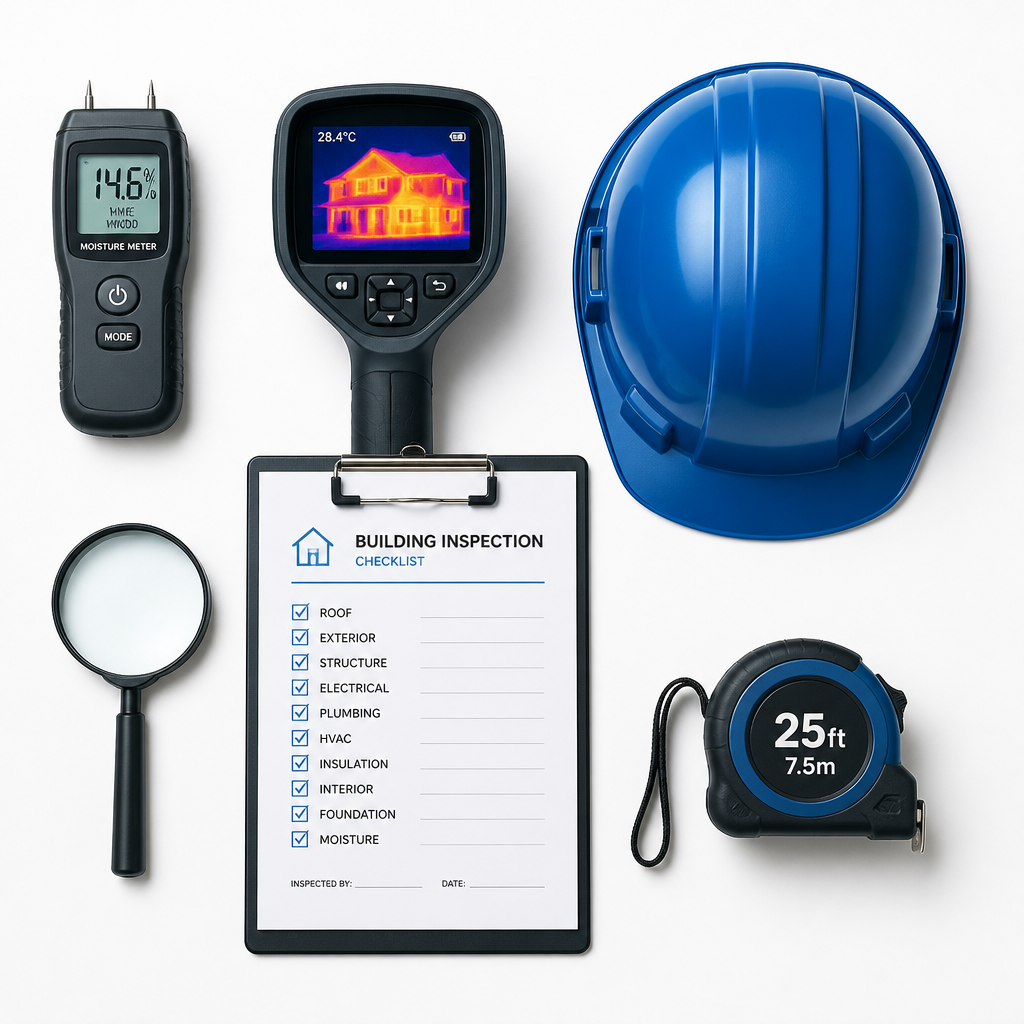
GoInspect’s approach to new home defects Brisbane and across the Gold Coast, Logan, Ipswich, and Redland Bay is built on this principle. Same-day photo-tagged reports assign each waterproofing defect to the specific trade responsible, which means the builder can direct rectification without ambiguity. For developers managing multiple units in a high-rise, this approach is the difference between a structured rectification programme and a chaotic back-and-forth across twenty different defect lists.
In practice, the most useful feature of a detailed waterproofing defect report is that it creates a fixed record at a point in time. Waterproofing defects that are identified before tiling can often be rectified at relatively low cost. The same defects discovered after settlement, after tiling, after the first wet season, require tile removal, membrane replacement, and retiling, which is the rectification scenario that generates those $25,000 average claim figures under the Queensland Home Warranty Scheme.
Pro tip: When reviewing a pre-handover inspection report for a new Queensland home, look specifically for whether waterproofing defects are listed with the trade responsible (tiler, waterproofer, or builder) and with a reference to the applicable standard or section of the NCC. A report that simply lists “waterproofing issue in bathroom” without this detail gives the builder too much room to dispute the scope and severity of rectification required.
Comparison of Inspection Approaches
Not all inspections of waterproofing defects in new homes are equal. The approach taken significantly affects what gets found, documented, and ultimately rectified before you take possession.
| Inspection Approach | What It Covers for Waterproofing | Practical Limitation |
|---|---|---|
| Builder’s own pre-handover walkthrough | Visual check of finished surfaces; may identify cracked grout or visible silicone gaps | No independent verification of membrane installation; conflict of interest in reporting defects that require their own subcontractors to re-do work |
| Independent inspector, written report only | Covers wet area waterproofing zones against AS 3740 and NCC requirements; identifies defects at visible surfaces and accessible junctions | Without photos, defect descriptions are open to interpretation; rectification scope often disputed between builder and homeowner |
| Independent inspector, photo-enhanced defect report (GoInspect model) | Full wet area assessment with photos of each defect location, trade responsibility assigned, and applicable standard referenced; same-day delivery for fast rectification before settlement | Does not include destructive testing (moisture meters beyond surface assessment); but captures the full scope of what is accessible and visible at the inspection stage |
The builder walkthrough is not an inspection in any meaningful sense for waterproofing purposes. It is a commercial presentation. An independent building inspection is the appropriate tool, and the format of the report determines how much of the inspection value is actually usable when it is time to have defects rectified.
Frequently Asked Questions
What are the most common waterproofing defects found in new Queensland homes?
The most common waterproofing defects found in new Queensland homes include inadequate membrane coverage at floor-to-wall junctions, insufficient membrane height on shower walls (below the required 1800 mm), poorly detailed pipe penetrations and floor waste installations, missing or thin membrane at shower hobs, and lack of waterproofing in laundry wet areas. The QBCC’s own inspection data confirms that membrane application issues and junction detailing failures are the recurring problems seen across residential construction statewide.
When is the right time to get a building inspection for waterproofing in a new home?
The right time is before practical completion, specifically at the pre-handover or practical completion inspection stage. Once tiles are laid, the waterproofing membrane is permanently hidden. Defects identified before tiling can often be rectified at low cost by the waterproofing contractor. Defects found after settlement require tile removal, membrane replacement, and retiling, which is the scenario that drives average rectification costs close to $25,000 per bathroom under the Queensland Home Warranty Scheme.
Does a standard building inspection test whether waterproofing membranes are actually working?
A standard pre-handover building inspection assesses the visual and accessible evidence of waterproofing installation: membrane height on walls, floor falls to drains, junction coverage, hob construction, and grout and silicone condition. It does not include destructive testing or flood tests of shower recesses. However, an experienced licensed inspector can identify the installation patterns, substrate preparation failures, and detailing shortcuts that predict membrane failures before any moisture damage is visible.
Is waterproofing in Queensland a licensed trade?
Yes. In Queensland, waterproofing is regulated work under QBCC licensing requirements and must be carried out by a licensed professional. Work performed by an unlicensed contractor is both a construction defect and a compliance failure that can affect eligibility for claims under the Queensland Home Warranty Scheme. Before accepting a new home at handover, it is worth confirming that waterproofing certificates have been issued by a licensed waterproofer, not simply signed off by the builder.
What should I do if my new home inspection report identifies waterproofing defects?
Document all identified defects in writing and submit them to your builder formally before you sign any practical completion documentation. The defects should be listed with specific locations, the applicable standard breached, and photos where available. Give the builder a reasonable timeframe to rectify, then arrange a follow-up inspection to confirm rectification before settlement. If the builder refuses to rectify or disputes the scope, the Queensland Home Warranty Scheme and the QBCC complaints process are the formal escalation pathways available to homeowners.
Why do balconies have higher waterproofing failure rates in Queensland?
Balconies in Queensland are exposed to a combination of intense UV radiation, significant thermal movement between summer and winter, and heavy rainfall events that other states do not experience at the same frequency or intensity. These conditions accelerate membrane degradation where coverage is thin or where termination details at door thresholds and wall upstands are insufficient. Balcony waterproofing failures are particularly expensive because they typically cause damage to the room or structure below the deck, not just to the balcony surface itself.
What does a GoInspect pre-handover inspection cover for waterproofing in Brisbane and South East Queensland?
A GoInspect pre-handover inspection assesses all wet areas including bathrooms, ensuites, laundries, and balconies against AS 3740 and the NCC requirements applicable to Queensland Class 1 buildings. The inspection documents membrane installation evidence, wall heights, floor falls, junction and penetration details, hob construction, and the visual integrity of grout and silicone joints. Every waterproofing defect identified is photographed, assigned to the responsible trade, and included in a same-day report. Inspections for standard Brisbane and South East Queensland new homes start from $550 including GST.
If you have had a waterproofing defect discovered in your new home, or if you are approaching practical completion and want to know exactly what a licensed inspector will look for, share your experience or question below.
We would love your feedback and any insights you would share with others. What perspective would you add?
References
- QBCC guidance on waterproofing requirements and common failures in Queensland new construction (2025)
- QBCC Industry Snapshot: waterproofing as a top defect category for Queensland homeowners
- Master Builders Queensland summary of NCC 2022 waterproofing amendments affecting Queensland residential builds
- Analysis of waterproofing failure data in Australian new construction and why junctions are the critical failure point
- National Construction Code provisions for waterproofing in Class 1 residential buildings