
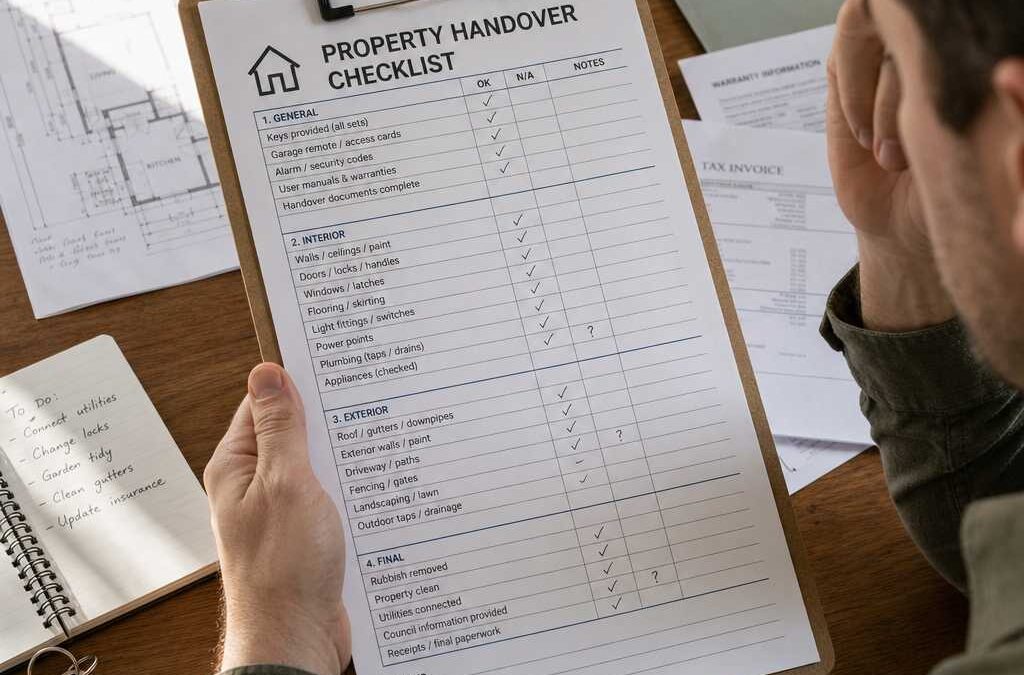
Signing off on your new home feels like the finish line. But for a significant number of Queensland homeowners, it turns out to be the starting gun on a much more stressful race. Post-handover defects are far more common than most buyers expect, and the legal landscape around them is genuinely complex. The moment you hand that certificate back to your builder, the clock starts ticking on specific statutory rights that most people have never read. If you have already signed off and you are now staring at cracked renders, doors that do not close properly, or waterproofing that leaks after the first rain, this article tells you exactly what your options are.
Table of Contents
- What Sign-Off Actually Means in Queensland
- Statutory Warranties That Protect You After Handover
- Types of Post-Handover Defects and How They Are Classified
- How to Document and Report Defects Effectively
- Comparison of Dispute Pathways for Queensland Homeowners
- Why a Practical Completion Inspection Changes Everything
- Frequently Asked Questions
- References
What Sign-Off Actually Means in Queensland
A lot of homeowners treat sign-off as a handshake moment, a social agreement that everyone is happy. Under Queensland law, it is nothing of the sort. When you sign a Certificate of Practical Completion, you are formally acknowledging that the builder has met the contracted specifications and that the home is fit for occupation. That acknowledgment has legal consequences that most people do not fully understand until a problem surfaces three months later.
Sign-off does not mean you forfeit all rights to complain. What it does mean is that your leverage on the builder shifts from contractual pressure to statutory warranty pressure, which is a meaningfully different position to negotiate from. Builders know this, and some rely on homeowners not knowing it.
In practice, the most damaging scenario is when a homeowner signs off without conducting a formal practical completion inspection. Once that certificate is signed, any defect you failed to identify becomes harder to pin to the original build contract. It is not impossible, but the evidentiary burden shifts toward you.
Statutory Warranties That Protect You After Handover
Queensland’s Queensland Building and Construction Commission Act 1991 (QBCC Act) creates a set of statutory warranties that apply to every residential building contract, regardless of what your specific contract says. These warranties cannot be contracted away, meaning a builder cannot include a clause that removes them. That is the good news.
The Six-Year Structural Defect Warranty
The most powerful protection for homeowners dealing with post-handover defects is the six-year warranty on structural defects. Under the QBCC Act, structural defects discovered within six years of practical completion must be rectified by the original contractor. Structural defects include anything that affects the load-bearing capacity or integrity of the building, including foundations, framing, and roof structures.
If the builder refuses to act, you can lodge a complaint directly with the QBCC, which has the power to investigate, issue rectification directions, and, if necessary, step in through the Queensland Home Warranty Scheme. According to QBCC data, thousands of complaints are lodged each year, with structural defects forming a consistent and significant portion of those complaints.
The One-Year Warranty on Non-Structural Defects
Non-structural defects, which include cosmetic issues, fixtures, finishes, and services, are covered for one year from practical completion. This sounds reasonable until you realise how quickly that year disappears, especially if the builder is slow to respond to your initial requests. A common mistake is waiting until the eleven-month mark to compile your defect list, only to find the builder disputes the timeline.
The QBCC requires that you attempt to resolve defects directly with the builder before the commission will accept a complaint. That dispute resolution step takes time, so starting the documentation process early is not optional if you want the warranty to mean anything.
“Statutory warranties under the QBCC Act exist to protect homeowners from the consequences of defective building work. They apply even where a certificate of practical completion has been issued.” — Queensland Building and Construction Commission, Homeowner Rights guidance.
Types of Post-Handover Defects and How They Are Classified
Not all defects are treated equally, and understanding the classification system is what determines which legal pathway you can use. The distinction between structural and non-structural is the primary dividing line, but within non-structural defects there is a further split between defects that affect function and defects that are purely cosmetic.
Structural Defects
These are the most serious and include issues with footings, slabs, wall framing, roof trusses, and any element that bears or transfers load. Structural defects are typically not visible at handover, which is why they often surface months or years into occupation. Waterproofing failures in wet areas are treated as structural defects in Queensland because they risk long-term damage to the building fabric.
Non-Structural Defects
Non-structural defects cover a broad range: doors that stick or do not seal, inadequate paint coverage, incorrect fixture installations, drainage that pools instead of draining, window seals that allow water ingress, and tiling issues. In practice, this is where the vast majority of post-handover disputes sit. These are also the defects that a thorough practical completion inspection would catch before sign-off, which is why the inspection is so important.
Cosmetic Defects
Cosmetic defects are surface-level imperfections that do not affect function or structural integrity. Scratches on benchtops, minor paint overspray, or small chips in tiles generally fall into this category. These are the hardest to pursue post-handover because the QBCC applies a reasonableness test, asking whether the defect materially affects the use or enjoyment of the home.


How to Document and Report Defects Effectively
Documentation is the single most important factor in whether a post-handover defect claim succeeds or fails. A complaint with photographs, timestamps, and a clear written trail will be taken far more seriously by both the builder and the QBCC than a verbal complaint or a vague email. This is not bureaucratic over-caution. It is the practical difference between getting rectification work done and spending months in unresolved dispute.
Step One: Create a Formal Defect Register
List every defect with a description, the location in the home, the trade responsible, and the date you first observed it. Include photographs for every item. If you engage a licensed inspector to compile this register, the report carries significantly more weight because it comes with professional credentials attached.
GoInspect’s photo-enhanced defect reports assign responsibility to specific trades within the report itself, which removes one of the most common stalling tactics builders use: claiming the defect belongs to a different subcontractor and therefore is not their problem to fix.
Step Two: Notify the Builder in Writing
Send a formal written notice to the builder, listing the defects and requesting rectification within a reasonable timeframe. Keep a copy of everything. Under Queensland law, you must give the builder a reasonable opportunity to inspect and rectify before the QBCC will accept a complaint. Thirty days is typically treated as a reasonable response period, though urgency can shorten this.
Step Three: Lodge a QBCC Complaint If the Builder Does Not Respond
If the builder ignores your notice, disputes the defects without inspection, or starts rectification work and then abandons it, you can lodge a formal complaint with the QBCC. The commission will investigate and can issue a direction to rectify. If the builder is insolvent or their licence has been cancelled, the Queensland Home Warranty Scheme may provide cover for eligible claims.
Pro tip: Always send defect notices via email so you have a digital timestamp and a delivery record. A phone call or in-person conversation does not create the paper trail you will need if the dispute escalates.
Comparison of Dispute Pathways for Queensland Homeowners
Once you have documented your post-handover defects and the builder has failed to respond adequately, you have three realistic pathways to resolution. Each has different costs, timelines, and likely outcomes. Understanding the trade-offs is important before you commit to a course of action.
| Pathway | Best Suited For | Likely Timeline and Cost |
|---|---|---|
| QBCC Complaint and Rectification Direction | Defects within statutory warranty periods where the builder is still trading and licensed. Works well for both structural and non-structural defects with documented evidence. | Three to six months typical. No direct cost to homeowner for the QBCC process itself, though professional inspection reports add cost upfront. |
| Queensland Civil and Administrative Tribunal (QCAT) | Disputes under $25,000 where builder and homeowner cannot agree after QBCC process. Suitable for non-structural defects and compensation claims for costs already incurred. | Three to twelve months depending on complexity. Filing fees apply. Legal representation adds cost but is not mandatory. |
| Queensland Home Warranty Scheme | Situations where the builder is insolvent, has died, disappeared, or had their licence cancelled. Structural defects within six years. Non-structural within one year. | Claims can take six to eighteen months. Scheme covers rectification costs directly. Homeowner must have made genuine attempts to contact builder first. |
The data consistently shows that homeowners who enter the QBCC process with a professional inspection report resolve disputes faster and with better outcomes than those who self-document. The professional report removes ambiguity about what constitutes a defect versus normal building variation, which is the most common argument builders use to deflect legitimate claims.

Why a Practical Completion Inspection Changes Everything
The most effective way to handle post-handover defects is to prevent them from becoming post-handover problems at all. A practical completion inspection conducted before you sign the certificate of practical completion gives you documented evidence of every defect while you still have maximum contractual leverage over the builder.
At that point, the builder has not been paid the final progress payment. That financial pressure is your strongest tool. Once the money has changed hands and the keys are in your hand, the dynamic shifts entirely. The builder’s motivation to fix things drops sharply, and your legal options, while real, require more time and effort to execute.
What a Professional Inspection Covers
A thorough pre-handover inspection by a licensed inspector will systematically check every accessible area of the building against the Australian Standards applicable to residential construction. This includes checking for compliance with AS 3740 for waterproofing, AS 1684 for timber framing, and the National Construction Code performance requirements. It also includes checking that all inclusions listed in your contract are actually present and installed correctly.
GoInspect’s reports are photo-enhanced and trade-specific, meaning each defect is photographed, described, and attributed to the responsible trade. This is particularly valuable in new home construction where multiple subcontractors have worked on the property and builders sometimes attempt to push responsibility between trades to avoid direct liability.
The Same-Day Report Advantage
Builders often schedule handover days with tight windows, knowing that a delayed defect report gives them grounds to push back on extending the handover date. GoInspect’s same-day reporting eliminates that tactic entirely. The report is in your hands on the day of inspection, which means you can serve it on the builder immediately and maintain the legal timeline without gaps the builder can exploit.
Pro tip: If your builder is pressuring you to sign off on the same day as your walkthrough without allowing time for an independent inspection, that is a significant red flag. Under Queensland law, you are entitled to take reasonable time to review the property. Do not let scheduling pressure override your legal rights.
When a Pre-Handover Inspection Was Not Done
If you have already signed off and you did not have an independent inspection, you are not without options. A post-handover inspection conducted within the first few weeks of occupation is still extremely useful. It creates a formal, timestamped record of defects that existed at the time of handover, which is far more credible than a list compiled six months later when the builder will argue the defects resulted from your occupation of the property.
For investors purchasing in high-rise developments across Brisbane, Gold Coast, Logan, Ipswich, and Redland Bay, the defect landscape is even more complex because body corporate obligations, developer obligations, and individual lot warranties can all overlap. A customised inspection report that addresses the specific structure and finishes of a high-rise unit is a different document from a standard house inspection, and it should be treated as such.
Frequently Asked Questions
Can I still claim for defects if I have already signed the practical completion certificate?
Yes. Signing the certificate of practical completion does not extinguish your statutory warranty rights under the QBCC Act. You retain a six-year warranty on structural defects and a one-year warranty on non-structural defects, measured from the date of practical completion. What you lose when you sign without an inspection is the contractual pressure point of the final progress payment, but your statutory rights remain intact.
What is the difference between a defect and normal building variation?
This distinction is one of the most contested areas in residential construction disputes. Australian Standards set tolerances for things like surface flatness, paint coverage, and tile alignment. A defect is a departure from the contracted specifications or applicable standards that exceeds those tolerances. Normal building variation is within the tolerance range. A licensed inspector applies the relevant standards objectively, which is why professional reports carry more weight than homeowner self-assessments in QBCC complaints.
How long does a QBCC complaint process take?
The QBCC targets resolution of complaints within three months, but complex cases involving structural defects or uncooperative builders frequently take longer. From initial complaint lodgement to a formal rectification direction, six months is a realistic expectation. If the builder then appeals or fails to comply with the direction, the timeline extends further. Starting the process with a well-documented professional report reduces delays caused by evidence disputes.
Does the Queensland Home Warranty Scheme cover all types of defects?
The scheme covers structural defects for six years and non-structural defects for one year, but only in specific circumstances: the builder must be insolvent, deceased, missing, or have had their licence suspended or cancelled. If your builder is still trading, you must pursue rectification directly through the QBCC complaint process first. The scheme is a backstop, not a first port of call. All residential contracts over a set value threshold (currently $3,300 including GST in Queensland) must include home warranty insurance as a mandatory requirement.
Is a practical completion inspection worth the cost for investors buying off the plan?
Absolutely, and arguably it is even more important for investors than for owner-occupiers. Investors often cannot be present in person during construction or at handover, which means defects go undetected until a tenant reports them. At that point, distinguishing builder defects from tenant damage becomes difficult and expensive. A pre-handover inspection creates a clean baseline record that protects the investor’s warranty rights and simplifies the defect rectification process before a tenancy begins.
What should I look for when choosing a building inspector for a post-handover defect report?
In Queensland, building inspectors must hold a current QBCC contractor licence in the relevant category. Beyond the licence, look for inspectors who produce photo-enhanced reports that reference specific Australian Standards and assign defects to trades. A report that simply lists “paint defects” without photographs, measurements, or trade attribution will not carry weight in a formal QBCC complaint. Same-day delivery matters too, because builders can argue timeline gaps if the report arrives weeks after the inspection.
Have you dealt with post-handover defects on a new home in Queensland? Share what worked, or what did not, in the comments below so other readers can learn from real experience.
References
- Queensland Building and Construction Commission: homeowner rights, statutory warranties, and complaint lodgement guidance for residential building defects
- Queensland Legislation: full text of the Queensland Building and Construction Commission Act 1991 and related residential building warranty provisions
- Queensland Civil and Administrative Tribunal: dispute resolution processes for building and construction matters including defect claims
- Australian Building Codes Board: National Construction Code performance requirements and standards applicable to new residential construction
- Australian Competition and Consumer Commission: consumer guarantees and statutory rights applicable to major construction contracts and new homes