
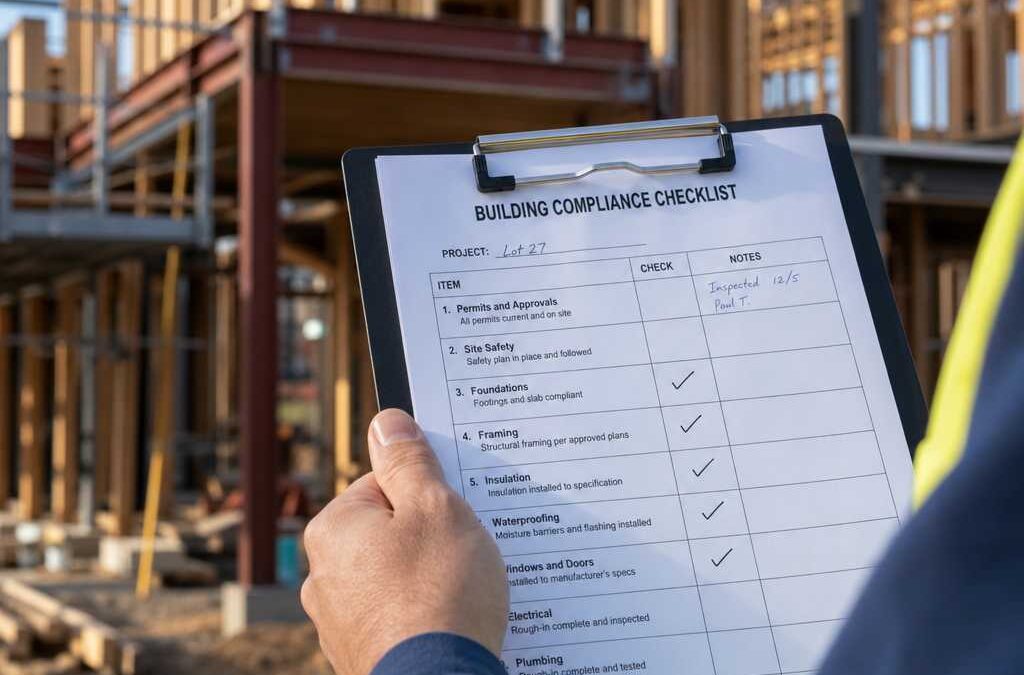
Most Queensland homeowners signing off on a new build assume that because it passed a council inspection, it must be compliant. That assumption is costing people thousands of dollars in post-handover repairs. The Queensland building code new home framework is detailed, trade-specific, and frequently misapplied on construction sites across Brisbane, Gold Coast, Logan, Ipswich, and Redland Bay. Understanding exactly which standards your builder is legally required to meet, and knowing how to verify compliance before you take the keys, is the difference between a home that performs and one that leaks, cracks, and drains your savings.
Table of Contents
- Quick Takeaways
- What Is the Queensland Building Code and Why Does It Matter for New Homes
- Key Building Standards Queensland Requires for New Residential Construction
- Common Areas Where Builders Miss the Mark on Code Compliance
- Comparison of Compliance Verification Approaches
- What a Construction Defect Inspection Actually Checks Against Code
- Your Rights at Practical Completion Under Queensland Law
- Frequently Asked Questions
- References
Quick Takeaways
| Key Insight | Explanation |
|---|---|
| The NCC governs minimum standards | The National Construction Code (NCC) sets the baseline structural, fire, energy, and safety requirements that every Queensland new home must meet, regardless of builder or price point. |
| Council approval is not a defect inspection | Building certifiers approve work for code compliance at key stages, but they do not check workmanship quality or trade-specific defects the way a licensed inspector does. |
| Practical completion is your key inspection window | Under Queensland’s QBCC framework, practical completion is the moment you have the strongest legal leverage to formally document defects before final payment. |
| Photo-documented reports carry legal weight | Defect reports with timestamped photos tied to specific trades are far more actionable in QBCC disputes than written descriptions alone. |
| Energy efficiency requirements tightened in 2023 | The NCC 2022 (adopted in Queensland in May 2023) lifted the minimum energy efficiency rating for new homes to 7 stars NatHERS, up from 6 stars. |
| Defect liability periods vary by defect type | Under the Queensland Home Warranty Scheme, structural defects carry a 6-year and 6-month warranty, while non-structural defects are covered for 1 year after completion. |
| Trade responsibility must be assigned clearly | A defect report that identifies which trade is responsible (tiler, renderer, plumber, etc.) speeds up rectification and prevents builders from deflecting responsibility. |
What Is the Queensland Building Code and Why Does It Matter for New Homes
The term “Queensland building code” is commonly used, but the actual regulatory architecture is layered. The primary instrument is the National Construction Code (NCC), published by the Australian Building Codes Board (ABCB) and adopted by Queensland through the Building Act 1975 and associated regulations. The NCC is divided into volumes: Volume One covers Class 2 to 9 buildings (including apartment complexes), while Volume Two applies to Class 1 and 10 buildings, which covers most detached houses and townhouses.
Queensland also applies its own state variations through the Queensland Development Code (QDC), which addresses issues specific to the state’s climate, site conditions, and local planning requirements. The QDC sits alongside the NCC and must both be satisfied for a building to be compliant.
For new homeowners in Brisbane, Gold Coast, Logan, Ipswich, and Redland Bay, this matters practically because your builder is legally required to comply with both instruments. If they do not, you have grounds for a formal QBCC complaint and warranty claim.
“The NCC is not a guideline. It is a mandatory performance standard. Builders who treat it as a checklist to be minimally satisfied are setting up their clients for expensive remediation work.” – Australian Building Codes Board, NCC 2022 Overview
The building certifier your builder appoints is responsible for inspecting work at mandatory hold points, including foundations, frame stage, and lock-up. However, certifiers are checking for code compliance at a structural and safety level. They are not tasked with identifying poor workmanship in tiling, rendering, painting, waterproofing, or joinery. That gap is exactly where construction defect inspection services like GoInspect operate.


Key Building Standards Queensland Requires for New Residential Construction
When you buy a new home in Queensland, several building standards Queensland mandates apply simultaneously. Understanding these helps you know what to look for when reviewing your builder’s work before handover.
Structural Requirements
Under NCC Volume Two, all structural elements including footings, slabs, framing, and roof structures must comply with the relevant Australian Standards, primarily AS 1684 for timber framing and AS 3600 for concrete. In practice, slab cracking is one of the most disputed defects in new Queensland homes. Not all cracking is a breach of code, but cracking that exceeds 0.3mm width in structural elements, or that allows water penetration, generally is.
Wind classification is also critical in South East Queensland. Homes in coastal areas like Redland Bay and parts of Gold Coast are often subject to higher wind classifications (C or D categories), requiring upgraded fixing schedules and roof tie-down systems. Builders who apply standard N2 or N3 schedules to C-category sites are building non-compliantly.
Waterproofing Standards
Waterproofing is governed by AS 3740, the Australian Standard for waterproofing of domestic wet areas. It specifies membrane types, application methods, upstand heights, and drainage fall requirements. A minimum 50mm upstand at wall-floor junctions in wet areas, and a minimum 1:100 fall to floor waste outlets, are standard requirements. In practice, inadequate floor falls and missing or thin membrane applications are among the most common defects GoInspect identifies in new Queensland homes, particularly in bathrooms and laundries.
Energy Efficiency Standards
Since May 2023, Queensland has required new homes to achieve a minimum 7-star NatHERS rating under NCC 2022. This covers insulation, glazing performance, air sealing, and building orientation. Compliance must be demonstrated either through an accredited NatHERS software assessment or the Elemental Compliance pathway. Builders who do not install the specified insulation or who substitute lower-performing glazing products without updating the energy report are in breach of this requirement.
Plumbing and Drainage
Plumbing work in Queensland must comply with the Plumbing and Drainage Act 2018, the Queensland Plumbing and Wastewater Code, and AS/NZS 3500. All plumbing work must be carried out by a licensed contractor and inspected by a licensed building certifier or plumbing inspector. Hot water temperature, pipe gradient, and drainage fall are specific measurable requirements, not subjective assessments.
Pro tip: Ask your builder for a copy of the NatHERS assessment report and verify that the insulation installed on site matches the R-values specified in that report. Substitutions happen more often than builders admit, and a discrepancy is a code breach you can formally pursue.
Common Areas Where Builders Miss the Mark on Code Compliance
Based on inspection data from new home projects across South East Queensland, certain defect categories appear with far greater frequency than others. Understanding these patterns helps homeowners know where to scrutinize most carefully before handover.
Roof and Guttering Defects
Roof flashings are among the most frequently non-compliant elements in new Queensland homes. AS 2050 (installation of roof tiles) and AS 1562 (design and installation of sheet roofing) both specify flashing dimensions, overlap lengths, and sealing requirements. Inadequate valley flashings, missing soaker flashings at abutment points, and insufficient fixing of ridge cappings are common failures. These do not always leak immediately, but they will fail within a few years.
Gutter gradient is another frequent deficiency. The NCC requires gutters to maintain a fall to outlets that prevents ponding. Flat or reverse-fall gutters are a code breach and a future maintenance liability.
Brickwork and Rendering
Masonry construction must comply with AS 3700. Common deficiencies include insufficient mortar fill in perpendicular joints (particularly in face brickwork), inadequate weep holes, and missing or incorrectly installed cavity ties. Rendering defects such as delamination, cracking, and inadequate thickness are frequently workmanship issues rather than code breaches, but where the finished surface does not meet the builder’s own specification, they still constitute defects the builder is required to rectify.
Painting and Internal Finishes
The HIA and QBCC both publish tolerances for internal finishes. Paintwork must be applied to achieve a uniform finish free from brush marks, runs, holidays (missed patches), and shadowing when viewed under normal lighting conditions. In practice, lighting angle matters significantly. A wall that looks fine in overhead fluorescent light will show significant imperfections under raking natural light. GoInspect’s inspectors assess finishes under conditions that replicate how the homeowner will actually experience the space.

Comparison of Compliance Verification Approaches
Not all approaches to verifying your new home’s compliance with Queensland building code are equal. The table below compares the three most common pathways homeowners use.
| Approach | What It Covers | Limitations |
|---|---|---|
| Building Certifier Inspections (mandatory stage inspections) | Structural compliance, fire safety, energy efficiency documentation at required hold points (slab, frame, lock-up, completion) | Does not assess workmanship quality, trade defects, or finish standards. Certifiers work for the builder on most residential projects. |
| Owner Walk-Through Before Handover | Visible surface defects identified by the homeowner during the pre-handover tour | Homeowners lack technical knowledge to identify code-specific deficiencies, waterproofing failures, or structural concerns. Easily rushed by builders. |
| Independent Pre-Handover Inspection (e.g., GoInspect) | Full defect identification across all trades, code compliance checks, photo-documented reports with trade-specific responsibility assignment, same-day reporting | Requires scheduling prior to settlement. Cost starts from $550 including GST, which is a fraction of typical rectification costs. |
The data consistently shows that independent pre-handover inspections identify significantly more defects than owner walk-throughs. More importantly, they produce documentation that is usable in formal QBCC complaints and legal proceedings, whereas a homeowner’s personal notes are rarely sufficient.
Pro tip: Schedule your independent pre-handover inspection at least five business days before your scheduled settlement date. This gives you time to formally issue a defect list to your builder before you are contractually obligated to complete the purchase.
What a Construction Defect Inspection Actually Checks Against Code
A professional construction defect inspection is not a general property report. It is a systematic review of every accessible element of the completed home measured against the NCC, relevant Australian Standards, the Queensland Development Code, and the builder’s own specifications and drawings.
Trade-by-Trade Assessment
GoInspect’s approach assigns each identified defect to the responsible trade, whether that is the concretor, bricklayer, carpenter, plumber, electrician, tiler, plasterer, painter, or roofer. This matters because builders routinely attempt to attribute defects to other trades or argue that issues are within acceptable tolerance. When a report clearly states that a specific floor tile has a 6mm lippage against a maximum allowable tolerance of 2mm under AS 3958, and that defect is attributed to the tiling contractor, the builder has very little room to argue.
Waterproofing and Wet Area Compliance
Waterproofing is one of the most critical areas of a new home inspection because failures are expensive and often not visible until water damage has already occurred. Inspectors check membrane application, upstand heights, shower screen sealing, floor falls, and drainage adequacy. A missing or inadequate waterproof membrane in a shower is not a cosmetic defect. It is a code breach under AS 3740 and a latent defect claim waiting to happen.
Door and Window Installation
Windows and doors must be installed plumb, level, and square within tolerances specified by the window manufacturer and Australian Standards. Gaps, binding, and misaligned hardware are common defects. More critically, inadequate flashing and sealing around window reveals is a waterproofing compliance issue under both the NCC and the window installation standard AS 2047.
GoInspect’s same-day photo-enhanced reports mean that by the time you leave your property after the inspection, you have a complete defect register ready to submit to your builder. This compresses the timeline significantly compared to inspection services that take three to five days to produce a report.
Your Rights at Practical Completion Under Queensland Law
Practical completion is a defined legal concept in Queensland construction contracts. Under a standard QBCC-regulated construction contract, practical completion occurs when the work is finished to the point where it can be used for its intended purpose, even if minor defects remain. This is the moment that triggers your obligation to make the final progress payment.
What many homeowners do not understand is that you are legally entitled to inspect the home and issue a defect list before practical completion is formally declared. Your contract should specify the notice period the builder must give you before calling practical completion, typically five business days. Use that window to conduct your independent inspection.
QBCC Warranty Coverage
Queensland’s Home Warranty Scheme, administered by the QBCC, provides statutory warranty coverage for defects that arise after handover. Structural defects are covered for 6 years and 6 months from practical completion. Non-structural defects are covered for 1 year. Subsidence and settlement defects are covered for 6 years. However, making a successful warranty claim requires documenting that the defect existed or originated during the construction period. This is where a pre-handover inspection report is invaluable.
What Happens If You Skip the Pre-Handover Inspection
A common mistake is assuming that defects found after handover will be easy to get the builder to fix. In practice, post-handover defect rectification is slower, more disputed, and more likely to require formal QBCC intervention than defects identified before final payment. Builders have significantly less financial incentive to act quickly once they have received their final payment. The leverage you hold before settlement is real and time-limited.
Frequently Asked Questions
What is the difference between the National Construction Code and the Queensland Building Code?
The National Construction Code (NCC) is the federal framework that sets minimum performance standards for all building work across Australia, including structural, fire safety, energy efficiency, and health requirements. Queensland does not have a separate standalone building code but applies the NCC through the Building Act 1975, supplemented by the Queensland Development Code (QDC), which adds state-specific requirements for issues like site coverage, setbacks, and certain design standards. When people refer to the Queensland building code for new homes, they typically mean the combined requirements of the NCC and QDC as they apply in Queensland.
Does my builder’s building certifier protect my interests?
No, not directly. The building certifier is engaged by your builder and is responsible for confirming that mandatory inspection stages meet code requirements. They are not tasked with protecting the homeowner’s interests or identifying workmanship defects. Their inspections are relatively brief and focused on structural and safety compliance at specific stages. An independent inspector working for you has a different mandate: to document every defect and non-compliance across all trades before you make your final payment.
What defects are most commonly found in new Queensland homes?
Based on pre-handover inspections conducted across Brisbane, Gold Coast, Logan, Ipswich, and Redland Bay, the most frequently identified defects include inadequate floor falls in wet areas, missing or insufficient waterproof membrane application, paintwork defects under raking light, tile lippage exceeding AS 3958 tolerances, inadequate or missing roof flashings, gaps in external wall sealing, and misaligned or binding doors and windows. Structural defects are less common but more serious when found, and include slab cracking, inadequate tie-downs in wind classification C and D areas, and framing out of plumb.
How long does a pre-handover inspection take, and when should I book it?
A thorough pre-handover inspection of a standard new home in South East Queensland typically takes two to four hours depending on the size and complexity of the property. High-rise apartment and multi-unit inspections follow a different schedule. You should book your inspection as soon as your builder notifies you that practical completion is approaching, ideally targeting a date at least five to seven business days before your scheduled settlement date. This gives you time to formally issue a defect list and begin negotiations with your builder before you are obligated to complete the purchase.
What should a good construction defect inspection report include?
A quality construction defect inspection report should include timestamped photographs of every identified defect, a description of the defect and its location, the Australian Standard or code provision that has been breached or the specification that has not been met, identification of which trade is responsible for the defect, and a recommended rectification action. Reports that simply describe defects without photos or trade attribution are difficult to act on in builder negotiations or QBCC complaints. GoInspect’s same-day photo-enhanced reports are specifically structured to assign trade responsibility and support the rectification process.
Can I make a QBCC claim if I did not get a pre-handover inspection?
Yes, you can still make a QBCC Home Warranty Scheme claim after handover without having conducted a pre-handover inspection. However, the absence of a pre-handover inspection can make it harder to establish that defects originated during the construction period rather than arising from post-handover use or owner modifications. Claims are also more likely to be disputed by the builder when there is no contemporaneous inspection record. A pre-handover report significantly strengthens your position in any subsequent warranty claim or dispute.
Have you encountered a specific building standard issue during your new home build, or do you have a question about what your builder is required to fix before handover? Share your experience in the comments and our team will respond.
References
- Australian Building Codes Board: official source for the National Construction Code and NCC 2022 updates including the 7-star energy efficiency requirements
- Queensland Building and Construction Commission: official guidance on the Home Warranty Scheme, defect liability periods, and homeowner rights under Queensland construction law
- Housing Industry Association: industry resources on building tolerances, construction standards, and compliance frameworks for residential construction in Queensland
- Standards Australia: home of Australian Standards including AS 3740 (waterproofing), AS 3958 (ceramic tiles), AS 2047 (windows and external glazed doors), and AS 1684 (timber framing)
- Queensland Legislation: full text of the Building Act 1975, the Plumbing and Drainage Act 2018, and associated regulations governing new home construction in Queensland