
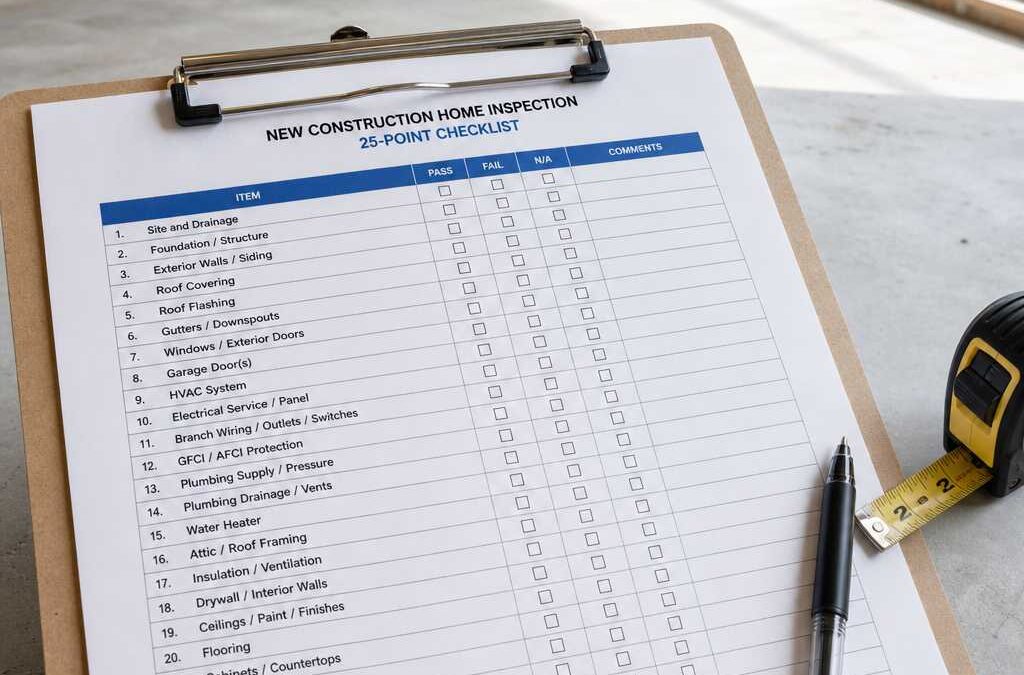
Roughly one in three new homes in Australia reaches handover with defects that were never identified on-site, according to building industry data compiled by consumer advocacy groups. A practical completion inspection is the single opportunity you have to catch those defects before the builder’s liability obligations shift. Miss something now, and you are chasing rectification at your own expense. This checklist covers the 25 specific items your inspector must verify, explains why each one matters, and shows you what separates a thorough pre-handover report from one that leaves money on the table.
Table of Contents
- What Is a Practical Completion Inspection?
- Quick Takeaways
- The 25-Point Checklist
- Structural and Waterproofing Checks
- Mechanical and Services Checks
- Finishes and Fittings Checks
- External and Site Checks
- What Makes a Great Inspection Report
- Comparison of Inspection Approaches
- Common Mistakes Buyers Make at Handover
- Frequently Asked Questions
- References
What Is a Practical Completion Inspection?
A practical completion inspection, sometimes called a pre-handover inspection or PCI, is a formal assessment of a newly constructed home carried out immediately before the builder hands over the keys. The inspection happens after the builder declares the home is ready for occupation but before you sign the handover paperwork and release the final progress payment.
In Queensland, where GoInspect operates across Brisbane, Gold Coast, Logan, Ipswich, and Redland Bay, the Queensland Building and Construction Commission (QBCC) framework gives homeowners the right to a defect rectification period. But that right only has teeth if defects are formally documented before handover. An uninspected handover effectively hands the builder a clean slate.
The practical completion stage is not just a tick-and-flick walkthrough. A licensed inspector is systematically checking over 100 individual elements grouped into five main categories: structural integrity, waterproofing, mechanical services, internal finishes, and external site work. The 25 items below represent the highest-risk failure points across those categories.
Quick Takeaways
| Key Insight | Explanation |
|---|---|
| Never sign handover before inspection | Signing releases your final payment and weakens your defect rectification rights under the QBCC framework. |
| Photo-enhanced reports are non-negotiable | Written-only defect descriptions are routinely disputed by builders. Photos with GPS metadata remove ambiguity and assign trade responsibility clearly. |
| Same-day reporting prevents builder delays | Builders have contractual windows to respond. A report delivered days later compresses your time to act before the settlement deadline. |
| Waterproofing is the costliest defect category | Rectifying failed bathroom waterproofing after tiling averages $4,000 to $12,000 per wet area. Identifying it at PCI costs nothing to fix while tiles are still accessible. |
| Trade-specific defect assignment speeds rectification | Reports that name the responsible trade (plumber, tiler, electrician) allow builders to dispatch the right subcontractor immediately rather than delaying for internal triage. |
| High-rise inspections require customized checklists | Common area obligations, balcony waterproofing, fire egress, and strata-specific finishes differ substantially from house inspections and need a purpose-built checklist. |
| Starting from $550 including GST is the market benchmark | Inspections priced well below $550 typically omit services testing, moisture meter readings, or same-day reporting, all of which are essential components. |
The 25-Point Checklist
The items below are drawn from real inspection data across new home builds in South East Queensland. They are ordered by trade category, not by importance, because any single item on this list can become a five-figure rectification job if missed at handover.


Structural and Waterproofing Checks
1. Roof Structure and Sarking
Your inspector should enter the roof cavity and verify that all trusses are braced according to the structural engineer’s specifications. Missing or incorrectly placed bracing is a common defect on volume-build homes where framing trades are under time pressure. Sarking, the reflective foil layer beneath roof tiles or metal sheeting, must be intact and lapped correctly.
2. Roof Covering and Ridge Capping
Every ridge cap should be fully bedded and pointed. Cracked or hollow-sounding pointing will fail within two wet seasons. On metal roofing, all fasteners must be correctly torqued, not over-driven, which crushes the rubber washer seal.
3. External Wall Flashings
Flashings above windows, doors, and penetrations must be correctly lapped and sealed. Missing window head flashings are one of the top five defects GoInspect’s inspectors identify across South East Queensland builds. Water ingress through an unfitted flashing can travel inside a wall cavity for months before it becomes visible internally.
4. Wet Area Waterproofing
Every bathroom, ensuite, laundry, and balcony must have waterproofing membrane that extends to the correct height on walls, typically 150mm above the floor in shower recesses and across the full floor area. Your inspector should use a moisture meter to check substrate readings where tiling is already laid. Any reading above 17 percent in a timber substrate indicates a failed or absent membrane.
5. Balcony and Deck Drainage Falls
Falls on external tiled or concrete surfaces must be sufficient to direct water to the drain outlet. Flat or reverse-fall balconies pond water against the door threshold and wall junction, which is the most common entry point for internal water damage in Queensland homes.
6. Sub-floor Conditions (where applicable)
On timber sub-floor homes, the inspector must verify that ground clearance meets the minimum 400mm requirement under AS 1684 and that there is no debris, ponding, or moisture damage to bearers and joists. Sub-floor defects are invisible once flooring is laid and are almost never noticed without a specific check.
Pro tip: Ask your inspector specifically whether they carry a calibrated moisture meter and whether sub-floor access is included in the scope. Inspectors who skip the roof cavity and sub-floor are not completing a full practical completion inspection.
Mechanical and Services Checks
7. Electrical Switchboard and Circuit Labeling
Every circuit breaker must be correctly labeled and the switchboard must include a current safety switch (RCD) on all power and lighting circuits. Under Queensland Electrical Safety Regulation 2013, newly constructed homes must have RCD protection on all final subcircuits. Non-compliance here is a direct safety defect, not just a cosmetic issue.
8. Smoke Alarm Placement and Function
Queensland smoke alarm legislation, effective from January 2022, requires interconnected photoelectric smoke alarms in all bedrooms, hallways, and on every storey. Your inspector must test every unit for function and verify that placement meets the Building Code of Australia specifications, including minimum distances from air conditioning vents.
9. Hot and Cold Water Pressure at All Outlets
Every tap, showerhead, and appliance connection must be tested for adequate pressure and for correct hot and cold side assignment. Reversed connections at the mixer are a surprisingly common plumbing defect that is trivial to fix before handover and disruptive to fix after tiles are grouted.
10. Hot Water System Operation and Tempering Valve
The system must reach operating temperature and a tempering valve must be installed to deliver water at or below 50 degrees Celsius at all sanitary fixtures. This is a mandatory Queensland plumbing requirement, and failure to install a tempering valve is a notifiable non-compliance.
11. Air Conditioning and Mechanical Ventilation
All installed air conditioning units must be powered on and tested for cooling and heating modes. Ducted systems must be tested at every outlet. The inspector should verify that condensate drains are connected and pitched correctly, as improperly drained systems are a leading cause of ceiling water damage in Queensland homes.
12. Exhaust Fan Discharge
Every bathroom, toilet, and kitchen exhaust fan must discharge to the external atmosphere, not into the roof cavity. Fans discharging into the roof space create the humidity conditions that grow mould and degrade timber framing. In practice, this defect is present in approximately one in five new builds GoInspect inspects.
13. Gas Fitting and Appliance Commissioning
Where gas is connected, all appliances must be commissioned and all connections leak-tested. The inspector should verify the gas meter is turned on and that the builder has provided the required certification from a licensed gasfitter.

Finishes and Fittings Checks
14. Door and Window Operation
Every door must open, close, and latch without binding or excessive effort. Every window must operate smoothly through its full range. Sticking doors and windows indicate either frame misalignment or swelling of timber components. Both are builder rectification items. The inspector should specifically check fire-rated doors where applicable, as these must seal fully when closed.
15. Tiling, Grout, and Silicone Joints
Tiles must be checked for hollow sounds (indicating lack of adhesive coverage), lippage between adjacent tiles exceeding 1mm, and cracked or missing grout. Silicone expansion joints at all internal corners in wet areas must be present and fully sealed. Missing silicone at shower corners is among the top three defects found in new Queensland homes because many tilers treat it as a cosmetic item rather than a waterproofing requirement.
16. Plasterboard Finish Quality
Under raking light conditions, your inspector should check plasterboard for nail pops, joint ridging, and poor stopping. AS 2589 specifies three finish levels for plasterboard. Level 4, which is required for painted walls visible under natural light, demands that no tool marks, ridges, or fastener heads are visible. Builders routinely dispute these defects after settlement because paint hides them temporarily.
17. Paint Coverage and Colour Consistency
Every painted surface must receive a minimum of two full coats as required under the Australian paint manufacturers’ application standards. The inspector checks for missed areas, colour variation between coats, and paint application over uncured stopping compounds, which causes shrinkage cracking within weeks of handover.
18. Kitchen Cabinetry and Bench Tops
All cabinet doors and drawers must operate on their soft-close mechanisms without adjustment. Bench tops must be fully supported, level within 3mm over 1.8 metres, and all joints must be sealed. Stone bench tops should be inspected for chips, cracks, and staining absorbed during construction.
19. Sanitary Fixtures and Fittings
Every toilet, basin, bath, and shower must be checked for chips, crazing, and secure fixing. Toilet pans must not rock. Basins must drain within a reasonable time. All chrome fittings must be free from scratches and correctly seated.
20. Floor Coverings
Timber and laminate floors must be checked for hollow spots, lifting joins, and gaps at skirting boards. Carpet must be stretched correctly with no visible ripples. Vinyl must adhere fully with no bubbling or lifting at seams.
Pro tip: Bring a torch and hold it at a low angle to painted walls and floor surfaces. Raking light reveals surface defects that flat overhead lighting completely obscures. Your inspector should do this as standard practice, but it is worth confirming before the inspection begins.
External and Site Checks
21. Drainage and Site Grading
The site must be graded so that stormwater drains away from the structure at a minimum fall of 1 in 50 within 1 metre of the external wall. Flat or inward-falling ground immediately adjacent to the footings is a direct cause of sub-floor moisture and eventual foundation movement in Queensland’s clay-heavy soil profiles.
22. Driveway and Path Construction
Concrete driveways and paths must be free from major cracking, and expansion joints must be correctly placed at intervals not exceeding 3 metres. Cracking that appears within the first 28 days after pour is a workmanship defect, not a settlement issue, and the builder is responsible.
23. Fencing and Retaining Walls
Where fencing is included in the contract, all posts must be plumb and rails and palings must be secure. Retaining walls are a high-risk item in sloped South East Queensland sites. The inspector must verify that retaining walls include adequate weepholes for drainage and that construction complies with engineering specifications.
24. Termite Management System
Queensland’s high termite pressure zone requires that every new home have an approved termite management system in place before occupation. The builder must provide a certificate from the pest management technician detailing the system type, product used, and warranty period. The inspector should verify physical barriers are visible at penetrations and slab perimeter.
25. Contract Inclusions Verification
The final checkpoint is a direct comparison between the contract schedule of finishes and what has actually been installed. Your inspector should arrive with a copy of your contract and verify that specified products, such as appliance brands and models, tapware ranges, and flooring grades, match what is installed. Substitutions made without written agreement from the homeowner are a contractual defect regardless of whether the substituted item appears identical.
What Makes a Great Inspection Report
The inspection itself is only half the value. The report is what you present to the builder, and the quality of that report determines how quickly defects are rectified. A report that consists of a numbered list of text descriptions will be disputed, misrouted, and delayed. A report that includes geo-tagged photographs, trade attribution, and referenced standards leaves no room for argument.
“Defect reports that clearly identify the responsible trade and cite the relevant Australian Standard or BCA provision result in rectification timeframes that are on average 40 percent shorter than reports that describe defects without that context.”
Queensland Building and Construction Commission, Industry Report
GoInspect’s same-day reporting model is specifically designed to work within the short contractual window between inspection and handover settlement. Receiving your report within hours of the inspection means your builder receives formal notification before any settlement deadline can be used as pressure to proceed with defects unresolved.
For high-rise and multi-dwelling developments, the report format needs to capture common area obligations alongside individual lot defects. A standard house inspection template is not appropriate for a high-rise apartment because it will miss fire door compliance, lobby finish standards, lift operation, and pool and gym facility handover items. Customized reports for these projects are an essential product difference, not an optional upgrade.
Comparison of Inspection Approaches
| Inspection Approach | Key Features | Best Suited For |
|---|---|---|
| Licensed Inspector, Photo-Enhanced Same-Day Report | Fully licensed inspector, geo-tagged photos, trade attribution, same-day delivery, customized for house or high-rise, from $550 including GST | Homeowners and investors who need defects formally documented before settlement and want maximum builder accountability |
| Builder’s Internal Defect Walk | Conducted by the builder’s site supervisor, no independent verification, no formal report issued to owner, no trade attribution | Builders only, not appropriate as a substitute for an independent inspection since the supervisor’s priority is handover completion not defect identification |
| Owner Self-Inspection Using a Downloaded Checklist | Low cost, uses generic checklists, no moisture meter, no roof cavity or sub-floor access, no licensed certification, no formal report | Suitable as a preliminary walkthrough only, not as a substitute for a licensed practical completion inspection since structural, waterproofing, and services defects require professional equipment and expertise |
Common Mistakes Buyers Make at Handover
The most damaging mistake is signing the handover certificate on the day of the inspection, before the report has been reviewed. Builders regularly present the handover paperwork at the site visit itself. Signing that document, even with verbal assurances that defects will be fixed, weakens your legal position substantially. In practice, always review the report before signing anything.
A second common mistake is treating the practical completion inspection as a cosmetic check. Buyers focus on scratched surfaces and paint scuffs while missing structural waterproofing failures, incorrect electrical protection, and absent termite barriers. The new home inspection checklist exists precisely because the eye naturally gravitates to visible cosmetic issues while missing the defects hidden inside walls, under floors, and in roof cavities.
A third mistake is engaging an inspector who does not carry professional indemnity insurance. If an inspector misses a significant defect and it later causes loss, an uninsured inspector offers you no recourse. Always confirm PI insurance before booking, not after.
Frequently Asked Questions
What is the difference between a practical completion inspection and a pre-settlement inspection?
A practical completion inspection occurs specifically at the point when the builder declares the home complete and ready for handover. A pre-settlement inspection is a broader term sometimes used interchangeably, but it can also refer to inspections on existing homes purchased through the real estate market. For new builds, PCI and pre-handover inspection mean the same thing. The timing, at the precise moment before keys change hands, is what makes this inspection distinct and critical.
How long does a practical completion inspection take?
A thorough inspection of a standard four-bedroom single-storey house in Brisbane or the Gold Coast takes between two and three hours. Dual-storey homes take three to four hours. High-rise apartment inspections for a single unit typically take one to two hours, but developer handovers involving multiple lots can span a full day. Any inspection that takes less than 90 minutes on a new house is unlikely to have covered the roof cavity, sub-floor, and all services in adequate detail.
Can I use a pre-handover checklist to inspect the home myself?
You can use a pre-handover checklist to supplement a professional inspection or to prepare your own observations beforehand. However, self-inspection cannot substitute for a licensed assessment because items 4, 6, 7, 10, 12, 13, and 24 on this checklist require specific tools, access points, and licensing to assess properly. Moisture meter readings, sub-floor access, electrical switchboard assessment, and termite certification verification are not achievable through a visual walkthrough alone.
What happens if defects are found during the inspection?
Defects identified in the formal report are presented to the builder before the final payment is released. The builder is contractually obligated to rectify defects to a satisfactory standard within the timeframe specified in the contract. In Queensland, the QBCC provides a statutory warranty framework that covers structural defects for six years and non-structural defects for one year. Formal documentation of defects at PCI is the foundation of any subsequent warranty claim.
Does a practical completion inspection cover new apartments and high-rise developments?
Yes, but the checklist must be adapted for the specific conditions of apartment construction. High-rise inspections add checks for fire door compliance, common area finishes, balcony waterproofing at greater heights, mechanical exhaust systems, and strata-specific inclusions. A standard house inspection checklist applied to an apartment will miss category-specific defects. GoInspect produces customized inspection reports for high-rise developments across Brisbane and the Gold Coast for exactly this reason.
How soon after the inspection will I receive my report?
With GoInspect’s same-day reporting model, you receive your completed photo-enhanced report the same day as the inspection. This matters because many construction contracts give you a window of only 24 to 48 hours to formally notify defects before the builder can proceed with handover. A report delivered two or three days later may arrive after that window has closed, reducing your leverage significantly.
Is $550 a reasonable price for a practical completion inspection?
For a standard residential house inspection that includes roof cavity access, sub-floor assessment where applicable, services testing, moisture meter readings, photo documentation, and same-day reporting, $550 including GST is a competitive and realistic price in the South East Queensland market. Inspections priced significantly lower typically exclude one or more of those components. Given that a single missed waterproofing defect can cost upwards of $8,000 to rectify, the inspection fee is not a place to save money.
Have you recently had a practical completion inspection on a new build? Share what your inspector found or what you wish had been checked before handover.
References
- Queensland Building and Construction Commission: information on statutory warranties, defect obligations, and homeowner rights for new construction in Queensland
- Australian Building Codes Board: the National Construction Code and Building Code of Australia standards that underpin construction compliance requirements
- Australian Competition and Consumer Commission: consumer rights guidance on new home construction contracts, defect obligations, and dispute resolution
- Standards Australia: Australian Standards referenced in construction including AS 1684 timber framing, AS 2589 plasterboard, and AS 3740 waterproofing
- Forbes: analysis of property investment risks and the financial impact of construction defects on residential asset values