
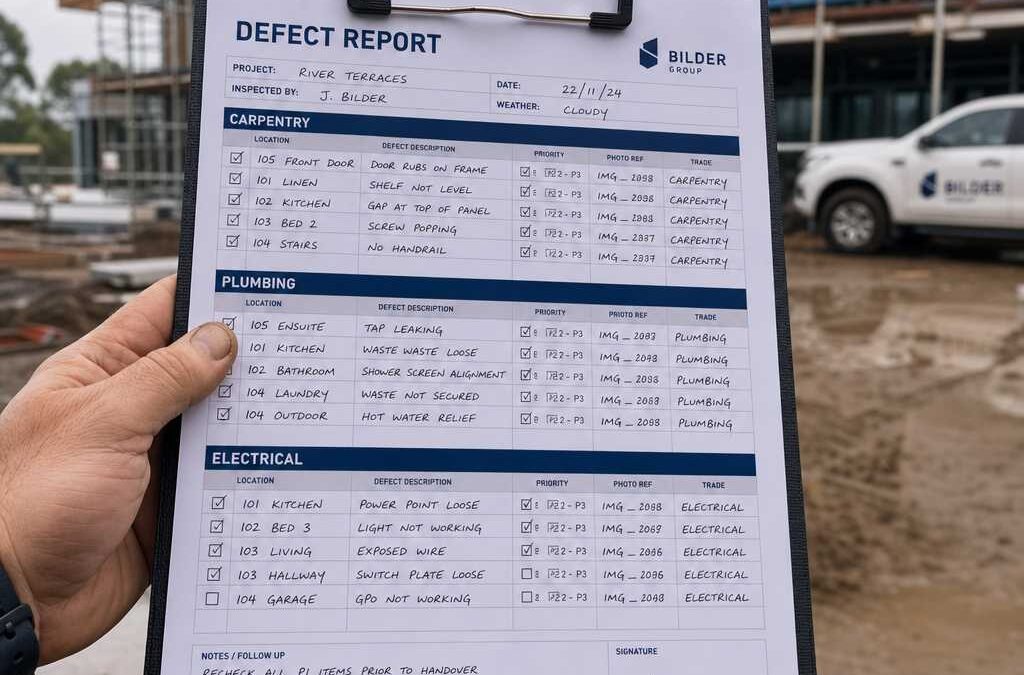
Across Brisbane, Gold Coast, Logan, and Ipswich, builders and developers are losing time and money on defect rectification because their inspection reports don’t tell trades what they actually need to fix. Generic defect lists create arguments about responsibility. Trade-specific defect reports eliminate that argument entirely. A quality assurance inspection Brisbane builders trust isn’t just a checklist – it’s a document that assigns each defect to the exact trade that caused it, backed by photographic evidence, delivered the same day. That specificity is the difference between a builder who closes out defects in a week and one who is still arguing with subcontractors three months after handover.
Table of Contents
- Quick Takeaways
- Why Generic Defect Reports Fail Builders and Developers
- What Trade-Specific Defect Reports Actually Contain
- Quality Assurance Across Brisbane Development Types
- Comparison of Inspection Report Formats
- How Same-Day Reporting Changes Site Management
- Townhouse and Housing Estate Inspections in Logan and Ipswich
- Frequently Asked Questions
- References
Quick Takeaways
| Key Insight | Explanation |
|---|---|
| Trade assignment eliminates blame disputes | When a defect report names the responsible trade – plasterer, tiler, painter – subcontractors cannot redirect the rectification cost to someone else. |
| Photo-enhanced reports reduce reinspection rates | Defects documented with photographs are rectified correctly the first time more often than text-only reports, cutting costly reinspection cycles on housing development sites. |
| Same-day delivery keeps settlements on schedule | Builders managing pre-settlement timelines in Brisbane cannot afford to wait 48-72 hours for reports. Same-day reporting from GoInspect keeps handover dates intact. |
| High-rise and townhouse reports need different structures | A customised format for multi-dwelling developments in Logan, Ipswich, and Redland Bay means defects are sorted by unit, level, or lot – not dumped into a single undifferentiated list. |
| Licensed inspectors carry legal weight | A builder defect report Brisbane contractors can act on must come from a fully licensed inspector. Reports from unlicensed operators can be challenged and dismissed during dispute resolution. |
| Practical completion inspections protect developers from statutory defect claims | Identifying defects before handover dramatically reduces the volume of post-settlement warranty claims under Queensland’s QBCC framework. |
| Starting from $550 including GST makes inspections viable at scale | For developers running multiple lots or stages, a flat accessible price point means inspections happen consistently rather than only when problems are already visible. |
Why Generic Defect Reports Fail Builders and Developers
A generic defect report says something like: “Cracking observed to internal wall, bedroom 2.” A trade-specific defect report says: “Cracking observed to internal wall, bedroom 2, north elevation, attributed to plasterboard fixing by the plastering trade. Photographic reference: Image 14.” The first version creates a meeting. The second version creates a work order.
In practice, builders managing multi-stage housing developments across Brisbane’s growth corridors receive dozens of defect items per dwelling. Without trade attribution, the site supervisor has to manually assess each item, identify the responsible subcontractor, and then argue the case if the subcontractor disputes it. That process can take weeks per dwelling and is the primary reason defect rectification stalls on large housing estates in Logan and Ipswich.
The data consistently shows that defect rectification timelines are a leading cause of handover delays in Queensland residential construction. According to the Queensland Building and Construction Commission, complaints about defective building work remain one of the highest categories of disputes lodged each year. The reports that lead to faster resolution are consistently those that leave no ambiguity about trade responsibility.
Pro tip: If a defect report you receive from a third-party inspector does not identify the responsible trade for each defect item, send it back. Accepting an undifferentiated list transfers the investigation burden onto your site team, which costs you more in labour than the inspection itself.


“>
The cost of ambiguous defect documentation
A common mistake builders make is accepting any inspection report as sufficient documentation for their QBCC obligations. An ambiguous report that cannot be traced to a specific trade creates a grey zone where neither the builder nor the subcontractor feels clearly responsible. That grey zone costs money. Subcontractors return to site, assess the defect, and then dispute whether it falls under their scope. The defect sits unresolved while the builder manages a disgruntled homeowner or investor.
Trade-specific reporting removes that grey zone at source. When the inspector has already identified that a tiling defect is a grouting issue rather than a substrate issue, the dispute about which trade owns the rectification is resolved before anyone sets foot on site a second time.
What Trade-Specific Defect Reports Actually Contain
A trade-specific inspection report organises every defect under the trade category responsible for it: concreting, framing, brickwork, plastering, painting, tiling, joinery, roofing, plumbing, electrical rough-in, and so on. Each defect item includes a written description, a precise location reference, and a photograph taken during the inspection.
This structure means a builder can hand the plastering section directly to the plasterer without that trade needing to review 80 other items. The painter receives only the painting section. The tiler receives only the tiling section. Each subcontractor gets a work order that looks like it was written specifically for them, because functionally it was.
Photo documentation as dispute prevention
Photographs are not a nice-to-have addition to a defect report. They are the primary mechanism that prevents subcontractors from claiming a defect was not present at the time of inspection, or that the photograph depicts a different area of the building. GoInspect’s photo-enhanced reports timestamp and geolocate each image, creating a documentation chain that holds up under scrutiny during QBCC dispute resolution.
Builders who have managed warranty claim disputes in Queensland know that a claim without photographic evidence from the pre-handover inspection is extremely difficult to prosecute. The homeowner or investor alleges the defect was present at handover. The builder denies it. Without dated photographic evidence from a licensed inspector, the builder’s position is weak regardless of the actual facts.
Pro tip: Request that your inspection provider photograph not only the defect itself but also the surrounding context – the room, the wall elevation, the overall area. Context photographs make location identification unambiguous for subcontractors who haven’t been on site recently.
Quality Assurance Across Brisbane Development Types
Brisbane’s residential construction market spans freestanding houses, duplexes, townhouse complexes, and high-rise apartment developments. Each development type requires a different approach to quality assurance inspection Brisbane professionals are equipped to deliver.
For a single dwelling in Redland Bay, the inspection moves room by room through every trade’s work, producing a single comprehensive report. For a 24-townhouse development in Logan, the same inspection methodology scales across every unit, with defects sorted by unit number and trade. For a high-rise in Brisbane CBD or the Gold Coast, the report is customised by level, apartment number, common area, and trade – a structure that makes sense for a developer managing dozens of subcontractors across a building with hundreds of distinct inspection points.
“Defect management is where project margins are won or lost on volume residential developments. The builders who close projects on time are invariably those who have a repeatable, documented quality assurance process at practical completion.” – Queensland Master Builders Association, residential sector commentary
Pre-handover versus practical completion inspections
These two inspection types are often confused by homeowners but are operationally distinct for builders and developers. A practical completion inspection is conducted when the builder considers the work complete, before the key handover event. A pre-handover inspection for a buyer is conducted immediately before the buyer takes possession.
For a developer selling multiple lots or units, the practical completion inspection catches defects while all subcontractors are still under contract and legally obligated to rectify. That is the optimal intervention point. Defects found post-settlement require the builder to call subcontractors back under warranty provisions, which costs more and takes longer.

“>
Comparison of Inspection Report Formats
Not all inspection reports are built the same way. The format of the report directly determines how quickly defects get resolved. Below is a comparison of the three main formats used by inspection providers operating in the Brisbane, Gold Coast, Logan, and Ipswich markets.
| Report Format | Structure and Content | Practical Impact for Builders |
|---|---|---|
| Generic checklist report | Pass/fail items grouped by room or area. No trade attribution. Limited or no photographs. Often template-based with little customisation. | Requires significant manual work from site supervisors to interpret, assign, and communicate defects to trades. High rate of subcontractor disputes over responsibility. |
| Narrative defect report | Written paragraphs describing defects observed. May include some photographs. Trade attribution is implied but not systematically assigned. | Better than a checklist for homeowners, but still leaves trade attribution ambiguous. Difficult to use as a work order without reformatting by the builder’s team. |
| Trade-specific photo-enhanced report (GoInspect format) | Defects categorised by responsible trade. Each item includes a written description, precise location reference, and timestamped photograph. Customised for housing type and development scale. Same-day delivery. | Can be forwarded directly to each subcontractor as a standalone work order. Minimal site supervisor input required. Reduces reinspection rate and accelerates defect closeout. Defensible in QBCC dispute processes. |
How Same-Day Reporting Changes Site Management
Builders managing handover schedules in Brisbane, Logan, and Ipswich operate in environments where a single day’s delay can push a settlement date, trigger penalty provisions in contracts, and damage relationships with buyers who have removalists booked. Same-day reporting is not a convenience feature. It is a site management tool.
When an inspection is completed at 9am and the report is in the builder’s inbox by 3pm, the site supervisor can issue subcontractor work orders the same afternoon. Trades can be scheduled for the following morning. Defects that are cosmetic in nature – paint touch-ups, grout cleaning, minor joinery adjustments – can be resolved within 24 to 48 hours of the inspection. That turnaround is only possible when the report exists and is actionable before the end of the business day.
Inspection providers that deliver reports in 48 to 72 hours introduce a structural delay into the defect rectification process that compounds across a multi-stage development. On a development with 40 lots completing in sequence, a 72-hour reporting lag on each lot adds up to a measurable schedule impact across the project.
Managing multiple simultaneous practical completions
Large housing estate developers in Logan, Ipswich, and Redland Bay regularly face periods where 8 to 12 dwellings are reaching practical completion at the same time. The inspection provider must be able to inspect multiple properties in a single day and deliver individual reports for each without degrading the quality of documentation. This is where GoInspect’s housing development inspection Logan Ipswich capacity – with fully licensed inspectors and systematic report generation – becomes operationally essential rather than simply convenient.
Townhouse and Housing Estate Inspections in Logan and Ipswich
Logan and Ipswich are two of Queensland’s most active residential construction markets. The combination of land availability, infrastructure investment, and population growth has produced a sustained pipeline of townhouse complexes, housing estates, and medium-density developments that require townhouse inspection Brisbane and regional services at scale.
In practice, townhouse developments present specific inspection challenges that freestanding housing does not. Party walls, shared rooflines, common property areas, and the proximity of multiple units under simultaneous construction mean that trade defects in one unit can be caused by work in an adjacent unit. A trade-specific report for a townhouse development must account for these boundary conditions and attribute defects accurately even when the causation crosses lot lines.
Builder defect reports and QBCC compliance in Queensland
Queensland builders operating under QBCC licences have statutory obligations that make documented quality assurance non-negotiable. A builder defect report Brisbane contractors use for QBCC purposes must come from a licensed inspector and must document defects with sufficient specificity to support a formal defect notice if necessary.
Investors purchasing new properties in Logan and Ipswich housing estates are increasingly sophisticated about their rights under QBCC warranty provisions. They commission their own pre-settlement inspections and they know how to lodge complaints. Builders who have already conducted thorough practical completion inspections using trade-specific reports are in a substantially stronger position when a buyer’s inspector identifies issues, because the builder can demonstrate that defects were identified, assigned, and scheduled for rectification before handover.
The builders who get into dispute are almost always those who skipped the practical completion inspection or relied on an internal site supervisor walkthrough rather than an independent licensed inspection. Internal walkthroughs have an inherent conflict of interest problem that no amount of diligence can fully resolve.
“>
Frequently Asked Questions
What makes a quality assurance inspection in Brisbane different from a standard building inspection?
A quality assurance inspection Brisbane builders use is specifically structured around trade accountability and defect attribution, rather than simply identifying whether a building meets a pass/fail standard. It is conducted at practical completion or pre-handover, documents every outstanding defect with photographic evidence, assigns each defect to the responsible trade, and is delivered in a format that a builder can use directly as a subcontractor work order. A standard building inspection for a buyer or homeowner typically focuses on safety and significant structural concerns and is not structured for trade management.
How does a trade-specific inspection report reduce costs for developers running multi-stage housing estates?
Trade-specific inspection reports reduce costs in three concrete ways. First, they cut the time site supervisors spend manually assigning defects from generic reports to individual trades. Second, they reduce reinspection rates because subcontractors receive clear photographic documentation of what needs rectifying rather than a vague written description. Third, they reduce post-settlement warranty claims by catching defects before handover, when all subcontractors are still under contract and the rectification cost falls on them rather than on the builder’s warranty budget.
Can GoInspect handle townhouse development inspections across multiple lots simultaneously in Logan and Ipswich?
Yes. GoInspect is specifically structured for housing development inspection in Logan, Ipswich, and surrounding areas, with fully licensed inspectors and customised report formats designed for multi-dwelling developments. Reports are delivered same-day, and the format is organised by lot or unit number rather than as a single undifferentiated list, which is essential for developers managing defect rectification across a large estate with multiple subcontractors.
What is the difference between a practical completion inspection and a pre-handover inspection for a builder?
A practical completion inspection is commissioned by the builder when they consider their work finished, before the buyer takes possession. Its purpose is to identify defects while all subcontractors are still under contract and can be called back at no additional cost. A pre-handover inspection is typically commissioned by the buyer immediately before settlement to confirm that the dwelling meets the agreed standard. Builders who conduct their own practical completion inspection using a licensed independent inspector are in a stronger position if the buyer’s inspector subsequently identifies issues, because the builder has documented evidence of a prior quality assurance process.
Why does trade attribution matter for QBCC dispute resolution in Queensland?
The QBCC dispute process requires documented evidence that a defect exists, when it was identified, and who is responsible for rectifying it. A defect report that assigns responsibility to a specific trade, supported by timestamped photographs from a licensed inspector, is substantially more defensible than a narrative report without trade attribution. Without clear trade assignment, a builder defending a QBCC complaint must reconstruct the chain of responsibility from site records alone, which is time-consuming and often inconclusive.
Is a $550 inspection fee viable for investors purchasing a single new home in Brisbane or Redland Bay?
It is not just viable – it is one of the most cost-effective risk management tools available to a new home buyer. A single defect that is not identified before handover and that requires the homeowner to pursue rectification post-settlement through QBCC processes can take months to resolve and cause significant disruption. The $550 investment, including GST, is a straightforward trade against that risk, particularly for investors who cannot personally supervise construction progress and are relying on the builder’s quality controls alone.
If you have worked with trade-specific defect reports on a Brisbane or regional Queensland development, share what made the difference in your defect rectification process – your experience helps other builders and developers understand what to demand from their inspection providers.
We would love your feedback and any insights you would share with others. What perspective would you add?
References
- Queensland Building and Construction Commission – licensing, defect disputes, and statutory warranty information for Queensland builders and homeowners
- Master Builders Australia – industry standards, residential construction quality guidance, and builder compliance resources
- Australian Building Codes Board – National Construction Code standards applicable to residential building quality and defect classification
- Statista – construction industry defect rates, warranty claim statistics, and residential building quality data
- Forbes – analysis of construction project management, quality assurance frameworks, and cost of poor quality in residential development