

Handover Inspections
Your new home. Your next chapter.
Getting the keys should be a moment to enjoy. We help you understand your new home’s condition, prepare for handover and move forward with a clear photographic report.
An exciting milestone, with a little preparation.
After months of plans, selections and watching your home take shape, handover is when it starts to feel like yours. It is a chance to see the finished spaces, learn how everything works and get ready for moving day.
Our role is to help with the building details, so you can spend more time looking forward to living there. A clear inspection report gives you and your builder a practical starting point for any work that still needs attention.
What is a handover inspection?
A handover inspection is an independent visual assessment of a newly built house, townhouse or apartment near completion. We inspect visible and safely accessible work for workmanship issues, damage and incomplete items within the agreed scope.
You may also hear it called a Practical Completion Inspection (PCI) or pre-handover inspection. The important part is arranging the right inspection at the right point in your build.
Your builder’s walkthrough
This is your opportunity to talk through the finished home with the builder, learn about its features and record agreed outstanding items.
Your independent inspection
We provide another experienced set of eyes on the workmanship, supported by photographs, locations and clear descriptions.
Your building certifier
Certification has a separate role in checking prescribed building requirements and approvals. Our report does not replace certification or an occupancy approval.
Your own selections
Keep your plans, specifications and variations handy. Raise anything that does not match your selections, and provide relevant documents when asking us to assess a particular concern.
What do we check?
Our inspection focuses on visible defects and workmanship in safely accessible areas. The property, completed work and agreed scope determine what can be inspected.
Walls, ceilings & finishes
Painting, plastering, visible cracking, damage and incomplete finishing work.
Doors, windows & joinery
Operation, alignment, glazing, cabinetry, handles and visible installation issues.
Floors, tiles & wet areas
Visible flooring and tiling defects, bathroom finishes and accessible fixtures.
External areas
Accessible brickwork, concrete, garages, balconies and external finishes within the agreed scope.
Visual inspections cannot reveal every concealed defect. Specialist testing, engineering certification and inaccessible areas are outside the standard visual inspection scope. Explore the defects we identify.
A new home can still have defects.
Many trades contribute to a new home. An independent inspection provides another experienced set of eyes and a clear record of the items that need attention—whether you are moving in, investing or purchasing an apartment.
Before inspection day.
A little coordination makes the visit more useful. As completion approaches, share the following details with us:
Plans & concerns
Send the floor plans and any documents relevant to a specific concern. Tell us about changes, unfinished work or items you have already discussed with your builder.
The site contact
Provide your builder or supervisor’s contact details so access can be coordinated. We can supply business, licence and insurance information if the builder requests it.
Readiness & access
Ask whether the property is ready for a detailed inspection. Safe access, completed work and a final clean help us see the finishes. Let us know about locked rooms or other access restrictions.
Your attendance
You do not have to attend. If you would like to come along, tell us in advance so it can be arranged subject to the builder’s permission and site safety requirements.
What to expect on inspection day.
Your inspector works through the accessible areas within the agreed scope, checking the completed work and recording findings as they go. This includes finishes and workmanship as well as the operation of accessible doors, windows and similar building elements.
We photograph every defect included in the report and identify its location and responsible trade where appropriate. In Queensland, our assessment considers the QBCC Standards and Tolerances Guide, with relevant building requirements and manufacturer instructions where applicable.
There is no fixed time limit for every home. A standard four-bedroom house often takes around 1.5 hours; larger properties or homes with more findings can take longer. The property’s condition and scope determine the time needed.
After the inspection: clear information, practical next steps.
Read the report and raise any questions about the findings with us. We usually send it directly to your builder as well when their email address has been provided. Keep a copy with your other building documents.
Discuss the items
Ask your builder or supervisor to review the findings, identify the relevant trades and explain the proposed next steps. Clear locations and photographs help everyone discuss the same item.
Record the plan
Keep an agreed list of outstanding work and proposed rectification dates. Record any items you and the builder disagree about, and keep correspondence together.
Allow for rectification
The builder and trades use the report to locate and attend to the items. Arrange suitable access for agreed work and keep track of what has been completed.
Consider a re-inspection
For an additional fee, we can return to check the rectification and identify new defects or damage. It provides an updated record of the items that remain outstanding.
Handover day: more than collecting the keys.
Make time for the builder’s handover walkthrough. Bring your questions, take useful notes and ask for demonstrations rather than trying to remember every instruction at once.
Keys, remotes & access
Check which door and window keys, garage remotes, gate controls and access fobs you are receiving. For an apartment, confirm parking, storage and common-area access arrangements with the appropriate contact.
Learn how the home works
Ask your builder or relevant installer to show you the water shut-off, electrical switchboard, hot-water controls, ventilation, air-conditioning controls and any installed smart systems. Keep the operating instructions.
Collect the documents
Ask for the applicable building inspection and final certification documents, any contractual Practical Completion certificate, appliance warranties, manuals and relevant service documentation.
Confirm outstanding items
Take your report and outstanding-work list to the discussion. Make sure the agreed rectification arrangements and contact person are clear before everyone moves on to their next job.
Final payment and Practical Completion depend on the building contract and applicable requirements. Your inspection report helps explain the condition of the work; it does not decide your contractual rights. Get appropriate advice if there is a disagreement about completion or payment.
Settle in and enjoy your new home.
Once handover and access are confirmed, you can focus on the enjoyable part: furnishing the rooms, unpacking and making the place your own. Confirm moving arrangements, utilities and the insurance you need for your circumstances before moving day.
Keep a simple home folder with your inspection report, certificates, warranties, manuals and builder correspondence. Follow the supplied care instructions for finishes and equipment, and note any maintenance requirements for items such as sealants, drainage and termite systems.
If you notice a new concern, take a photograph and notify your builder promptly in writing. You do not need to wait until a scheduled maintenance visit. Complaint and insurance timeframes can differ from contractual maintenance periods.
Later, a 12-month maintenance inspection can provide a fresh assessment of visible workmanship issues after you have lived in the home.
See the issue.
Know where it is.
Your digital report gives you a clear record of the defects identified, with information that helps your builder and trades locate each item.
- A photograph of every reported defect
- Clear descriptions and locations
- The responsible trade, where applicable
- A digital PDF you can keep and share
Reports for standard residential inspections are generally issued the same day. We usually also send the report directly to your builder when their email has been provided.
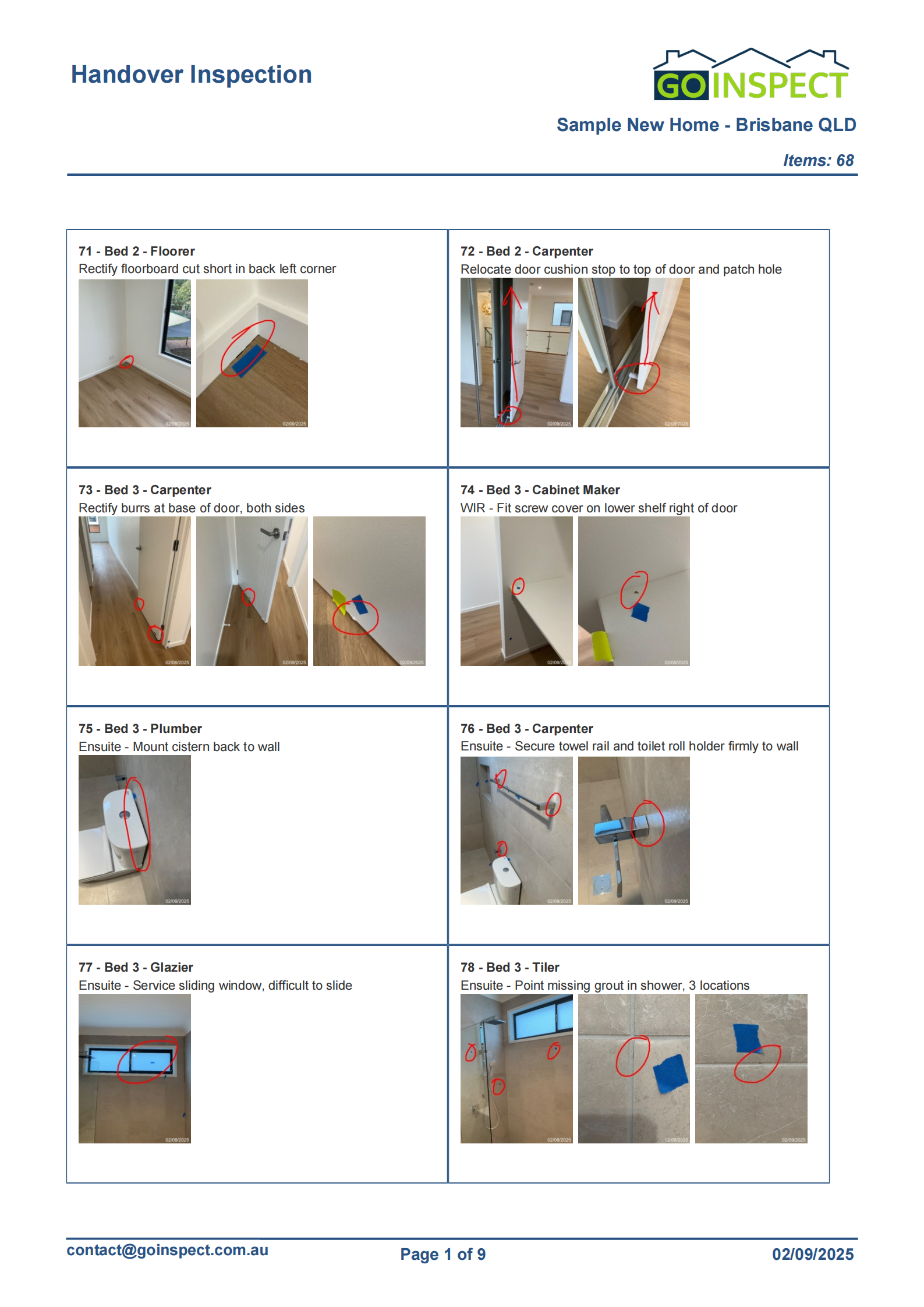
Sample handover report · Select to view the PDF
From booking to next steps.
- 01
Choose & book
Get your price online and provide your property and contact details. We confirm the inspection timing and access arrangements.
- 02
Inspect & report
An experienced inspector checks the agreed areas and documents the findings with photographs and clear locations.
- 03
Discuss & rectify
Use the report to discuss the identified items with your builder. A further inspection can be arranged for an additional fee where needed.
Your questions,
answered.
Need help choosing an inspection? Call (07) 3063 0793 or contact our team.
Is PCI different from a handover inspection?
PCI, pre-handover and handover inspection are commonly used for similar checks of a new home near completion. Tell us how far construction has progressed so we can confirm the right timing and scope.
Do you inspect apartments and townhouses?
Yes. We inspect new houses, townhouses, units, duplexes and apartments. For development-wide inspections, including common areas, use our builders and developers quote form.
Do I need to attend?
No. We can coordinate access with your builder or site contact and send you the report afterwards. If you would like to attend, let us know so it can be arranged subject to site requirements.
Can you check the repairs afterwards?
Yes. For an additional fee, we can return to check rectification and identify new defects or damage. You can select inspection options in the quote form.
Is the roof included?
Walking on external roof surfaces is not included as standard. Ask us about a separate drone roof inspection where suitable; availability and scope are confirmed for your property.
Ready for a clearer handover?
See your inspection price online. You can request a booking before the date is known.