
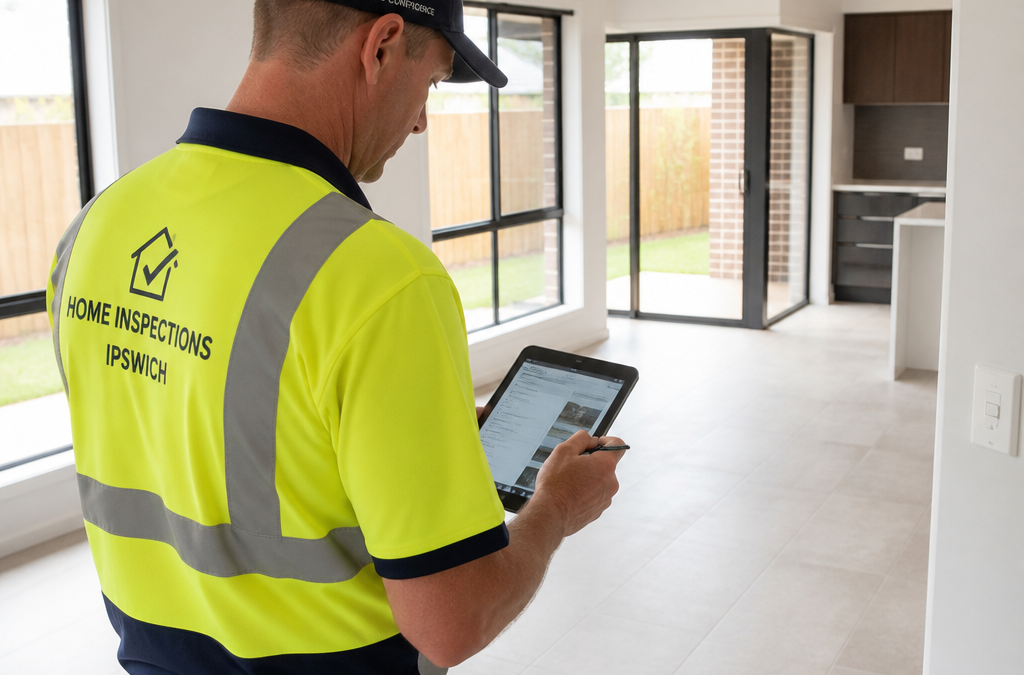
Ipswich is handing over more new homes than at any point in recent memory. In the 2025-26 financial year alone, 3,157 new dwellings were created across the city, and 2,875 new lots were registered, up 35.6 per cent on the prior year. That pace of construction puts enormous pressure on subcontractor availability, site supervision, and the quality of finishes that reach practical completion. The result, seen across hundreds of inspections in suburbs like Ripley, Redbank Plains, White Rock, Deebing Heights, and Spring Mountain, is a predictable pattern: new homes handed over with defects that buyers never detect before signing off. A new home inspection Ipswich buyers commission independently, before their handover appointment, is the most effective single action to protect a property investment that routinely exceeds $600,000.
Table of Contents
- Quick Takeaways
- Ipswich Growth and the Defect Problem
- What a Pre-Handover Inspection Actually Covers
- Most Common Defects Found in Ipswich New Builds
- Independent vs. Builder-Nominated Inspection
- The QBCC Framework and What It Does Not Guarantee
- How to Choose a Building Inspector in Ipswich Queensland
- What Happens After Defects Are Documented
- Frequently Asked Questions
- References
Quick Takeaways
| Key Insight | Explanation |
|---|---|
| Book before you accept the keys | An Ipswich pre-handover inspection must happen before you sign the handover documents. Once you accept, your leverage to demand rectification from the builder shrinks significantly. |
| Volume build pressure is real | Estates like Springfield Lakes, Ripley Valley, and Redbank Plains see multiple builders completing large stages simultaneously, which stretches subcontractor capacity and increases defect rates. |
| Certifier inspections are not the same thing | Mandatory council or private certifier inspections confirm code compliance at specific stages. They do not assess workmanship quality, finishes, or incomplete items at handover. |
| Photo-enhanced reports get results | A report that assigns each defect to the responsible trade, with photos, gives builders a clear action list. Vague written-only reports are easier for builders to dispute or delay. |
| QBCC licensing does not prevent defects | The Queensland Building and Construction Commission licenses builders and can issue Directions to Rectify, but it does not inspect every home before handover. That gap is yours to close. |
| Same-day reporting matters for timing | Handover appointments are scheduled tightly. A report delivered the same day as the inspection gives you documented evidence before your builder expects a response. |
| New build defects Ipswich inspectors find are mostly fixable | The vast majority of defects found at practical completion are minor to moderate and straightforward to rectify. The risk is not finding them. That is where post-handover disputes and costs begin. |
Ipswich Growth and the Defect Problem
Ipswich is Queensland’s fastest-growing city by any measure that matters to new home buyers. The population is now tracking toward 535,000 by 2046, and the council’s 2025 City Plan is specifically designed to unlock the construction of 100,000 additional homes over the next two decades. That ambition is already visible in the suburb-level data: White Rock, Ripley, Redbank Plains, Deebing Heights, and Spring Mountain are all recording significant residential completions each quarter.
The problem is structural, not exceptional. When hundreds of new homes are being completed in a single corridor within the same period, subcontractors work across multiple sites simultaneously. Supervision becomes inconsistent. Trades that are stretched thin cut corners not always out of bad faith, but out of time pressure. The result is a predictable cluster of defects that appear at practical completion on estates across the Ipswich region, year after year.
A new home inspection commissioned independently by the buyer, before accepting handover, is not an act of mistrust toward the builder. It is the mechanism that gives the builder a clear, documented opportunity to fix what needs fixing before the buyer’s final payment is released.
What a Pre-Handover Inspection Actually Covers
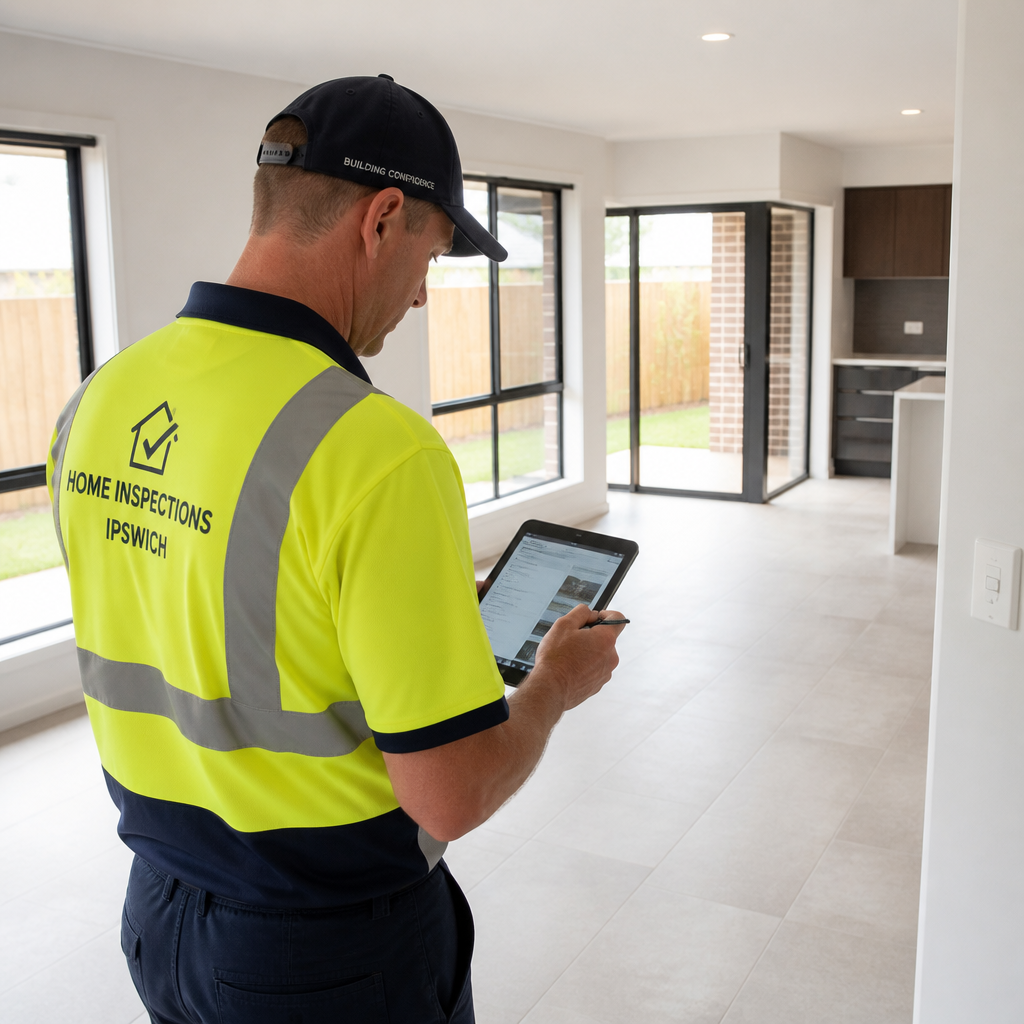
The Practical Completion Inspection, commonly called a PCI or pre-handover inspection, is carried out when the builder advises that construction is substantially finished. This is the most critical point in the entire build cycle. It is the buyer’s formal opportunity to document defects and incomplete items before accepting handover, and it is the only point at which the builder is contractually obligated to address those items without cost or dispute.
What a qualified inspector examines
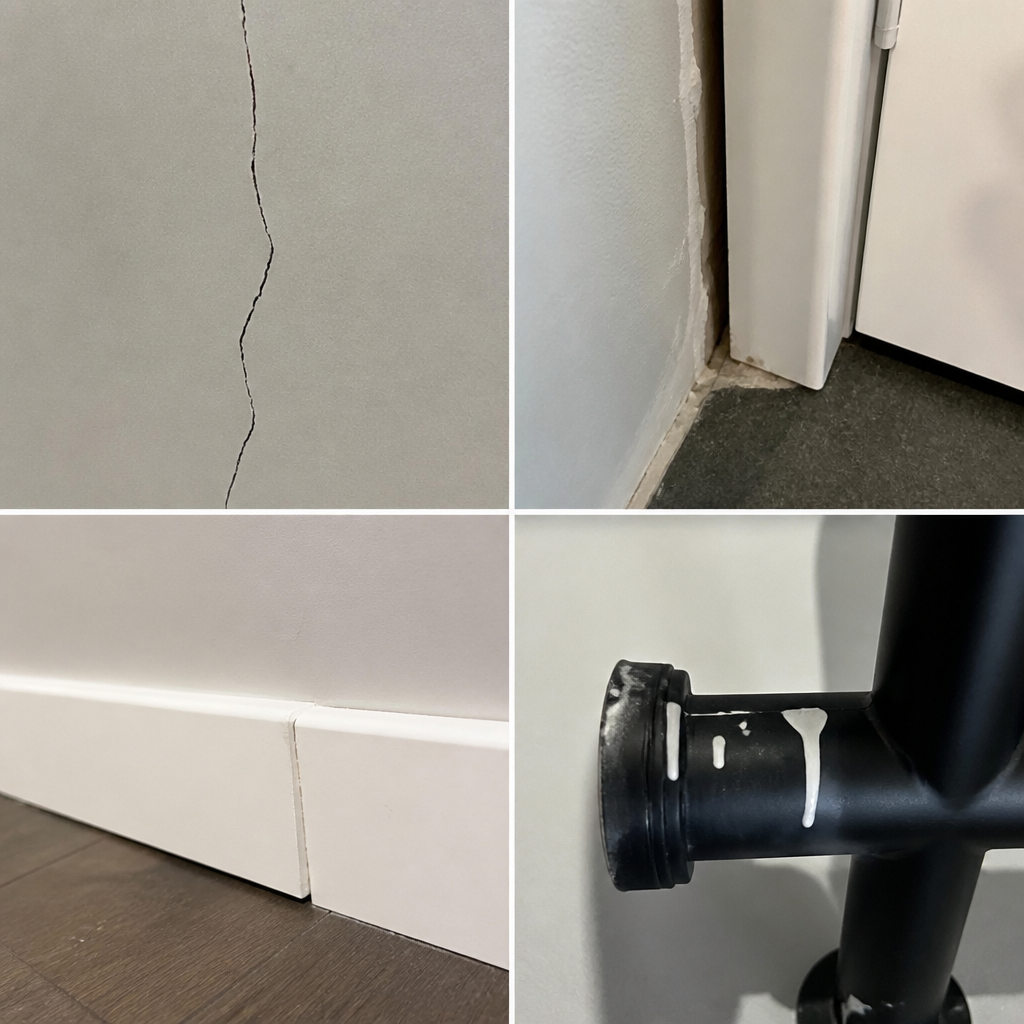
A thorough Ipswich pre-handover inspection covers the roof (including tiles, guttering, flashing, and penetrations), external walls and render, windows and doors, wet areas including waterproofing in bathrooms, ensuites, and laundries, floor coverings, joinery and cabinetry, plasterboard and cornices, electrical fittings, plumbing fixtures, and the garage slab and door operation. In practice, the inspection also checks that what is present on site matches what was specified in the contract, because omissions are as problematic as defective workmanship.
What the inspection does not replace
A pre-handover inspection is not a substitute for mandatory stage inspections carried out by a private certifier during construction. Those inspections verify structural compliance at defined points, such as the slab, frame, and lock-up stages. The PCI comes after all of those and assesses finished workmanship, completeness, and compliance with contracted specifications. Both serve different purposes, and both matter.
Pro tip: Ask your inspector to confirm whether the finished work reflects what was specified in your building contract, not just whether the construction meets the minimum code. Builders sometimes substitute finishes or fittings and rely on buyers not noticing.
Most Common Defects Found in Ipswich New Builds
Inspectors working consistently across the Ipswich corridor find recurring defect categories that appear regardless of builder size or price point. This is not about singling out any individual builder. It is an observable pattern driven by the volume and speed of construction in this market.
Waterproofing failures
Bathrooms, ensuites, and laundries are the most consistently problematic areas in new Ipswich builds. Membrane application and curing requirements are frequently compromised when tilers move in too quickly after waterproofing is applied. A failure here is not cosmetic. It leads to structural water damage that can cost tens of thousands of dollars to remediate after handover.
Framing and structural alignment
Walls that are out of plumb, door frames that are not square, and rooflines that show inconsistent pitching are found regularly on volume-built homes in estates where framing is completed under time pressure. These issues affect how doors hang, how windows seal, and how subsequent finishes sit. They are detectable before handover and should be documented when found.
External cladding and render cracking
Render is applied over a range of substrates in Ipswich new builds, and shrinkage cracking at joins, corners, and around window reveals is one of the most commonly documented defects. Some cracking is within acceptable tolerances under Australian Standards. Some is not. A qualified building inspector Ipswich Queensland can tell the difference and document what falls outside the standard.
Incomplete or poorly fitted joinery
Kitchen and bathroom cabinetry, wardrobes, and door hardware are consistently flagged at practical completion for misalignment, missing fixings, damaged panels, and soft-close mechanisms that do not operate correctly. These are straightforward to fix before handover and contentious to pursue afterward.
Drainage and site works
Ponding adjacent to the foundation, poorly graded driveways, and stormwater drainage that does not flow away from the structure appear regularly on Ipswich estates, particularly where cut-and-fill earthworks were involved. These are not always visible during a casual walkthrough.
The defects that cost buyers the most money are rarely the ones that look dramatic during a handover walkthrough. They are the ones hidden behind finishes, under tile beds, or in drainage that only fails after the first heavy rain. An independent inspection before handover is the only systematic way to find them while the builder still carries the obligation to fix them.
Independent vs. Builder-Nominated Inspection
Some builders offer their own pre-handover walk-through, sometimes with a staff member or a nominated inspector. This is not the same as an independent inspection. Understanding the difference is important before you agree to any process your builder proposes.
Comparison of inspection approaches
| Approach | Who Controls the Process | What the Buyer Gets |
|---|---|---|
| Builder walk-through (no independent inspector) | Builder’s representative | Verbal acknowledgement of obvious items only; no formal report the buyer owns |
| Builder-nominated inspector | Builder selects and pays the inspector | Written report, but inspector’s commercial relationship is with the builder, not the buyer |
| Independent inspection (buyer-commissioned) | Buyer selects and pays the inspector directly | Comprehensive photo-enhanced report the buyer controls; defects assigned to responsible trades; same-day delivery |
The distinction matters because the inspector’s obligation runs to whoever engages them. An inspector commissioned by and paid by the builder has a commercial incentive to maintain that relationship. An inspector commissioned by the buyer has one obligation only: to document what they find, accurately and completely.
Pro tip: Before your handover appointment, confirm in writing with your builder that you are entitled to have an independent inspector attend before you sign any documents. In Queensland, buyers have this right under standard building contracts. Do not allow a builder to pressure you into waiving it by setting a tight signing deadline.
The QBCC Framework and What It Does Not Guarantee
The Queensland Building and Construction Commission (QBCC) is the regulatory body for the building industry in Queensland. It licenses builders and subcontractors, administers the Queensland Home Warranty Scheme, and has the power to issue Directions to Rectify when defective work is identified. These are meaningful protections. They are not a substitute for catching defects before handover.
A Direction to Rectify requires a QBCC inspector to have carried out a site inspection and found non-compliant work. That process begins only after a complaint is lodged, which means it begins after handover. By contrast, a pre-handover inspection puts the documented defect in front of the builder while the contract is still live and the final payment has not been released. That timing difference is significant. Builders respond faster to pre-handover documentation than to post-handover complaints, because the financial pressure is reversed once the final payment clears.
The QBCC licensing framework requires that all residential building work comply with the National Construction Code and relevant Australian Standards. That requirement is real. But compliance is not automatically verified on every home before handover. An independent building inspector Ipswich Queensland provides that verification in the one window where it has the most practical force.
How to Choose a Building Inspector in Ipswich Queensland
Not all inspection services are equivalent, and the differences are not always visible from a website or a price. Here is what actually separates a useful inspection from a box-ticking exercise.
Licensing and qualifications
In Queensland, anyone carrying out a building inspection for a fee must hold a current QBCC inspector’s licence. Ask for the licence number and verify it before booking. A fully licensed inspector has met the regulatory minimum. What distinguishes better inspectors is whether they have direct construction trade experience, not just inspection training.
The report format
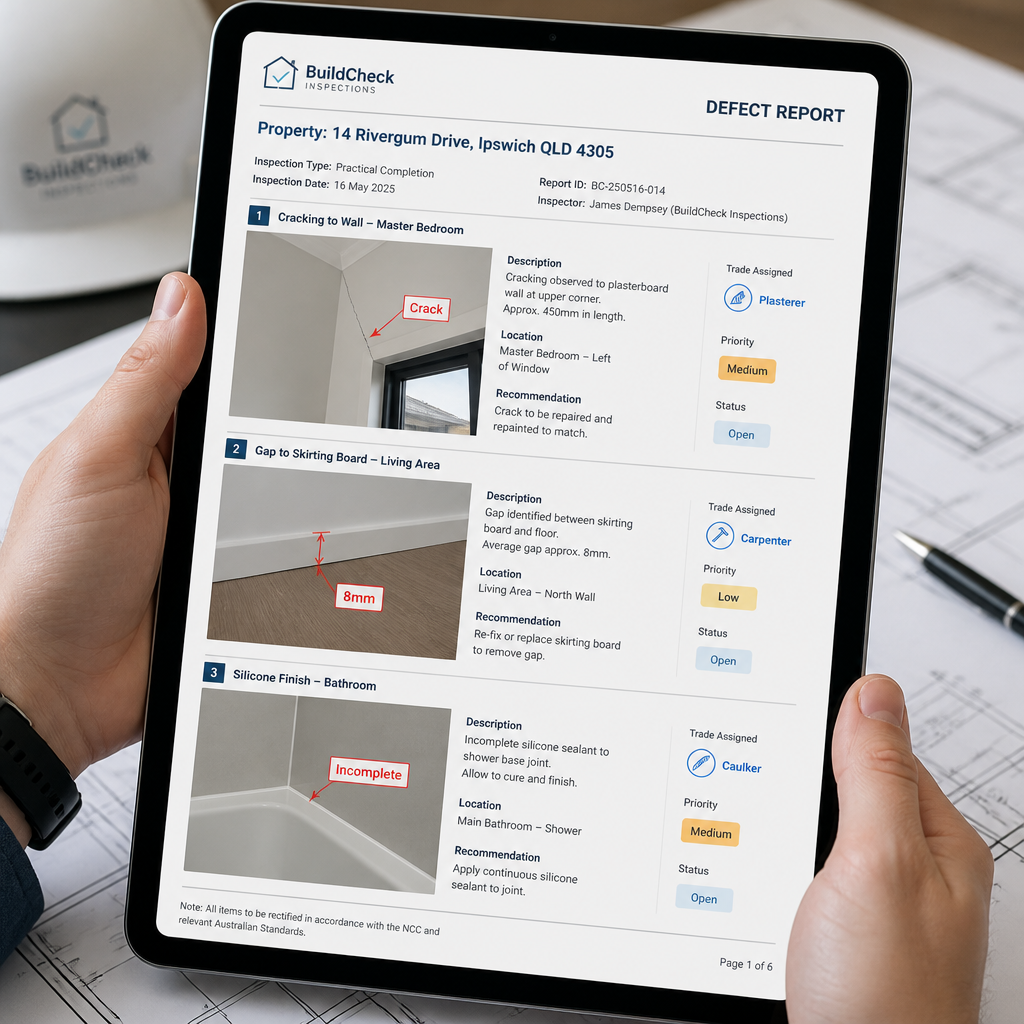
The report is not incidental to the inspection. It is the product. A report that describes defects in plain text without photos is difficult for builders and subcontractors to act on and easy to dispute. The standard that actually drives rectification is a photo-enhanced report that documents each defect with images, references the applicable standard where relevant, and assigns the item to the trade responsible. This is the format GoInspect produces for every inspection across Ipswich, Brisbane, Gold Coast, Logan, and Redland Bay.
Turnaround time
Handover timelines in Ipswich are often compressed. Builders notify buyers of practical completion with a short window to accept. A same-day report gives you documented evidence to work with before the builder expects a response, rather than scrambling to gather information days later when momentum has already moved toward sign-off.
Familiarity with the local market
An inspector who regularly works in Springfield Lakes, Ripley, Redbank Plains, White Rock, and Deebing Heights knows which defect types appear on which estate types, which builder’s trades tend to produce which issues, and what the local building conditions require in terms of slab preparation, drainage, and external finishes. That context makes the inspection faster and the report more specific.
Pro tip: GoInspect’s Ipswich pre-handover inspection service starts from $550 including GST, which covers the full inspection and a same-day photo-enhanced defect report with trade-specific responsibility assignments. This is a fixed, upfront price. You should be cautious of services that quote low and charge separately for the report or for additional defect categories identified on site.
What Happens After Defects Are Documented
A well-structured inspection report is the beginning of a process, not the end of one. Here is how that process works in practice when the inspection is done properly.
The buyer receives the same-day report and reviews it before responding to the builder’s handover request. Items are categorised by trade, so the builder’s site supervisor can distribute the action list immediately to the relevant subcontractors rather than managing a single undifferentiated complaint. Each defect is documented with a photo, so there is no scope for the builder to claim an item was not present or was within tolerance if it clearly was not.
The builder then has the opportunity to rectify the listed items before a second walkthrough. In most cases, builders do act on clearly documented pre-handover defect reports, particularly when the items are specific, photographed, and assigned to trades. The documentation also protects the buyer if a builder disputes any item, because the report creates a timestamped record of the property’s condition before handover was accepted.
For investors and developers managing multiple handovers across a stage, GoInspect’s builder and developer service provides trade-specific reports designed to streamline the rectification process across multiple dwellings simultaneously. The same reporting framework that works for a single homeowner scales efficiently to high-rise and estate-wide applications.
If defects are identified after handover that were not in the pre-handover report, the buyer can still pursue remedies through the builder’s statutory defect liability period and, where necessary, through the QBCC’s Direction to Rectify process. But the practical position is always stronger when defects are documented before handover rather than after. Post-handover disputes are slower, more expensive, and more contested than pre-handover rectification requests backed by a clear report.
Frequently Asked Questions
When should I book a new home inspection in Ipswich?
Book as soon as your builder notifies you that the home has reached practical completion. Do not wait until the builder sets the handover appointment date. Inspectors in the Ipswich area can be in high demand during peak completion periods, particularly on large estates where multiple dwellings are being handed over in the same week. Booking early ensures you have your independent inspection completed before you are under pressure to sign off.
Does a new home in Ipswich come with any warranty protection?
Yes. Residential construction in Queensland is covered by the Queensland Home Warranty Scheme, administered by the QBCC. This provides insurance cover for defects that arise after handover in circumstances where the builder is unable or unwilling to rectify. However, the scheme has specific eligibility conditions and claim processes. It is not a substitute for catching and documenting defects before handover. Post-handover warranty claims take time and create disputes that are far more disruptive than pre-handover rectification.
Is an independent building inspection Ipswich Queensland legally required before handover?
No, it is not legally required. But Queensland building contracts give buyers the right to have an independent inspection carried out before accepting handover. Exercising that right is strongly advisable given the volume of construction activity and the documented pattern of defects found at practical completion in Ipswich’s growth suburbs. The absence of a legal requirement does not make the inspection optional if your goal is to protect your investment.
Can I attend the inspection myself?
Yes, and it is generally useful to do so. Attending the inspection allows you to ask the inspector questions directly as they work through the property, and it gives you a clearer understanding of each item in the report before you engage with your builder. Some buyers find it more practical to receive the report and review it before any conversation with the builder. Either approach works. What matters most is that the inspection is carried out by a qualified, independent inspector before you accept the keys.
What if my builder says the defects I found are within acceptable tolerances?
This is a common response, and it is sometimes legitimate. Australian Standards set specific tolerances for items like wall plumb, paint finish, tile grout width, and crack widths in render. A qualified inspector’s report will reference the applicable standard for each item, which removes any ambiguity about whether the builder’s tolerance claim is accurate. When a builder says an item is within tolerance but the report references the standard that proves otherwise, the documentary record favours the buyer. This is exactly why the report format matters as much as the inspection itself.
How long does a pre-handover inspection take in Ipswich?
For a standard single-dwelling new home in Ipswich, expect the inspection to take between two and three hours depending on the size of the home, the number of wet areas, and the complexity of the roofline. Larger homes with multiple bathrooms, ensuites, and complex external cladding will take longer. The same-day report turnaround means the additional time spent on a thorough inspection does not delay your response to the builder.
Does GoInspect service all of the Ipswich growth suburbs?
Yes. GoInspect’s licensed inspectors service the full Ipswich corridor, including Springfield Lakes, Ripley, Redbank Plains, White Rock, Deebing Heights, Spring Mountain, Camira, Collingwood Park, and surrounding estates. The same fixed-price, same-day reporting service available in Brisbane and the Gold Coast applies across Ipswich, with no additional travel charges for the Ipswich region.
If you are currently navigating a handover in Ipswich or approaching practical completion on a new build, we would be glad to hear about your experience and any specific concerns you encountered at this stage.
We would love your feedback and any insights you would share with others. What perspective would you add?
References
- Ipswich housing boom: 2025-26 lot and dwelling creation figures and fastest-growing suburbs
- Ipswich City Plan 2025: Council plan for 100,000 new homes over 20 years
- QBCC Direction to Rectify: How the Queensland Building and Construction Commission handles defective building work
- QBCC defective work resolution process for Queensland homeowners
- Ipswich City Council: New residents and new dwellings data showing scale of residential growth