

Roofing defects in new Queensland homes are rarely dramatic, which is exactly why they get missed. A new roof looks finished from the street, so most owners assume the hard part was done by the builder. Our inspectors see the gap every week across Brisbane, the Gold Coast, Logan, Ipswich and Redland Bay. Some defects are cosmetic, but others are water paths that only show up after the first heavy storm. This guide covers the roof defects inspectors find most often, why they matter for your warranty and your long-term costs, and how to get them recorded and fixed before settlement.
Table of Contents
- Quick Takeaways
- Where Roofing Defects Start
- Tiles, Sheeting and Fixings
- Flashings, Valleys and Penetrations
- Ponding Water and Drainage Failures
- Hidden Leaks: Ceilings, Insulation and Underlay
- What Queensland Defective Work Means for Your Roof
- Timing Your Roof Inspections on a New Build
- Frequently Asked Questions
- References
Quick Takeaways
| Key Insight | Explanation |
|---|---|
| Check flashings before the ceiling goes in | Once plasterboard is fixed, a poorly sealed valley or pipe penetration is out of sight and usually out of reach. |
| Ponding water is a defect, not a quirk | Water that stays on a roof section after the rain has stopped points to wrong fall, sagging sheeting or a blocked outlet. |
| Ask which trade is responsible | A report that names the responsible trade speeds up rectification and stops the builder and subcontractors passing the job between them. |
| Late spring and summer storms are the real test | A new roof often gets its first hard rain and wind in its first wet season, so drainage and flashings should be checked before then. |
| A ceiling stain is a late signal | By the time a stain shows, water has usually travelled along a batten or through insulation, so the roof itself needs inspecting. |
| Log structural and non-structural defects separately | Different defect types carry different warranty consequences, so record each one with photos, location and date. |
Where Roofing Defects Start
Roofing defects in new homes are rarely the result of one bad decision. They build up across a chain of trades, from frame and truss installers to sheeters, tilers, plumbers and the people who fit flashings and gutters. Each trade has its own tolerances, and each handover between them is a point where something gets missed.

In practice, the frame stage is where many problems begin. Trusses and battens set out of line make every later trade work harder, and sheeting or tiles laid over an uneven base rarely sit flat. A roof can look tidy from the footpath and still show waviness along the eaves when you sight down the edge in good light.
Frame and batten alignment before the sheeting goes on
Alignment problems are cheap to fix at frame stage and expensive afterwards. Once sheets are fixed, correcting a bowed batten means lifting material, which damages what was already done. Ask the builder whether the frame was checked before roofing started, and if it was, ask for that check to be recorded.
Trade sequencing and afterthought penetrations
The second risk is sequencing. Roofing often finishes before plumbers, electricians or insulation installers have completed their work, which means holes are cut through sheeting after the fact. Afterthought penetrations are often patched in a hurry, and a hurried patch is where a dry roof starts leaking.
A common mistake is to treat the roof as finished because the crew has left the site. The real test is whether every penetration, junction and edge was completed by the trade that should have done it, and whether anybody checked.
Tiles, Sheeting and Fixings
The visible surface of the roof is where you can judge workmanship without tools. Tiles or sheets should run straight, overlap correctly and sit flat without rocking underfoot. Once you know what good looks like, a poor install stands out quickly.
Fixings are the next layer. Missing or misplaced fasteners, screws driven too tight that crack sheets, and mixed metals that set up corrosion are all defects we see in new work. Some of these are invisible from ground level, which is why a walk around the outside of the house is never enough on its own.
Fixing and fastener defects
Fasteners that are missing, under-driven or over-driven can allow sheets to lift in wind or split around the screw. In Brisbane, Logan and Ipswich, where summer storms bring fast-moving, wind-driven rain, a loose sheet is not a cosmetic problem. Ask for the fixing specification from the builder and check a sample of sheets against it.
Surface damage, cracked tiles and displaced granules
Tiles get cracked during handling or when a worker steps on them, and sheeting picks up scratches that can become rust points over time. Where a roof has granule or aggregate surfacing, losing that surface layer is a recognised defect. Tremco’s blog on common roofing defects lists displaced aggregate and granule loss among the recurring problems in roofing generally, and handling damage can produce the same result from the first day on site.
Pro tip: Photograph every sheet or tile defect with a reference object, such as a tape measure, so the rectification contractor can find the exact spot without guessing.
Flashings, Valleys and Penetrations
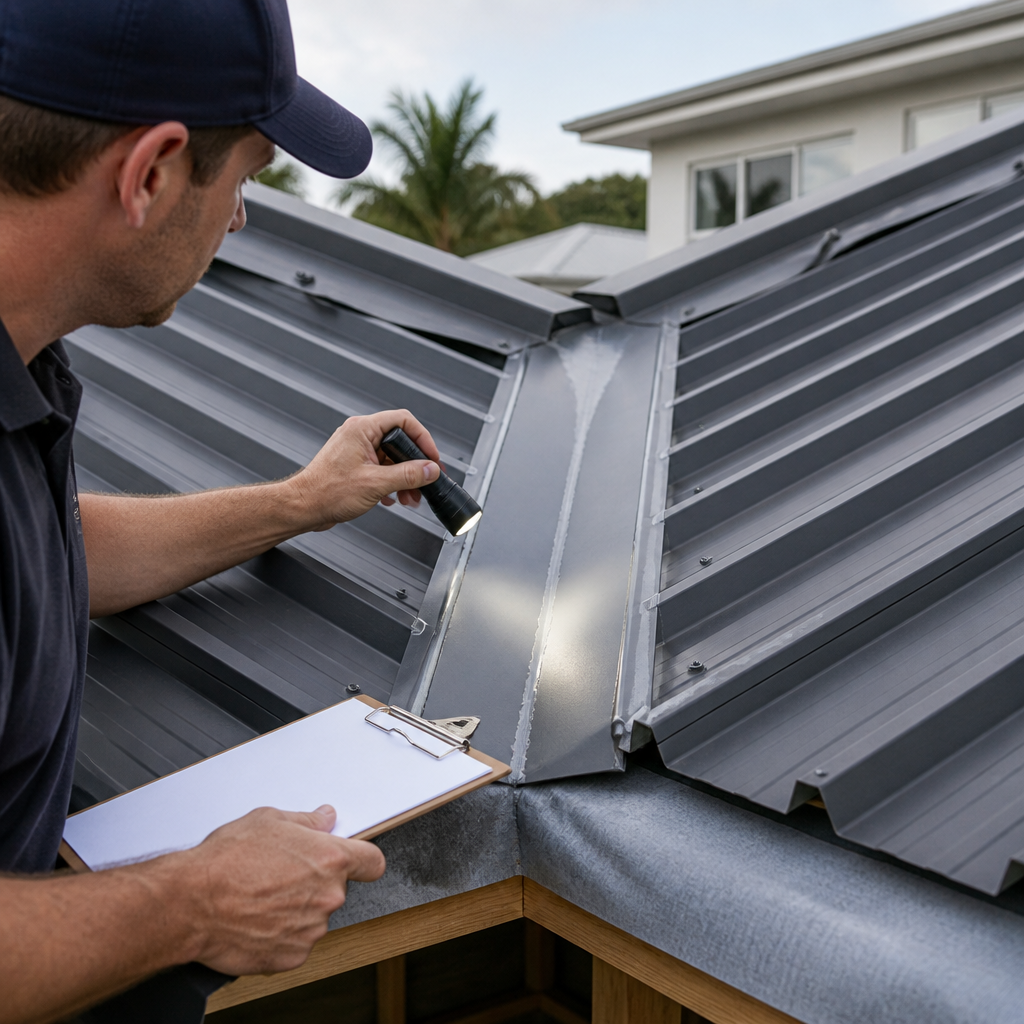
Flashings are the metal pieces that seal junctions where the roof meets walls, chimneys, skylights, pipes and valleys. They do most of the work of keeping water out, and they are also where we find the most serious defects in new homes. A flashing that is missing, bent or set too low will carry water into the structure even when the sheeting itself is perfect.
Valleys deserve particular attention because they collect water from two roof planes at once. The valley needs enough width and fall to carry peak flow, and the sheeting either side must be cut and folded cleanly. A valley that is narrowed, kinked or partly blocked by debris will overflow during the first heavy downpour.
Valleys and gutter junctions
Watch for valleys where the metal is overlapped rather than continuous, and for box gutters where the lining is joined with visible gaps. Gutter junctions with roof sheets should have the sheet edge tucked properly under the gutter lip rather than sitting on top of it. A defect here usually shows up as staining on the fascia or ceiling near the corner of the house.
Pipes, vents and skylights
Pipe penetrations are often sealed with a flexible collar that is not properly tucked under the sheeting above it. Skylight kits should be installed to the manufacturer’s instructions, with flashing on all four sides and upslope flashing that directs water away from the frame. In our experience, skylight leaks in new homes more often trace back to installation than to the product itself.
Ask the builder which flashing was fitted at each penetration, and check it. A flashing that looks neat from ground level may still have been fitted without the lap it needs.
Ponding Water and Drainage Failures
Ponding water is one of the defects we treat most seriously, because it is easy to dismiss as a minor cosmetic issue. Water that sits on a low section after rain is a sign that the fall is wrong, the sheeting is sagging or the gutter is set too flat. Tremco’s guidance on common roofing defects also lists standing or ponding water as a recurring problem, and it matches what we see on site.
A common mistake is to assume the problem will settle once the house is lived in. It will not. Standing water adds load, speeds up corrosion at fixings and pushes water under laps that were never designed to be submerged.
Gutter fall and downpipe capacity
Gutters need a consistent fall toward the downpipes, and a level run will hold water at the low point until it overflows. Downpipes that are undersized for the catchment, or that sit too far from the outlet, can clog and back up. Check gutters after rain, not just on a dry day, because the defect only shows when water is moving.
Flat sections and low points
Verandas, skillion sections and small flat areas are where ponding tends to hide. Look for a dark or discoloured band along the sheeting and debris lines that mark where water stopped. A low point that holds a puddle long after the rain has stopped is a defect to record, not a feature to accept.
Water finds the weakest seam in a roof, and a defect that holds water on handover is usually the one that leaks in the first long wet season.
Pro tip: Inspect gutters and downpipes within a day or two of heavy rain, while water is still visible in the system. That is the fastest way to confirm whether the fall and outlets are doing their job.
Hidden Leaks: Ceilings, Insulation and Underlay
Some of the most expensive roofing defects never show on the outside of the house. Water that gets past the sheeting or flashing can run along battens, soak into insulation and stain the ceiling far from the original entry point. By the time a stain appears, the damage has usually spread.
That is why we do not rely on an exterior check alone. Inside the roof space, the underside of the sheeting, the underlay and the insulation tell you whether water has been getting in. New roof spaces are usually clean and dry, so any water mark or dark staining is easier to spot before the owner moves in.
Stains that appear after the first storm
A ceiling stain that appears after the first big storm is a late signal of an earlier defect. Trace it upslope to the nearest junction, penetration or valley, and check the roof space above that point. Photograph the stain, note the date and the rainfall that preceded it, and keep the record with your defect report.
Underlay damage and compressed insulation
Roof underlay can be torn, puckered or punctured during fixing, and the damage is often hidden under battens. Insulation that has got wet loses its performance and can hold moisture against the frame long after the roof has dried. A roof space that smells damp or shows dark timber is a defect that needs investigating, not just ventilating.
Ask whether the underlay was installed with the correct overlap and whether anyone checked it before the battens went on. Once the ceiling is up, that answer is much harder to find.
What Queensland Defective Work Means for Your Roof
The Queensland Building and Construction Commission describes defective work as faulty or unsatisfactory building work that may arise during or after the completion of a building project. That definition matters because it covers more than the day you take the keys. A roof that leaks in its first wet season can still fall under it, even if the builder considers the job finished.
Defective work versus normal settling and wear
Not every mark on a new roof is a defect. Minor timber movement, a light layer of construction dust and a scuff left by a tradie are normal on a new build. A defect is something that does not meet the contract, the relevant building requirements or the manufacturer’s installation instructions, and that affects performance, safety or appearance in a way you did not agree to accept.
Writing up roof defects so they can be enforced
A defect entry that says “roof leaking” gives the builder room to argue. A useful entry names the location, describes the defect, photographs it with a reference point and states which trade is responsible. Send it to the builder in writing and keep a copy, because a conversation on the driveway is hard to rely on later.
Timing matters too. Queensland’s home warranty framework applies different time limits to structural and non-structural defects, so check the current QBCC guidance and your contract dates early rather than when a leak appears. If a builder does not respond, the QBCC defective work dispute process is the next step to understand.
Timing Your Roof Inspections on a New Build
The best time to inspect a roof is before anything covers the defects. That means before plasterboard goes up, before insulation is installed in the roof space and before the final clean hides the evidence. Most owners only get one real pass at handover, so timing is part of the inspection itself.

Before plasterboard and insulation
This is the stage where flashings, underlay and penetrations are still visible. If you can arrange a check with the builder’s site supervisor, ask for the roof space to be inspected while the ceiling is still open. Defects found here are generally quicker and cheaper to correct than those found after the ceiling is closed in.
Practical completion and handover
Practical completion is the point where most roofing defects should be listed and rectified, so a full roof inspection at this stage is the one most owners rely on. GoInspect provides same-day, photo-enhanced defect reports that assign each defect to a specific trade, starting from $550 including GST. That turns a vague list into a rectification plan the builder can act on.
Comparing approaches helps you decide where to spend your effort. The table below sets out three common options and what each one can and cannot catch.
| Inspection Approach | What It Catches | Main Limitation |
|---|---|---|
| Builder’s own final walk-through | Obvious finish issues and items the builder already knows about | The builder is checking its own work, and roof access is often limited |
| Pre-plasterboard roof inspection | Flashing, underlay, fixing and penetration errors while they are still visible | Only covers the stage it is done at, so later work needs a second check |
| Pre-handover roof inspection with photo defect report | Surface, flashing, drainage and fixing defects, with responsibility assigned by trade | Does not replace a check after the first heavy storm |
Pro tip: Book a post-storm check into your first month of ownership, and compare what you find against the handover report. Any new water mark tells you which defects were missed or were not yet visible at handover.
Frequently Asked Questions
Can I check the roof of a new home myself?
You can look at the roof from the ground and check gutters, downpipes and visible flashings for obvious gaps. A full assessment needs safe access, good light and someone who knows what a correct install looks like. Walking on a new roof also risks damaging sheets and tiles, so leave the close inspection to a qualified inspector.
When should a roof be inspected on a new build?
Ideally, inspect the roof twice: once before plasterboard and insulation go in, and again at practical completion or handover. A third check after the first heavy storm will catch anything that only appears under sustained rain.
Are roofing defects covered by the builder’s warranty?
Defective work is generally the builder’s responsibility, but how a claim is handled depends on the type of defect, the timing and your contract. Put every defect in writing with photos and dates, and check the current QBCC guidance on time limits before you rely on any specific period.
Is ponding water always a defect?
Water that drains away shortly after heavy rain may be acceptable on some low-slope sections, but a puddle that stays after the rain has stopped is a defect. It usually points to incorrect fall, sagging sheeting or a blocked outlet, and each of those needs to be fixed rather than monitored.
What should a roof defect report include?
A useful report includes the location of each defect, a clear photo with a reference point, a description of what is wrong, the responsible trade and a suggested fix. It should also be dated and state how the roof was inspected, such as whether it was accessed directly or viewed from the ground.
Do roofing defects affect resale value?
Yes, if they are left unresolved. A roof with active leaks or visible ponding will be flagged by a buyer’s inspector, and that reduces your room to negotiate. Resolving the defects and keeping the rectification records is the simplest way to protect the value of the property.
Have you found a roofing defect in a new home you bought or built, and how did the builder respond? Share your experience with us so other owners can learn from it.