
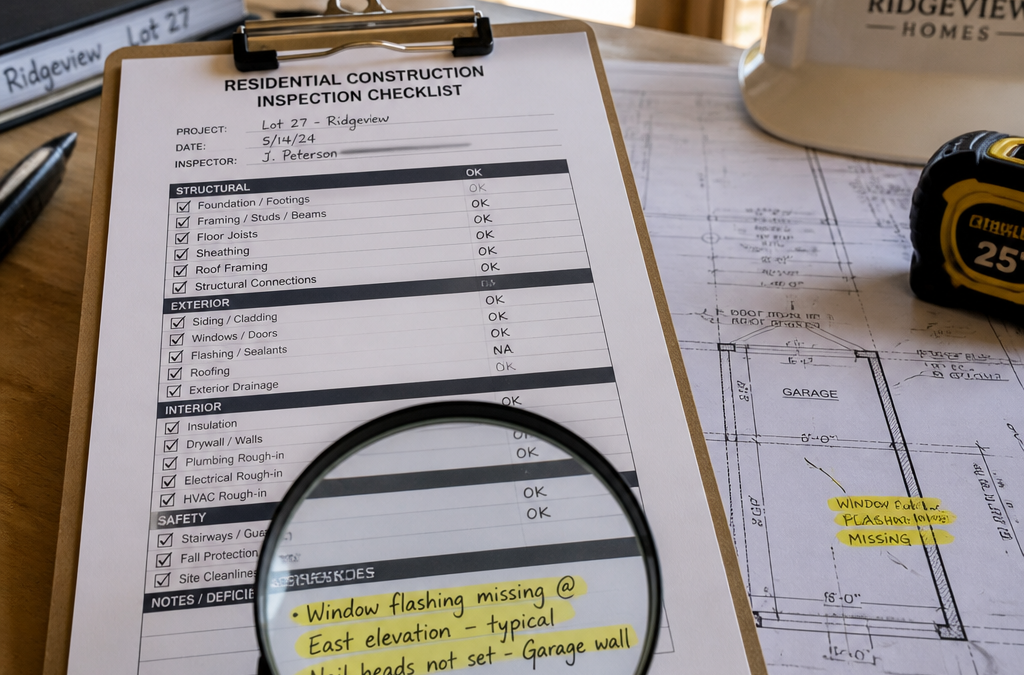
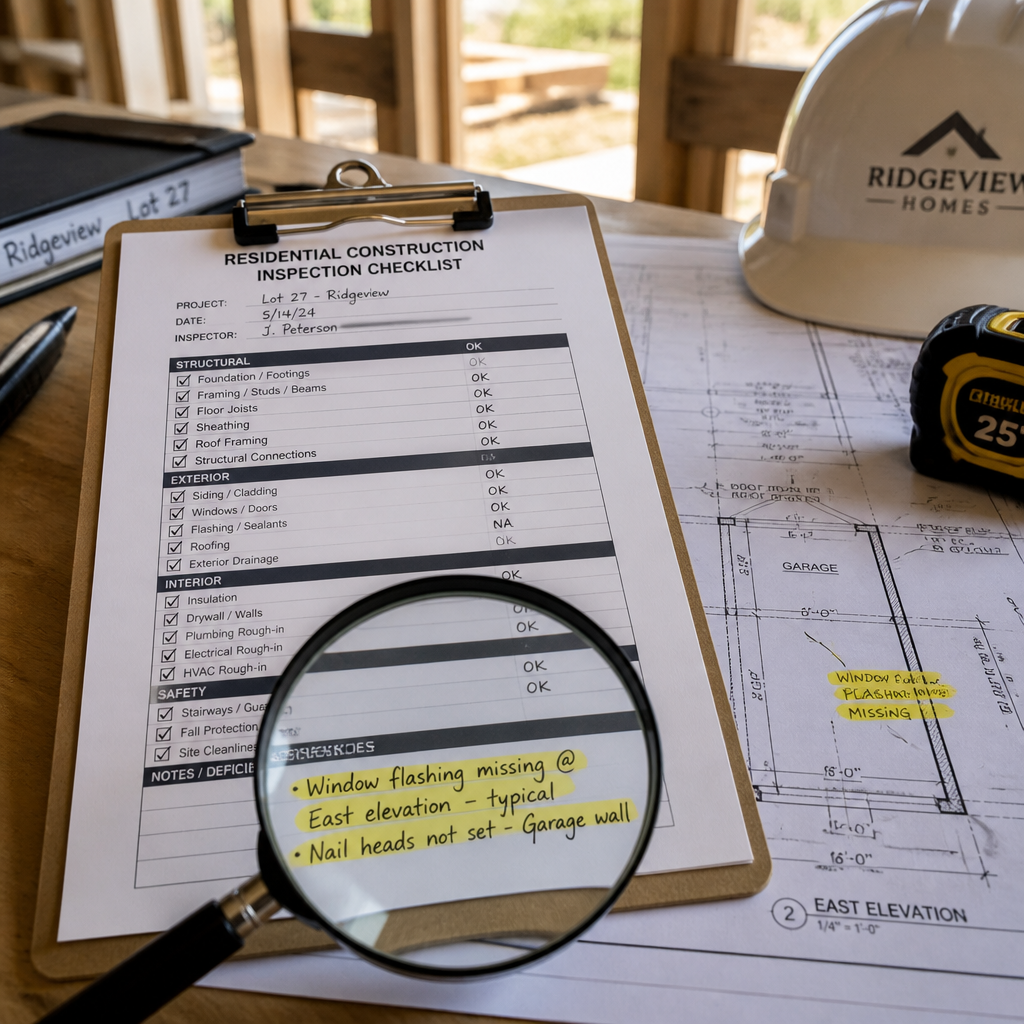
Most new homeowners walk into their practical completion inspection expecting a formality. They leave with a report containing between 20 and 40 documented defects. That gap between expectation and reality is not unusual across South East Queensland, where volume construction, stretched site supervision, and rapid handover schedules consistently produce the same categories of issues, property after property, suburb after suburb. Knowing what to expect before you walk through that door is the difference between signing off on problems you will live with for years and holding your builder accountable before you hand over the final payment.
Table of Contents
- What Is a Practical Completion Inspection in Queensland?
- Quick Takeaways
- Defect 1: Waterproofing Failures in Wet Areas
- Defect 2: Poor Paint Finish and Surface Preparation
- Defect 3: Plasterboard Cracking and Hollow Sections
- Defect 4: Tiling Defects: Lippage, Grout, and Fall
- Defect 5: Roofing and Roof Space Issues
- Defect 6: Drainage and Stormwater Problems
- Defect 7: Door and Window Alignment and Sealing
- Defect 8: Cabinetry and Joinery Faults
- Defect 9: Render Cracking and Delamination
- Defect 10: Plumbing Fixture Leaks and Incorrect Drainage Fall
- How a Building Defect Report Protects You Legally
- PCI Approaches Compared
- Frequently Asked Questions
- References
What Is a Practical Completion Inspection in Queensland?
A practical completion inspection (PCI) is the formal final inspection of a new home carried out when the builder advises that construction is substantially finished. In Queensland, this inspection stage is recognised by the QBCC as the point at which the owner and builder walk through the property together to identify defects, incomplete work, or items not built to specification. Everything found is documented in a defects list that is typically signed by both parties.
The QBCC confirms that you can engage an independent building inspector to carry out this inspection on your behalf, at your own cost. That distinction matters enormously, because a builder-led walkthrough and a licensed inspector’s systematic assessment produce very different outcomes. Builders have every commercial incentive to minimise what goes on the list. An independent inspector has only one job: find everything that needs fixing before you accept the keys.
In Queensland, the statutory warranty scheme provides coverage for structural defects for 6 years and 6 months, and for non-structural defects for 12 months from practical completion. Property owners must notify the contractor of any defects within 12 months of noticing them. Documenting defects at the PCI stage creates the paper trail that underpins any warranty or QBCC complaint later.
Quick Takeaways
| Key Insight | Explanation |
|---|---|
| Waterproofing is the highest-risk defect category | Wet area waterproofing failures may not cause visible damage until years after handover, by which point remediation costs can be significant. Finding them at PCI stage keeps the builder responsible. |
| Paint defects are the most frequently found | Poor coverage, roller lines, and paint on fixtures appear in virtually every new home inspection across Brisbane, Gold Coast, Logan, and Ipswich. They are quick to fix but easy to miss in a casual walkthrough. |
| The defects list is a legal document | A signed defects list at PCI forms the basis of any subsequent QBCC complaint or warranty claim. Verbal agreements made during the walkthrough carry no weight. |
| Independent inspectors find significantly more defects | Independent inspections across South East Queensland consistently find 20 to 40 defects in new builds. A builder-led walkthrough rarely surfaces the same volume of issues. |
| Trade-specific assignment speeds up rectification | A quality building defect report assigns each defect to the responsible trade, so the builder knows exactly which subcontractor needs to return. This cuts delays in the rectification process. |
| Queensland’s climate creates specific defect risks | High humidity, heavy rainfall, and cyclone wind regions mean roofing, drainage, waterproofing, and render are more failure-prone here than in southern states. |
| Signing off without a professional PCI is a financial risk | Once you have accepted practical completion, your ability to withhold final payment is gone. Defects found after that point require negotiation, warranty claims, or QBCC involvement to rectify. |
Defect 1: Waterproofing Failures in Wet Areas
Waterproofing is, without question, the defect category that carries the greatest long-term financial risk. Failures in shower recesses, bathrooms, and balconies can remain completely invisible at handover and only present as water damage months or years later. By that point, remediation typically requires removing tiles, membrane replacement, and retiling, which is an expensive and disruptive process in an occupied home.
In South East Queensland new builds, the most common waterproofing defects found during a practical completion inspection include: membrane not extended to the required height on wet area walls, silicone joints that have not been applied or have been applied over painted surfaces (preventing adhesion), and incorrect falls in shower bases that pool water rather than direct it to the waste. On Gold Coast properties with balconies and elevated decks, balcony waterproofing that does not return correctly at penetrations is a consistent finding.
Pro tip: Ask your inspector to specifically test shower recesses and balcony membranes for continuity and correct installation height. This single check has more long-term financial impact than any other item on the PCI checklist.
Defect 2: Poor Paint Finish and Surface Preparation
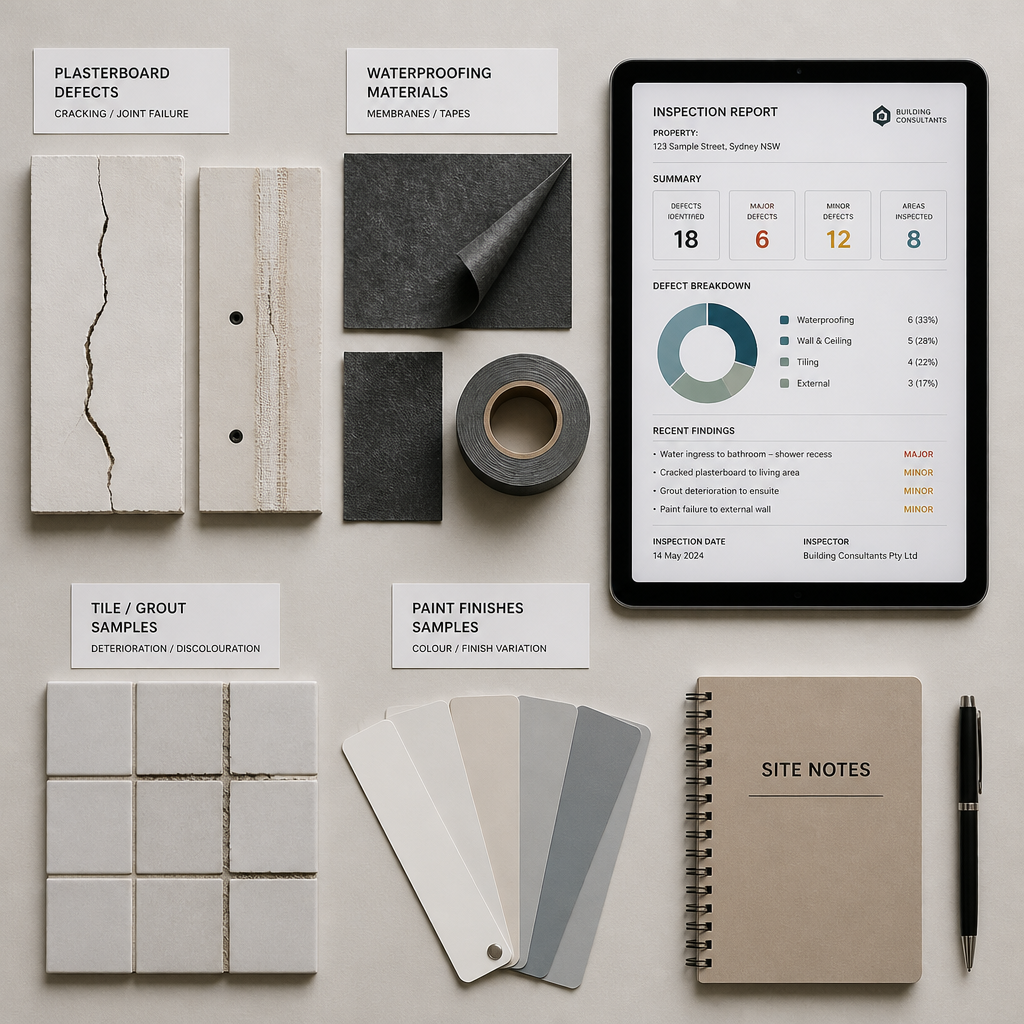
Poor paint finish is the most frequently documented defect in new home inspections across South East Queensland. It tops the list in Brisbane, Gold Coast, Logan, and Ipswich builds consistently. The defects are rarely dramatic individually, but they accumulate: patchy coverage across walls and ceilings, visible roller lines especially in raking light, paint applied over filler that has not been properly sanded, paint on light switches, door hinges, and window frames, and entire sections left unpainted behind doors or inside cupboards.
The reason this defect appears so frequently is structural: painting crews in volume construction environments work quickly across multiple properties simultaneously. Quality control at the site level is inconsistent, and a final check before handover is often rushed. The defects are easily fixed when documented at PCI, but become cosmetic issues you own once you have accepted the property.
What a Paint Defect Assessment Covers at Handover
A thorough PCI paint assessment checks coverage uniformity, surface preparation quality, paint on non-painted surfaces, finish consistency between rooms, colour match against the contract schedule, and whether all areas specified in the contract have been completed. An inspector using raking-angle torchlight will surface defects that a natural-light walkthrough simply cannot detect.
Defect 3: Plasterboard Cracking and Hollow Sections
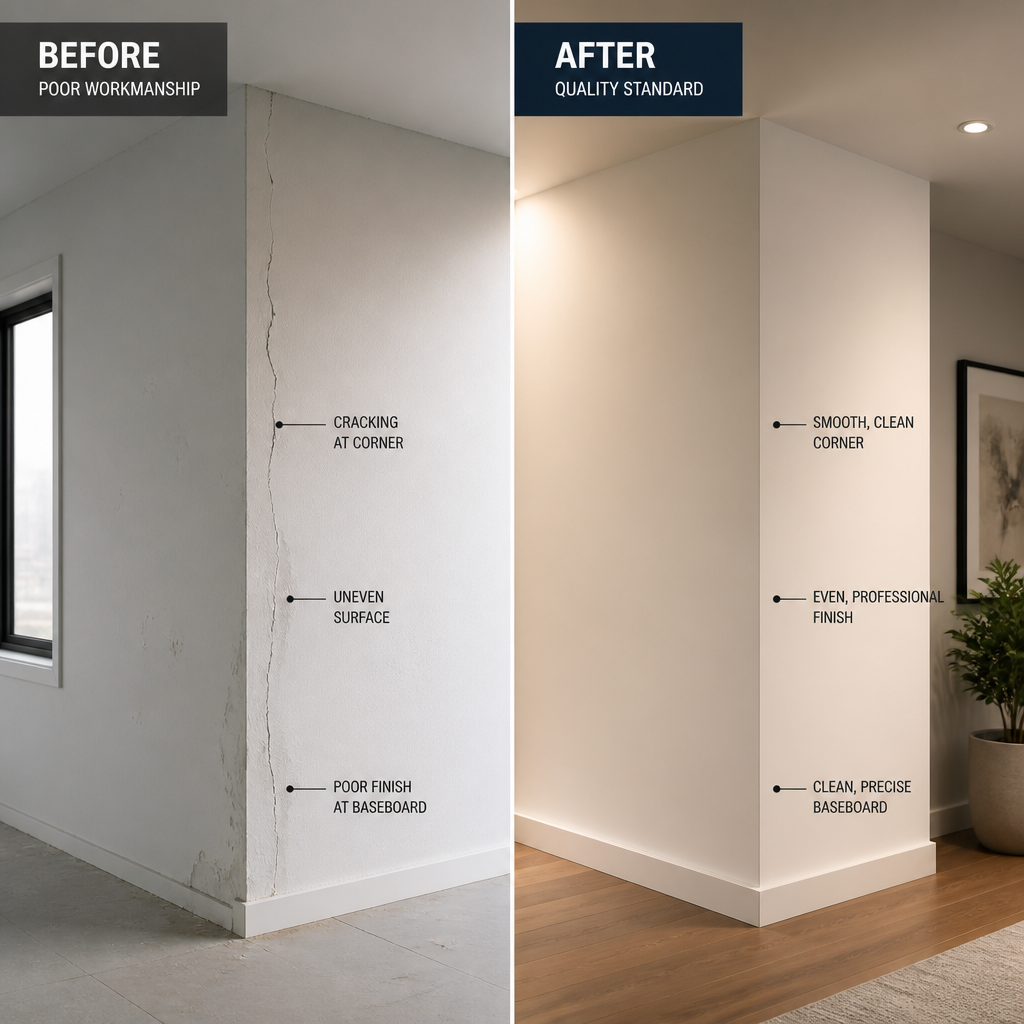
Plasterwork defects are a reliable feature of volume construction. Cracking at cornice joins, at sheet joins, and around door frames appears regularly in new Brisbane and Ipswich homes. Hollow sections, where the plasterboard has not bonded properly to the frame or where filler has been used over gaps rather than proper fixing, are also common and can be identified by a simple tap test during inspection.
In Queensland’s climate, thermal movement in timber framing is a contributing factor. Homes built quickly and handed over before the structure has had time to settle will sometimes show cracking that worsens in the first wet season. Documenting it at PCI stage, even if it appears minor, creates a record. If it deteriorates within the 12-month statutory warranty period, the builder is clearly on notice.
Defects in new residential construction are not rare events. Research by the Australian Building Codes Board has found that a significant proportion of new homes have at least one reportable defect at the time of practical completion.
Defect 4: Tiling Defects: Lippage, Grout, and Fall
Tiling defects appear in almost every new home inspection report across South East Queensland. The most common are lippage (where adjacent tile edges are not level, creating a trip hazard and an aesthetically unacceptable finish), missing or inconsistent grout, cracked tiles from point loading during installation, and incorrect fall in shower floors and wet areas.
Incorrect fall is the most structurally significant of these. A shower floor that does not slope adequately toward the waste will pool water constantly. That standing water, over time, tests every silicone joint and grout line, and eventually finds its way through to the substrate below the waterproofing membrane. What looks like a minor tiling issue at handover can become a waterproofing failure within two to three years.
Pro tip: Bring a small spirit level to your PCI walkthrough, or confirm your inspector will test wet area falls. Tiling contractors frequently dismiss this as a minor item, but the fall specification is a National Construction Code requirement, not a preference.
Defect 5: Roofing and Roof Space Issues
Roofing defects in SEQ new builds cover both the external roof surface and the roof space. Externally, common findings include inadequate tile bedding and pointing, damaged or cracked roof tiles, poorly seated ridge caps, and incorrect flashing around penetrations such as skylights, exhaust fans, and solar conduits. On metal roofing, screw fixings that are overtightened and breach the sealing washer are a regular finding that creates an immediate leak path.
Inside the roof space, inspectors check insulation installation quality, sarking placement, tie-down connections, and whether all penetrations are correctly flashed and sealed. Insulation batts that are compressed against the roof sarking, missing, or installed without the required air gap create ongoing thermal performance issues. In Brisbane and Gold Coast homes, where summer heat is significant, this has real comfort and energy cost implications from day one.
Wind Region Compliance on the Gold Coast
Gold Coast and coastal SEQ properties built in higher wind regions under the National Construction Code face specific cyclone tie and bracing requirements. An inspector checking roofing on these properties should assess cyclone tie compliance as part of the structural assessment, not just the cosmetic condition of the roof surface.
Defect 6: Drainage and Stormwater Problems
South East Queensland receives significant rainfall, and drainage is one of the areas where a poorly supervised build causes the fastest and most expensive post-settlement damage. Common drainage defects found at practical completion inspections include stormwater outlets not connected or incorrectly graded, surface drainage that directs water toward the house rather than away from it, downpipes that discharge onto the slab edge rather than into the stormwater system, and incomplete landscaping or drainage works that were listed in the contract but not delivered at handover.
In Logan and Ipswich, where housing estates often involve significant cut-and-fill earthworks, site drainage is particularly important and particularly prone to being incomplete at handover. Defects in this area are not cosmetic. Water pooling near a slab edge in Queensland’s climate is a direct threat to the slab itself and to subfloor ventilation.
Defect 7: Door and Window Alignment and Sealing
Doors and windows that do not sit square in their frames, do not latch properly, or do not seal correctly against weather are among the most visible and frequently complained-about defects in new homes. In practice, misalignment is often traced back to the frame stage: if wall frames are not set square and plumb before lining, every door and window fitted to them will be slightly out. By handover, the structural opportunity to fix the underlying cause properly has already passed.
The practical finding at a PCI is doors that bind or swing open or closed by themselves, windows that cannot be fully closed or that have visible daylight gaps around the frame, and sliding door tracks that are not level. Weather sealing failures on windows in Queensland’s climate have direct implications for both water ingress and energy efficiency. A gap in a window seal that appears trivial in a dry month can allow significant water entry during a heavy summer storm.
Defect 8: Cabinetry and Joinery Faults
Cabinetry and joinery defects are consistently found across all new home types in SEQ, from entry-level house-and-land packages to mid-range custom builds. The typical findings at handover include doors that do not sit level or hang square, handles and hinges that are misaligned or loose, drawers that stick or do not close flush, shelving that is not secured correctly, and kickboards that are not fitted or are fitted with visible gaps. Bench tops are checked for chips, scratches, and joins that do not align properly.
These defects are overwhelmingly the result of rushed installation rather than material failure. Joinery contractors working across multiple sites under time pressure frequently skip final adjustments and rely on the owner not noticing at handover. A systematic check with doors and drawers opened and closed in sequence takes only minutes but catches items that a casual walk-through misses entirely.
Defect 9: Render Cracking and Delamination
Rendered external walls are a dominant aesthetic feature of new homes across the Gold Coast, Brisbane, and Logan growth corridors. Render cracking and delamination are among the most frequently cited defects in the Gold Coast specifically, where large render-finished homes are standard. Hairline cracking at control joints, at internal corners, and around window reveals is common in new render and some degree of shrinkage cracking is expected and manageable. The concern at PCI is render that has delaminated from the substrate, render applied over damp or inadequately prepared masonry, or render finishes that do not match the specified texture across the elevation.
Delaminated render is not cosmetic. Once the bond between render and substrate breaks, water gets behind the coating. In Queensland’s climate, that moisture path leads to efflorescence, staining, and eventually to masonry damage that requires full-face remediation. Catching render delamination at practical completion, when the builder is still on site and still accountable, is far less disruptive than pursuing a warranty claim 18 months later.
Defect 10: Plumbing Fixture Leaks and Incorrect Drainage Fall
Plumbing defects at practical completion inspections fall into two categories: visible and immediately testable, and concealed. Visible defects include leaking taps, showerheads, and toilet cisterns, pipe connections under vanities that weep, and hot water systems with fittings that have not been correctly tightened. These are straightforward to identify and straightforward for the builder to rectify.
Concealed plumbing issues, particularly incorrect drainage fall in waste pipes within wall or floor cavities, are more difficult to assess visually and more consequential. Insufficient fall in a waste pipe results in slow drainage, blockages, and eventual backflow. These issues may not become apparent until the home is occupied and in regular use, at which point accessing the pipe for remediation can require opening finished wall linings or floors.
Why Same-Day Reporting Matters for Plumbing Defects
For plumbing defects specifically, the ability to receive a same-day written report with photographs documenting the leak or drainage issue is critical. A verbal note during a walkthrough that a tap was weeping is not enforceable. A photo-enhanced defect report delivered the same day creates an undeniable record that is difficult for a builder to dispute and straightforward for a plumbing subcontractor to act on.
How a Building Defect Report Protects You Legally
A building defect report produced by a licensed inspector is not simply a shopping list of things to fix. In the context of Queensland’s statutory warranty scheme and QBCC dispute resolution process, it is the foundation of your legal position. The QBCC can direct builders to rectify defective work, but without documented evidence from the time of practical completion, owners are frequently in a weaker position than they should be.
Queensland’s statutory warranty provides coverage for structural defects for 6 years and 6 months, and for non-structural defects for 12 months from practical completion. Property owners must notify the contractor of any defect within 12 months of noticing it. A comprehensive inspection report with photographs and trade-assigned responsibility gives you a timestamped record of what was identified, when, and by whom. That record is your starting point for every follow-up conversation with the builder, and your evidence base for any QBCC complaint.
GoInspect’s photo-enhanced reports go a step further by assigning each defect to the responsible trade, so the builder’s site supervisor can immediately identify which subcontractor needs to return. This does not just protect your legal position. It eliminates the delay and negotiation that typically occurs when a defect sits in a report with no clear trade ownership assigned.
PCI Approaches Compared
Not all practical completion inspections are conducted the same way, and the approach you choose has a direct impact on how many defects are identified, how quickly they are rectified, and how well you are protected if disputes arise.
| Approach | What It Covers | Key Limitation |
|---|---|---|
| Builder-led PCI walkthrough only | Visual walk-through with the site supervisor. Produces a builder-managed defects list. | Conflict of interest: the builder has commercial incentives to minimise the defects list. No independent verification. No photo-enhanced documentation. |
| Independent licensed inspector (checklist-based report) | Systematic independent inspection against NCC and Australian Standards. Written report provided. | Basic reports without photographs or trade assignment create rectification delays. Builder may dispute defects without photographic evidence. |
| Independent licensed inspector with photo-enhanced, trade-assigned report (GoInspect model) | Full structural, wet area, roofing, drainage, finishes, and services assessment. Same-day delivery. Each defect photographed and assigned to the responsible trade. | Higher upfront cost than a builder-led walkthrough only, but directly reduces the risk of post-settlement disputes and warranty claim complications. |
The comparison above is not theoretical. Builders across Brisbane, Gold Coast, Logan, Ipswich, and Redland Bay work with volume production schedules that prioritise speed. An independent photo-enhanced defect report gives both the homeowner and the builder a clear, actionable document that removes ambiguity about what needs fixing, who fixes it, and by when.
Frequently Asked Questions
What is the difference between a practical completion inspection and a pre-settlement inspection?
In Queensland, the terms are often used interchangeably because they describe the same inspection stage: the final check carried out before you accept handover and make the final payment to the builder. A practical completion inspection is the formal name under the building contract. Pre-settlement inspection is the term commonly used by homebuyers and investors who are more familiar with the property purchase process than the construction contract process. Both refer to the same event.
Can I bring my own inspector to a practical completion inspection in Queensland?
Yes. The QBCC confirms that owners can engage a building inspector to check building work on their behalf at the practical completion stage, at their own cost. You should advise your builder in advance that you will be bringing an independent inspector. Most reputable builders will accommodate this without issue. If access becomes a problem, consult your solicitor or conveyancer before proceeding.
How many defects should I expect to find in a new home inspection in South East Queensland?
Independent inspections across Brisbane, Gold Coast, Logan, and Ipswich consistently find between 20 and 40 identifiable defects in new builds. This figure is not a sign that the build is unusually poor. It reflects the reality of volume construction and the thoroughness of a systematic professional inspection versus a casual walkthrough. Most of those defects are fixable at no cost to you if they are documented before you accept practical completion.
What happens if the builder refuses to rectify defects listed at the PCI?
In Queensland, if a builder refuses to rectify defects documented in the defects list, the owner can lodge a complaint with the QBCC. The QBCC can direct the builder to rectify defective work and can take disciplinary action against non-compliant licensed contractors. The statutory warranty scheme provides coverage for structural defects for 6 years and 6 months, and non-structural defects for 12 months from practical completion. Having a professional, photographic defect report significantly strengthens your position in any QBCC process.
Is a new home inspection in Ipswich or Logan worth it for a house-and-land package?
Without qualification, yes. House-and-land packages are built to a volume schedule, which means site supervisors are covering more properties simultaneously and individual quality control is thinner. The defects found in these builds are not smaller or less significant than in custom builds. They are frequently the same categories: waterproofing, drainage, paint, plasterwork, and roofing. The investment in a professional pre-handover inspection is a fraction of what post-settlement rectification, warranty disputes, or QBCC complaints will cost you in time and money.
How quickly will I receive my building defect report after the inspection?
GoInspect provides same-day reporting for practical completion inspections across Brisbane, Gold Coast, Logan, Ipswich, and Redland Bay. Same-day delivery matters because the defects list is typically required to be agreed and signed promptly after the inspection. Waiting days for a report puts you under pressure to sign off before you have the documentation you need to negotiate effectively with your builder.
What areas does GoInspect cover for new home inspections in South East Queensland?
GoInspect provides practical completion inspections, pre-handover inspections, and pre-settlement inspections across Brisbane, Gold Coast, Logan, Ipswich, and Redland Bay. The company works with homeowners, investors, builders, and developers, and provides customised inspection reports for both individual houses and high-rise developments. Starting from $550 including GST, the service delivers licensed inspectors and photo-enhanced, trade-assigned defect reports.
If you have recently been through a practical completion inspection in South East Queensland, share what defects your inspector found in your new build. Your experience may help other buyers know what to look for before they accept the keys.
We would love your feedback and any insights you would share with others. What perspective would you add?
References
- Queensland Building and Construction Commission: Guide to Practical Completion Inspections and Owner Rights
- Builder Obligations in Pre-Settlement Inspections: Statutory Warranty and QBCC Coverage Explained
- Australia’s Top 10 Most Common Building Defects in New Construction
- Handover Inspection for New Builds in Brisbane: Common Defects and What to Expect
- Master Builders Queensland: What to Do Before Moving Into Your New Home