

Few things frustrate a new home owner more than a handover delay in Queensland that the builder explains badly. One week the keys are promised for a Friday, and the next you are looking at a revised date three weeks out, with trade work still open and the final payment sitting in limbo. Most owners treat that extra time as dead weight. In practice, it is the most useful window you will get to find defects, put them in writing and set up the handover properly.
Table of Contents
- Quick Takeaways
- Why Handover Delays Happen in Queensland
- What Practical Completion Actually Requires
- Using the Extra Days for a Pre-Handover Inspection
- Building a Defect Schedule You Can Enforce
- Comparing Your Response Options During a Delay
- Protecting Your Final Payment and Paperwork
- How Builders and Developers Can Use the Delay
- Frequently Asked Questions
- References
Quick Takeaways
| Key Insight | Explanation |
|---|---|
| Get every revised date in writing | Verbal updates are where delays get lost. Confirm the new practical completion date by email and check it against the 2 to 3 week notice the builder should give you. |
| Book your pre-handover walk early | The QBCC suggests an on-site inspection about a week before the handover inspection. Use those days to get open items fixed before the final walk. |
| Test against “suitable for occupation” | Power, water and weatherproofing are the minimum. If any of these fail, the home is not ready, whatever the builder’s calendar says. |
| Separate minor items from major defects | Touch-ups can remain outstanding at handover. Major defects cannot. Label every item so the two categories never blur together. |
| Hold final payment until certificates arrive | Some contracts require all certificates of inspection before final payment. Read that clause before you sign off on the handover. |
| Photograph, locate and assign every defect | A photo, a room name and the responsible trade turn a vague complaint into an item the builder has to close out. |
Why Handover Delays Happen in Queensland
A handover delay in Queensland usually has a simple cause, even when the explanation from the site office feels messy. A trade runs late, a product is held up in supply, or a sign-off misses its slot, and the builder moves the date by a week. Each slip looks minor on its own. Together they can push settlement back by a month.

Weather is a regular factor across south east Queensland, particularly once the summer wet season sets in from December. Rain stops external work, delays waterproofing and compresses plastering, painting and tiling into tighter windows. If you know this before your handover date is set, you can plan around it rather than reacting to every revised notice.
Trade sequencing and rework
Most delays do not come from one big problem. They come from rework, such as a cabinet fitted before the wall was finished, a tiler returning to correct a fall to the waste, or an electrician revisiting a switchboard after the plasterer has finished. Each return visit resets that trade’s program, and the builder’s final list shrinks more slowly than anyone hoped.
In practice, a second inspection often finds fresh faults in areas already signed off. The rework itself introduced new problems, and nobody went back to check the neighbouring work. Ask the builder which trades are returning and when, because rework is the cause that most often keeps moving the date.
Certificates and sign-offs holding up completion
Completion is not only a physical state. Certificates of inspection and any final certificate need to be in hand before the contractor can finalise, and a late document can hold up the handover even when the house looks finished. Ask which certificates are outstanding and who is responsible for each one, then write the answer down.
Owners often assume that a finished house means a finished file. The two rarely line up on the same day. Keeping a simple tracker of certificates alongside the defect list gives you a clear picture of what is really blocking the date.
What Practical Completion Actually Requires
Before you challenge a delay, you need to know what the builder is actually obliged to deliver. The QBCC describes practical completion as the point where all building work is done and the property owner can move in. The home must be suitable for occupation, meaning it functions as a normal home, has power and water, and is weatherproof.
The suitable for occupation test
Use that definition as your checklist. Run every tap, flush every toilet, test every power point and light, and walk the perimeter looking for gaps in cladding, flashing or door seals. If any of these fail, the house is not at practical completion, regardless of what the builder’s calendar says.
This test matters most when a delay is long. Pressure to hand over tends to push builders toward calling a house finished while basic services are still being commissioned. Testing services yourself removes the guesswork.
Minor items versus major defects
The QBCC guidance is clear that a home can still have outstanding items, such as painting touch-ups, but must not include major defects. The practical problem is deciding which side of that line a defect falls on. A chipped skirting board, a sticking door and a scuffed wall are minor. A window that leaks in rain or a cracked floor tile in a wet area is not.
Owners often let minor items slide, then discover that a leak they noticed in week one is now described as a small matter. Log everything the day you find it, with a date. A defect logged on day one is far harder to dismiss than one mentioned casually in week six.
Using the Extra Days for a Pre-Handover Inspection
The QBCC suggests arranging an on-site inspection between contractor and owner, perhaps a week before the date nominated for the handover inspection. That gap is your advantage when a delay is announced. Use it to find problems while trades are still on site and the builder can send someone back without a new booking.
Timing the walk-through
Book your pre-handover walk for the week before the revised handover date, not the day the builder first suggests. If the date moves again, rebook rather than letting the walk lapse. Confirm the time in writing, ask the site supervisor to attend, and request that trades with open items visit before you arrive.
A walk with no one who can fix anything produces a list nobody acts on. The aim is to have the people who will do the work standing in the room, or booked to return within days of your walk.
What to bring on the day
Bring your phone for photographs, a copy of the plans and building contract, a small electrical device to test power points, a bright torch and masking tape to mark defects for the builder. Owners who arrive with a torch and tape tend to get more items written down, because the marks make the problems impossible to ignore. A notepad or digital checklist with room names lets you match each photo to an item later.
Pro tip: Walk the house a second time at dusk, or with the lights switched off and a torch held low across the walls. Raking light shows plaster ripples, uneven paint and tile lippage that daylight hides.
A structured inspection is easier to act on than a walk with a notepad. GoInspect’s pre-handover reports are photo-enhanced, assign responsibility to specific trades and are issued the same day, so the list is already with the builder while the trades are still on site.
Building a Defect Schedule You Can Enforce
A defect list is only useful if it creates obligations. The QBCC describes a defects document that lists the minor defects and omissions the contractor and owner agree to, and it must state when the contractor will attend to each matter. Without a date, a defect is an opinion. With a date, it becomes a commitment.
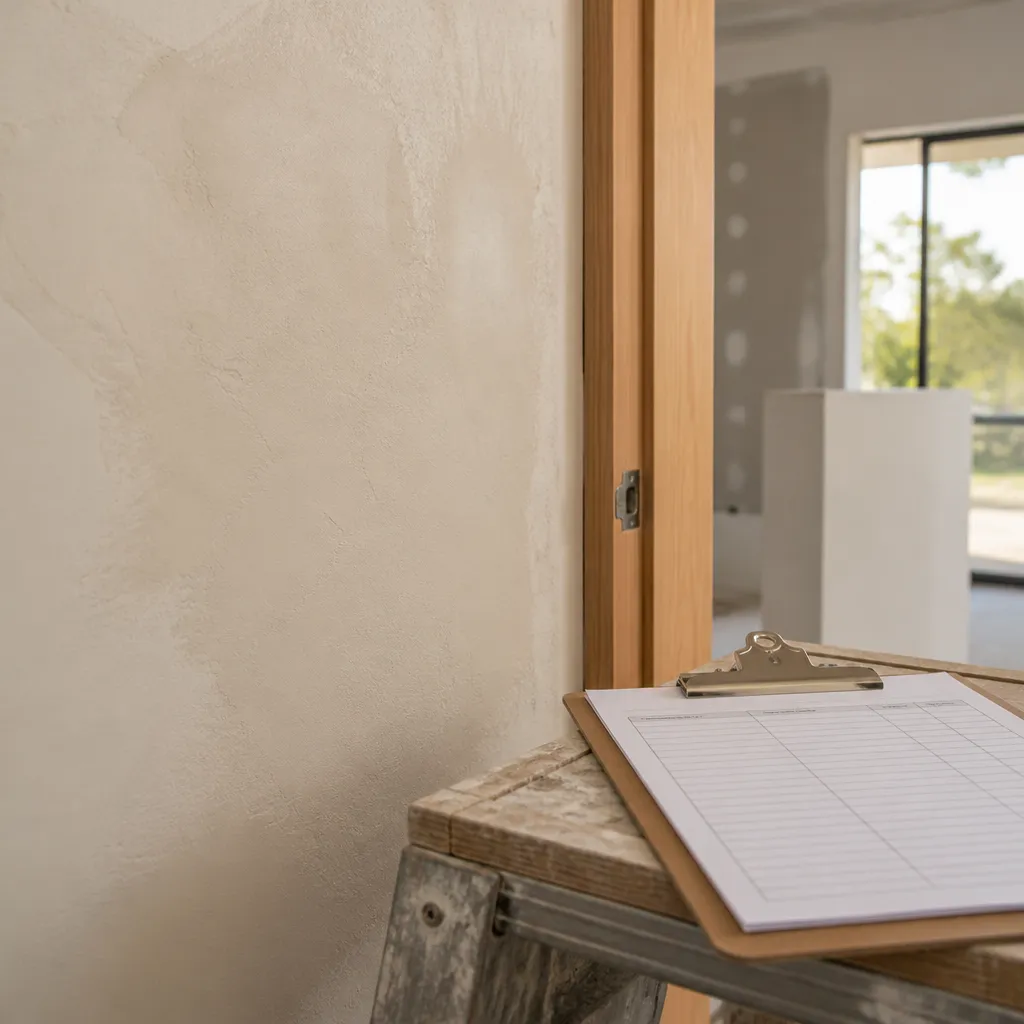
What the defects document must contain
Under the QBCC guidance, the defects document must state when the contractor will attend, list separately any minor defects that only the owner believes exist, and be signed by both parties. Insist on that separate section. Owners often hold legitimate concerns the builder does not share, and if those concerns are not recorded, they disappear once the keys change hands.
If the contractor has not signed, the document still needs to reflect what was agreed on the day. Do not accept a verbal summary in place of a written list, and keep a copy for yourself before you leave the site.
Photo evidence and trade attribution
Each item needs four things: a location, a photo, a description and the trade responsible. A photo of a cracked tile labelled “bathroom floor, near door, tiler” is actionable. “Bathroom needs work” is not. Assigning responsibility matters because builders often pass defects between subcontractors, and a clear trade label cuts the back and forth that stretches a delay.
A defect that is photographed, located and assigned is a defect that gets fixed. A defect that lives only in conversation is one you will be arguing about months later.
Comparing Your Response Options During a Delay
During a delay you have a few realistic responses. Each suits a different situation, and choosing the wrong one costs time you cannot get back.
Accepting a revised date and waiting
Waiting is reasonable when the delay is short, the defect list is small and the builder answers messages promptly. Even then, do the pre-handover walk before the new date. Waiting without a walk is the most common way owners end up with a surprise list on the final day.
Escalating open items in writing
When the date keeps moving with no reason given, send a dated written list of open items and ask for a program. A written record changes the tone of the conversation, because the builder now has to respond to specific matters rather than general frustration. Keep copies of everything you send.
| Response | Best used when | Main risk |
|---|---|---|
| Accept the revised date and wait | The delay is short, the defect list is small and the builder responds quickly | Items get forgotten, and the final walk turns up new faults |
| Run a pre-handover walk now and send a written list | The delay is long, or the builder keeps moving the date | The builder may dispute items that sit outside the contract scope |
| Hold final payment and escalate under the contract | Major defects remain or required certificates are missing | Friction with the builder, so check your contract terms before taking this step |
Protecting Your Final Payment and Paperwork
The final payment is the builder’s last incentive to finish, and it is also your last point of leverage. The QBCC notes that the contractor can ask for final payment once practical completion is reached, with notice of at least 2 to 3 weeks. Some contracts require all certificates of inspection, including the final certificate, before that payment is made.
Certificates before the cheque
Make a list of the certificates your contract requires and tick them off as they arrive. The QBCC recommends that the contractor provides all certificates of inspection before receiving final payment, and notes this can be a mandatory contract condition. Read that clause yourself rather than relying on a summary from the sales office.
If a certificate is missing on handover day, do not treat it as a formality. Agree a date for delivery in writing, and make the payment conditional on receiving it.
Warranties and who to call
Appliance warranties come from the product supplier. The QBCC is explicit that if an appliance has issues after handover, the property owner should contact the product supplier rather than the contractor. Collect every manual, warranty card and service provider document on handover day, and store them alongside the defects document.
Pro tip: Ask for the full documentation pack as a single PDF before you pay. Builders can usually produce one, and a missing item is far easier to chase while they still want your final payment.
How Builders and Developers Can Use the Delay
If you build or develop, the delay window only works in your favour when you use it on purpose. A builder who sends a clear defect list before the owner’s walk avoids the expensive scramble of a second handover visit. The same principle applies to a single house or to a multi-unit project where many owners walk through in sequence.

Clearing the list before the owner arrives
Run your own pre-handover inspection, log items against trades and give each trade a firm return date. A house that is ready when the owner walks in produces a shorter defect schedule and fewer disputed items. Owners tend to remember how the handover felt far more than how long the delay lasted.
For high-rise developments and larger housing projects, a consistent report format across units makes the process easier to manage. Each unit’s issues sit in the same structure, so trades and site staff can work through them in batches.
Communicating revised dates
Tell owners about a revised date as soon as you know it, with the reason and the new target. The QBCC suggests the builder tells the client 2 to 3 weeks before the expected handover, and provides notice at least 5 business days before practical completion. Missing those windows creates a dispute before the walk even starts.
Frequently Asked Questions
How do I know if a handover delay in Queensland is reasonable?
The delay itself is less important than the paperwork around it. A delay with a clear reason, a dated program and regular written updates is manageable. A date that keeps moving with no explanation is the one to challenge, so ask for the program in writing and check your contract’s completion and notice terms.
Can I arrange my own inspection before the builder says the house is ready?
Yes. The QBCC notes that a property owner can engage a building inspector to go through the building work on their behalf. A pre-handover walk is worth arranging as soon as most trades have finished, because that is when the most fixable items are still visible.
What is the difference between a pre-handover inspection and a handover inspection?
The pre-handover inspection is the earlier walk, usually about a week before the handover date, when items can still be fixed while trades are on site. The handover inspection is where the defects document is completed and signed. Use the first to shape the second.
Do I have to pay the final payment on handover day?
Not automatically. The contractor can ask for final payment once practical completion is reached, but some contracts require certificates of inspection first. Check the clause before you pay, and make payment conditional on receiving any outstanding documents.
Who do I contact if an appliance fails after handover?
Contact the product supplier. The QBCC guidance specifically says that appliance issues after handover should go to the supplier, not the contractor, so keep the warranty paperwork somewhere you can find it quickly.
How much does a GoInspect pre-handover inspection cost?
GoInspect’s defect rectification inspections start from $550 including GST. Reports are photo-enhanced, identify construction issues, assign responsibility to specific trades and are issued the same day.
Have you dealt with a handover delay in Queensland, and which of these steps made the biggest difference for you? Share your experience in the comments below.