
Most Brisbane buyers assume a new home means a perfect home. That assumption is expensive. Across pre-handover inspections conducted throughout Brisbane, Gold Coast, Logan, Ipswich, and Redland Bay, defects turn up in virtually every new build, from minor paintwork issues to waterproofing failures that cost tens of thousands of dollars to fix after tiles are laid. Knowing which common new home defects in Brisbane appear most often, and why, puts you in a far stronger position at the handover table. This guide covers the 10 defects GoInspect’s licensed inspectors identify most frequently, what causes them, and what to do when they show up in your report.
Table of Contents
- Quick Takeaways
- 1. Waterproofing Failures in Wet Areas
- 2. Render and Plasterwork Cracking
- 3. Roofing and Guttering Faults
- 4. Drainage and Site Fall Issues
- 5. Door and Window Alignment Problems
- 6. Tiling Defects and Lippage
- 7. Electrical Installation Issues
- 8. Plumbing Leaks and Incorrect Fall
- 9. Slab Cracking and Structural Movement
- 10. Paintwork and Finishing Defects
- How Defect Types Compare: Minor vs. Major vs. Structural
- Frequently Asked Questions
- References
Quick Takeaways
| Key Insight | Explanation |
|---|---|
| Waterproofing is the costliest defect category | Each residential bathroom waterproofing claim under the Queensland Home Warranty Scheme averaged almost $25,000 in rectification costs in the 2024-25 financial year, according to the QBCC. |
| New builds are not defect-free by default | Defects appear across volume builds and custom homes alike. A builder’s warranty gives you a path to remedy, but a pre-handover inspection gives you leverage before you hand over the final payment. |
| Wet areas fail most often in Queensland homes | Bathrooms, laundries, and balconies are the highest-risk zones. Incorrect membrane installation and missing silicone at junctions are both common findings at practical completion. |
| Defects should be assigned to specific trades | A quality inspection report names the responsible trade for each defect, not just the builder. This speeds up rectification because it removes ambiguity about who returns to site. |
| Drainage issues are preventable but persistent | Incorrect site falls, driveways that direct water toward the home, and stormwater connections that are incomplete or blocked appear regularly in South East Queensland new-build reports. |
| Catching defects before settlement is the strongest position | Once you accept the keys and pay the final certificate, your path to rectification shifts from a contractual right to a warranty claim process. Pre-handover is the right time to act. |
| Most defects found at handover are fixable | The majority of items in a pre-handover report are workmanship items, not structural failures. The goal is documentation so that the right subcontractor returns to complete the job properly. |
1. Waterproofing Failures in Wet Areas
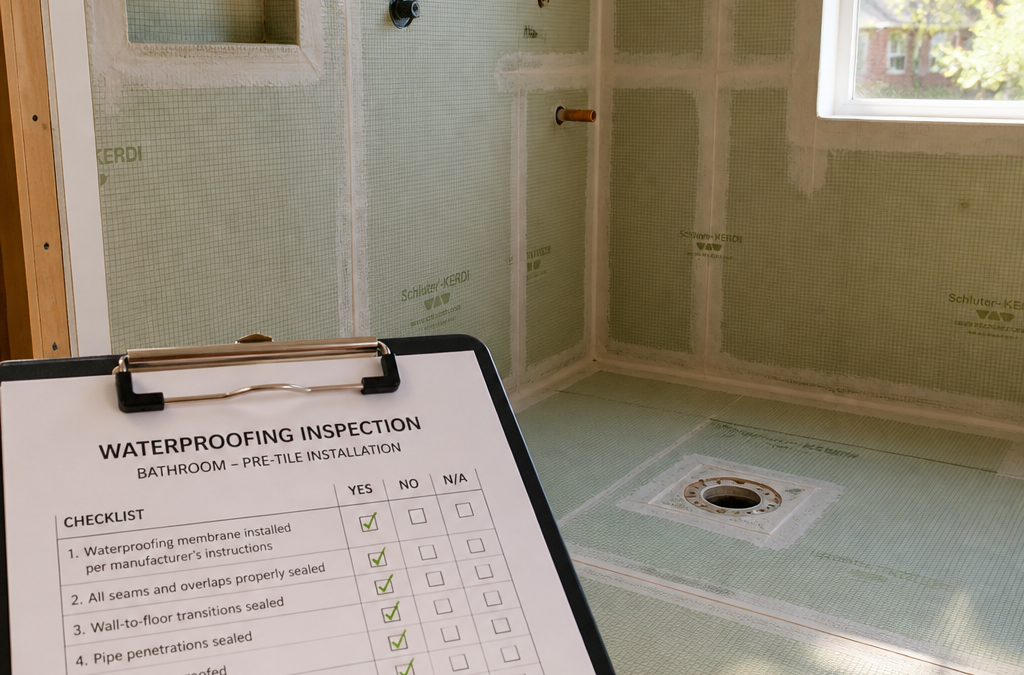
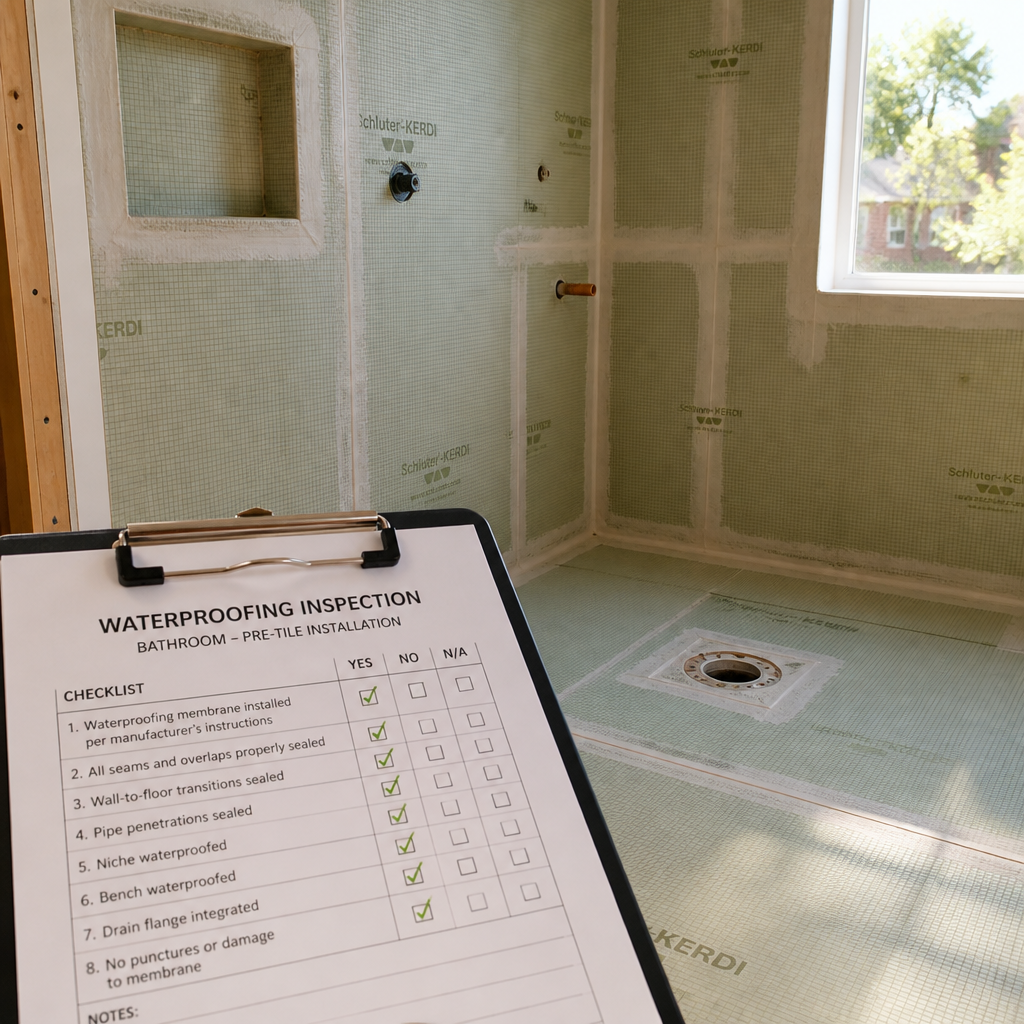
Waterproofing is consistently the highest-risk defect category in new Brisbane homes, and it earns that ranking because the damage happens slowly, invisibly, and expensively. When a waterproofing membrane is incorrectly installed, missing entirely at a junction, or applied too thin at the wall-to-floor angle in a shower, water migrates into the substrate beneath the tiles. You will not see it at handover. You will see it six to eighteen months later when grout starts cracking, tiles de-bond, or water appears in a room below.
The QBCC’s 2025 Industry Snapshot confirmed that waterproofing defects consistently rank among the top ten most common defective work complaints across Queensland residential construction. The average rectification cost for a residential bathroom waterproofing claim under the Queensland Home Warranty Scheme reached almost $25,000 per claim in the 2024-25 financial year. That figure reflects the reality that fixing failed waterproofing after tiles are installed means removing everything: tiles, substrate, and membrane, then starting over.
At a pre-handover inspection, a licensed inspector cannot perform a destructive moisture test, but they can assess the installation patterns that predict failure: whether the membrane has been turned up the wall to the required height, whether silicone joints are present at every internal angle, whether the shower base has the correct fall toward the drain, and whether the shower screen base is sealed. Balconies are another common failure point. In Brisbane’s subtropical climate, balcony waterproofing that does not meet the National Construction Code requirements will degrade quickly.
Pro tip: If your inspector notes a waterproofing concern in a wet area at handover, do not accept the builder’s verbal assurance that it meets the standard. Ask for photographic evidence of the membrane installation completed prior to tiling, or request a water retention test before settlement.
2. Render and Plasterwork Cracking
Cracking in render and internal plasterwork is one of the most frequently noted defects in new Brisbane builds. Not all cracking is equal, and understanding the difference matters when you are deciding whether to push for rectification or accept it as a minor workmanship item.
Shrinkage Cracking vs. Structural Cracking
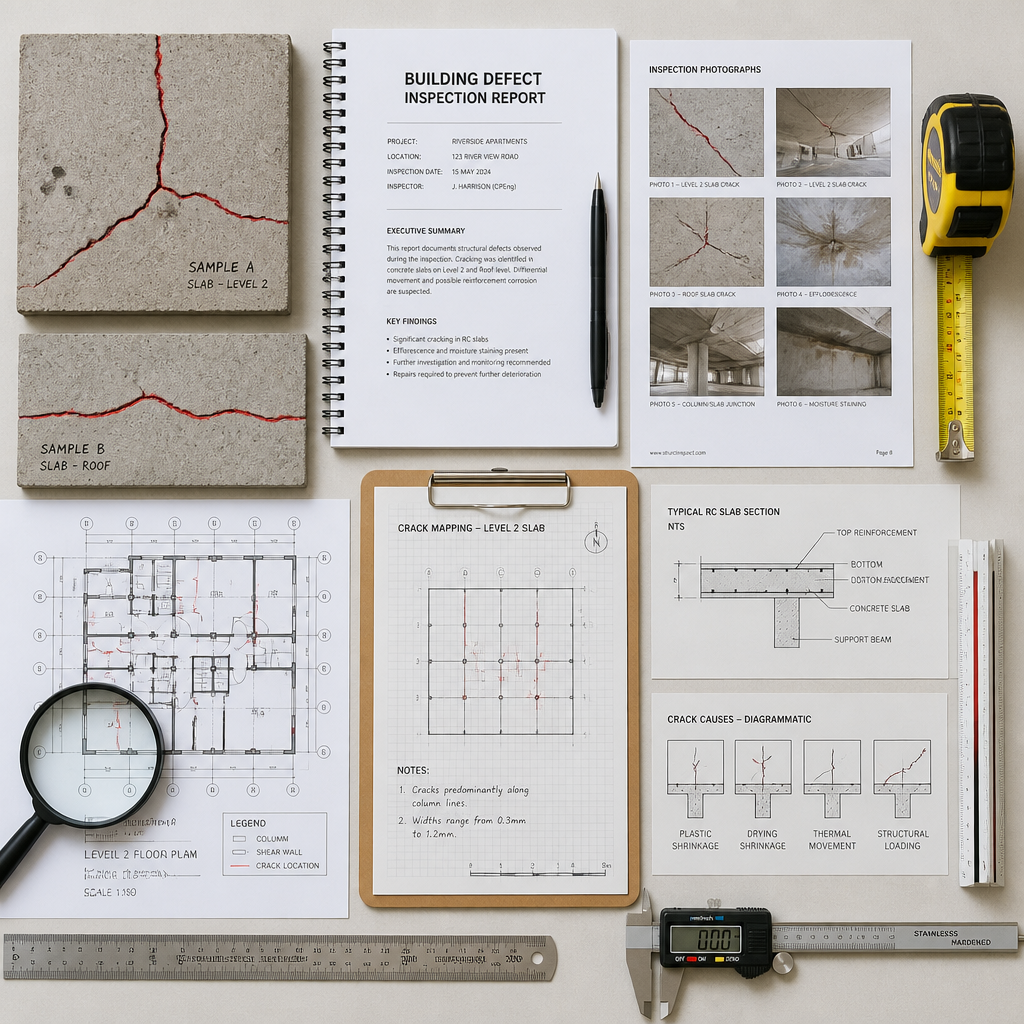
Hairline shrinkage cracks in plasterwork at corners and joins are common in new construction and typically appear within the first few months as the structure settles. These are classified as minor defects under Queensland standards. Wider cracks, cracks that step along brick mortar joints, cracks at window and door openings that follow a diagonal pattern, or cracks that are wider at one end than the other all warrant closer investigation because they can indicate structural movement rather than normal settlement.
In masonry construction, which is still common across suburban Brisbane and South East Queensland, early shrinkage cracks in the mortar joints are assessed as part of a thorough handover inspection. GoInspect’s inspectors assess cracking patterns against the QBCC Standards and Tolerances Guide, which sets Queensland’s accepted benchmarks for what is and is not a defect requiring rectification.
Render Defects on External Walls
External render that is applied inconsistently, applied over unprepared substrate, or not sealed correctly before painting will crack, hollow, and allow water ingress. Hollow render spots, detectable by tapping the wall surface, are a finding that appears regularly in volume-built homes where rendering crews work across multiple sites simultaneously. Hollow render on external walls creates a water trap behind the cladding and, in Brisbane’s wet season, that becomes a direct path for moisture into the wall cavity.
Pro tip: Run your hand along external rendered walls and listen for a hollow sound when tapping. If your inspector identifies hollow sections, mark them on site and request rectification in writing before you sign the handover documentation. Do not rely on the builder’s site supervisor to remember verbal agreements.
3. Roofing and Guttering Faults
The roof is the single most important weather barrier on any home in South East Queensland, and it is also one of the areas where defects create the most consequential downstream damage. Roofing and guttering faults appear regularly in new Brisbane build reports, particularly around penetrations, valleys, and gutter-to-downpipe connections.
At a practical completion inspection, the roof space is inspected for insulation installation quality, sarking placement, tile or metal sheet alignment, flashing around penetrations such as exhaust fans and skylights, and ridge and valley conditions. Gutters, downpipes, fascias, and external cladding are inspected from ground level and, where safe access permits, from the roof itself. Common findings include incorrectly lapped roof sheets, missing or poorly positioned flashing at wall-to-roof junctions, gutters installed without adequate fall toward downpipes, and downpipes that discharge incorrectly or are not connected to the stormwater system at all.
In Brisbane’s climate, where heavy rainfall events are routine from November through March, a guttering fault that causes water to back up and overflow toward the wall cladding or fascia will cause timber damage and potential internal water entry within a single wet season. Finding it at handover is straightforward. Finding it after two wet seasons is a structural repair job.
4. Drainage and Site Fall Issues
Drainage defects and incorrect site fall are persistent findings across new builds throughout Brisbane, Logan, Ipswich, and the Gold Coast. The issue is almost always rooted in the final grading of the site: whether the ground slopes away from the home, whether driveways and paths are correctly pitched, and whether stormwater runoff reaches the drainage system rather than pooling against the footings.
The QBCC has specifically highlighted that paths placed too close to walls without movement joints, and surfaces with incorrect falls, can direct water back toward the home or toward neighbouring properties, which breaches the National Construction Code’s moisture and surface water management requirements. Soft or uneven foundations, along with inadequate compaction during preparation, contribute directly to drainage performance failures that show up at practical completion.
The expense of repairing drainage and waterproofing defects far exceeds the cost of getting the work right the first time, and the health impacts of water damage left unaddressed compound the problem well beyond the initial rectification bill.
A pre-handover inspection will assess whether the immediate subfloor and perimeter drainage is functioning as designed, whether downpipes terminate correctly, and whether the finished levels around the home match what the approved plans specify. Do not assume the council-approved drainage design was executed correctly in the field, because site supervision quality varies significantly between builders.
5. Door and Window Alignment Problems
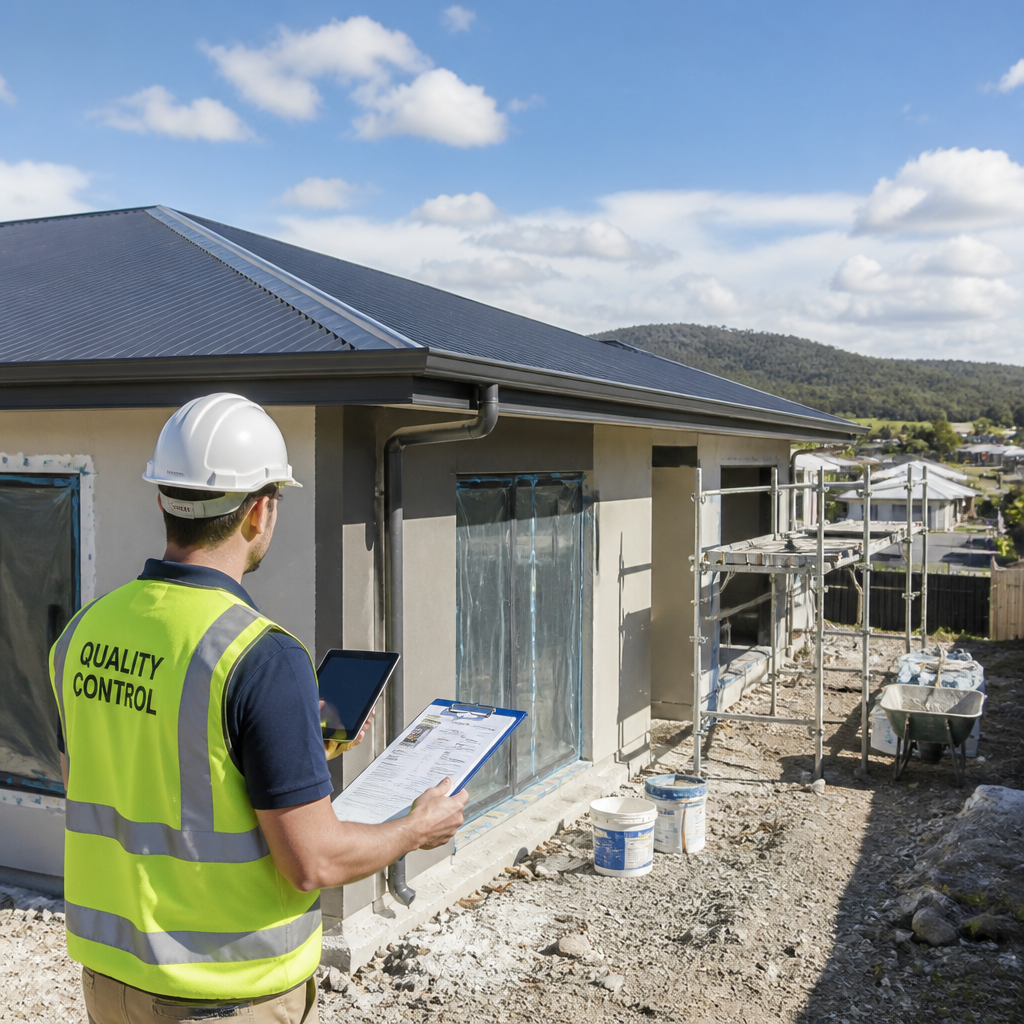
Misaligned doors and windows are among the most common workmanship defects in new Brisbane homes, and they are often more than a cosmetic issue. A door that does not sit square in its frame, binds on the floor, or fails to latch correctly is both a security risk and a water ingress risk if the gap at the perimeter is large enough to compromise the weather seal.
Volume builders frequently have door and window frames installed by one subcontractor, with final fitting and hanging completed by another. When coordination between trades is poor, frames that are not perfectly plumb or square produce doors and windows that never function correctly regardless of how many times they are adjusted after the fact. The correct fix is to address the frame, not repeatedly plane the door leaf.
Window installations are also assessed for correct flashing and sealing around the perimeter. In Queensland’s climate, an improperly flashed window opening is a direct water entry point. The building wrap or sarking behind external cladding must integrate correctly with the window flashing tape, and this integration is not visible once cladding is complete. Inspectors look for signs of incorrect installation from the internal reveal and from any accessible external detail.
6. Tiling Defects and Lippage
Tiling defects are a consistent finding in both wet areas and living areas of new Brisbane homes. The most common issues are lippage (uneven tile edges that create a trip hazard and a visual flaw), missing or inconsistent grout joints, cracked tiles, and incorrect fall in shower bases.
In wet areas, tiling defects often compound the waterproofing risk. If grout has not been applied correctly to the full depth of the joint, or if silicone joints at internal angles have been replaced with grout (which will crack as the building moves), water has a direct path to the membrane below. This is why tiling and waterproofing are assessed together at a practical completion inspection, not in isolation.
Lippage in large-format floor tiles, which are increasingly common in new Brisbane builds, is a frequent finding. Australian Standards provide tolerances for lippage, and volume tile installers working quickly across multiple sites regularly exceed those tolerances. The standard fix is a tile relay, and builders will sometimes resist this unless the defect is clearly documented with measurements in the inspection report. A report that photographs the lippage with a straightedge and records the measurement removes the scope for disagreement.
7. Electrical Installation Issues
Electrical defects in new homes are not always dangerous wiring faults. The majority of electrical findings at a pre-handover inspection in Brisbane are functional issues: power points that are not live, light fittings that are missing a globe or a fitting cover, safety switches that have not been correctly labelled on the switchboard, or exhaust fans that have been wired but do not turn on because the connection at the junction box is loose.
A pre-handover inspection is a visual and functional check. Inspectors test power points, switches, and light fittings for correct operation. They check safety switches are present and correctly zoned for wet areas, and that the switchboard is complete and labelled. They do not perform a licensed electrical compliance test, but they will identify anything that does not function correctly and flag it for the licensed electrician to rectify before handover.
Air conditioning installations are also checked where applicable. In new Brisbane homes, split systems are commonly included as a contract item and are frequently found with condensate lines that drain incorrectly, filters that have not been fitted, or remote controls that are missing. These are minor findings but they are yours to chase before you settle rather than after.
8. Plumbing Leaks and Incorrect Fall
Leaking taps, showerheads, toilets, and pipe connections are common findings in newly completed homes. New fittings can arrive from the factory with seals that are not perfectly seated, and trade installation at volume builds is not always thorough enough to catch every drip before handover. A small drip at a flexi-hose connection under a vanity becomes a cabinet floor water damage problem within months.
Incorrect fall in shower bases and floor wastes is a more serious finding because it means water does not drain completely. Pooling water in a shower is a hygiene and waterproofing issue. The National Construction Code specifies minimum fall requirements toward floor wastes in wet areas, and inspectors check this with a spirit level as a standard part of the wet area inspection. Volume builders working to tight timelines occasionally have shower bases that are level or that drain to the wrong corner, and these are not self-correcting problems.
Hot water systems are also checked for correct installation, temperature and pressure relief valve positioning, and connection to the external drainage point. In Queensland, solar and heat pump hot water systems are common in new builds, and inspector checks confirm the system is functioning, not just installed.
9. Slab Cracking and Structural Movement
Slab-on-ground construction is the dominant form of residential construction across Brisbane and South East Queensland. This means the concrete slab is both the foundation and the ground floor of the home, and cracking in the slab is a finding that requires careful assessment to distinguish between acceptable shrinkage behaviour and a defect requiring investigation.
Early shrinkage cracks in a new concrete slab are expected and are typically classified as minor defects unless they exceed the tolerances set out in the QBCC Standards and Tolerances Guide. Cracks that are wider than allowable tolerances, cracks that have differential movement across the crack (where one side is higher than the other), or cracks that align with control joint placements that were positioned incorrectly may indicate a more significant issue with subgrade preparation or slab design.
GoInspect’s inspectors assess visible cracking in concrete slabs, exposed brickwork, and masonry as part of every pre-handover inspection. Where cracking patterns suggest structural movement rather than normal shrinkage, the report notes this clearly and may recommend a structural engineer’s assessment before settlement. That recommendation, if followed, is the most important investment a buyer can make before accepting a property.
10. Paintwork and Finishing Defects
Paintwork and finishing defects are the most visible category of new home inspection findings, and they are also the most commonly underestimated. Runs, holidays (missed patches), roller marks, paint over unprimed plaster, and paint applied to surfaces that were still wet are all findings that appear regularly in Brisbane new build reports. On their own, they are workmanship items. But they matter because they often mask the surface below: paint applied too heavily over a poorly finished plaster join will crack along that join within months.
Joinery and cabinetry finishing defects are similarly common. Doors that do not sit flush with cabinet frames, handles that are misaligned, drawers that stick or do not close fully, and shelving that is not secured all appear regularly in pre-handover reports across South East Queensland. These are items that volume builders’ finishing crews are supposed to address in the final clean-up before handover, but site supervision in the final days before practical completion is often thin.
The reason finishing defects matter more than they appear to is documentation. If you accept the home without a record of these items, you are accepting them as satisfactory. Getting them recorded in a formal inspection report before handover means the builder has a contractual obligation to rectify them at their cost, not yours.
How Defect Types Compare: Minor vs. Major vs. Structural
Not all defects carry the same weight, and knowing the distinction affects how hard you push for rectification before settlement, and how you use your inspection report in conversations with the builder. Queensland uses the QBCC Standards and Tolerances Guide as the primary reference for assessing whether a defect exists and what category it falls into.
| Defect Type | Examples in New Brisbane Homes | What It Means for Settlement |
|---|---|---|
| Minor / Workmanship Defect | Paint holidays, minor tile lippage, misaligned door handles, hairline plaster cracks, missing grout touch-ups | Should be rectified before settlement. Rarely justifies delaying settlement unless numerous and unaddressed. Document everything to establish a baseline. |
| Major Defect | Failed waterproofing in wet areas, significant render cracking, incorrect drainage fall directing water toward the home, roof flashing failures, plumbing leaks within walls | Strong grounds to require rectification before handover. These are expensive to fix post-settlement and create ongoing damage if left. Push for written confirmation of rectification before releasing final payment. |
| Structural Defect | Slab cracking with differential movement, out-of-plumb load-bearing walls, roof framing that deviates from approved plans, inadequate bracing | Do not settle until a licensed structural engineer has assessed and provided written clearance. These are not builder-rectify-and-move-on items. They require engineering oversight and often a formal rectification plan. |
In practice, the GoInspect pre-handover inspection report assigns each defect to the responsible trade and categorises it clearly so that your builder, solicitor, and you are all working from the same documented record rather than a verbal walkthrough that nobody writes down.
Frequently Asked Questions
How many defects should I expect to find in a new Brisbane home?
There is no average that is useful as a benchmark. Volume builds in South East Queensland commonly produce inspection reports with anywhere from fifteen to sixty-plus documented items, most of which are workmanship and finishing defects. Custom builds tend to produce fewer items but can still include serious findings in wet areas and drainage. The number matters less than the category. One waterproofing failure is more consequential than forty minor paintwork items.
Does a builder’s warranty mean I do not need an independent inspection?
No. A warranty is a mechanism for claiming rectification after the fact, usually under the Queensland Home Warranty Scheme. A pre-handover inspection is your opportunity to identify defects before you accept the property and pay the final certificate. Those are two very different positions. From a handover inspection, you have contractual leverage and have not yet made your final payment. From a warranty claim, you are dealing with an administrative process that can take months to resolve.
What is a Practical Completion Inspection (PCI) and is it the same as a pre-handover inspection?
In Queensland building contracts, Practical Completion Inspection (PCI) is the formal contractual term for the final inspection conducted before you accept handover of your new home. Pre-handover inspection is the common term used by homeowners. They refer to the same event: the inspection that occurs before you sign off on the property and release the final payment. GoInspect conducts these inspections across Brisbane, Gold Coast, Logan, Ipswich, and Redland Bay.
Can I attend the inspection myself rather than hiring an independent inspector?
You can attend, and you should. But attending alongside an independent licensed inspector is a different exercise from conducting your own walkthrough. An experienced inspector knows the QBCC Standards and Tolerances Guide, has assessed dozens or hundreds of similar builds, and knows which details to look at behind finished surfaces, inside roof spaces, and within wet areas. A homeowner attending without inspection experience will miss most of the significant findings that end up in a formal report.
What should I do if the builder disputes a defect finding in the report?
A photo-enhanced report that documents each defect with images, assigns it to the responsible trade, and references the applicable standard makes disputes much harder to sustain. If a builder disputes a finding, the QBCC Standards and Tolerances Guide is the first reference point. You can also request a QBCC inspection if the dispute cannot be resolved. Do not accept verbal assurances. Every agreed rectification item should be confirmed in writing before you release any payment or sign the handover certificate.
How long does a pre-handover inspection in Brisbane take?
A thorough pre-handover inspection of a standard new house in Brisbane typically takes two to four hours, depending on the size and complexity of the property. High-rise apartment inspections and larger dual-occupancy builds take longer. GoInspect provides same-day reporting, so you receive your documented defect report on the day of inspection, ready for use in your handover conversation or to send directly to your builder.
What new home defects in Brisbane are most expensive to fix after settlement?
Waterproofing failures in bathrooms, laundries, and balconies are consistently the most expensive, with QBCC warranty claims averaging almost $25,000 per bathroom claim in the 2024-25 financial year. Drainage failures that allow water to sit against the footings and roofing defects that permit water ingress are the next most costly, because both involve remediation work across multiple trades. Structural defects, while less common, can exceed six figures to rectify if they involve slab or frame issues.
Have you recently gone through a new home handover in Brisbane or South East Queensland? Share what defects you found, or what you wish you had looked for, in the comments below.
References
- QBCC 2025 Industry Snapshot: Top 10 Building Defects Reported Across Queensland
- QBCC Home Owner Series: Waterproofing Defects and Rectification Costs in Queensland
- Most Common Defects Found at Handover in New Brisbane Builds
- Australia’s Top 10 Most Common Building Defects in New Homes
- QBCC Guidance on Driveway and Path Defects and Drainage Compliance