

Developers delivering apartment buildings, townhouse complexes, and mixed-use projects across Southeast Queensland face a pressure point that residential builders rarely discuss openly: a defect found by a buyer at handover costs far more to fix, and far more to your reputation, than one caught during a structured multi-residential inspection a week before practical completion. The multi-residential inspection Australia market has matured significantly, and the developers who treat it as box-ticking are the same ones fielding QBCC complaints six months after settlement. This guide explains exactly what a multi-residential inspection covers, why it differs from a standard new home inspection, and what developers and investors need to demand from an inspection provider before signing off on any lot.
Table of Contents
- Quick Takeaways
- What Is a Multi-Residential Inspection?
- How It Differs from a Standard New Home Inspection
- What a Multi-Residential Inspection Actually Covers
- Why Developers Need One Before Handover
- Queensland’s Regulatory Framework: What Developers Must Know
- Apartment Inspection Types Compared
- Choosing the Right Inspection Provider for Multi-Residential Projects
- Frequently Asked Questions
- References
Quick Takeaways
| Key Insight | Explanation |
|---|---|
| Multi-residential inspections are not standard house inspections | Apartment and townhouse developments require assessment of common property, fire door compliance, inter-tenancy walls, balcony waterproofing, and mechanical systems that a residential checklist never touches. |
| Developers carry warranty obligations for years after handover | Under QBCC statutory warranties, builders are responsible for minor defects for 12 months from practical completion and major defects for 6 years and 6 months. Defects documented at handover are far easier to contest or resolve quickly. |
| A pre-handover inspection protects both the developer and the buyer | Catching defects before settlement gives the responsible trade time to rectify the work without emergency callout costs, buyer frustration, or formal complaints lodged with the QBCC. |
| Trade accountability requires inspection reports that assign responsibility clearly | A photo-enhanced defect report that names the specific trade responsible for each item shortens the rectification cycle. Vague reports produce disputes between subcontractors about who owns the defect. |
| High-rise inspections require customised checklists | Class 2 buildings (multi-storey apartment blocks) have different NCC compliance requirements to detached houses, including fire safety systems, common area finishes, and building envelope performance. |
| Same-day reporting matters in multi-lot projects | When dozens of lots settle within days of each other, delayed inspection reports cause settlement holdups. Same-day reporting keeps the settlement schedule intact for buyers, developers, and financiers. |
| Coordinated multi-lot inspections reduce per-unit cost | Inspecting multiple units in the same complex on the same day is significantly more cost-efficient than scheduling each lot separately, making professional inspection viable even for investor-grade projects. |
What Is a Multi-Residential Inspection?
A multi-residential inspection is a structured, trade-by-trade assessment of a residential development containing two or more dwellings under a single project. This includes townhouse complexes, low-rise apartment blocks, mid-rise and high-rise developments, and mixed-use buildings with residential components. The inspection examines both individual lots and the common property elements that will eventually be managed by a body corporate.
The term covers several different inspection types depending on where in the construction timeline they occur. A practical completion inspection (PCI) happens at the point where the builder declares the works substantially complete. A pre-handover inspection takes place before the buyer physically takes possession. A pre-settlement inspection occurs immediately before settlement is finalised and ownership is transferred. All three can apply to multi-residential developments, and in many projects, more than one is appropriate.
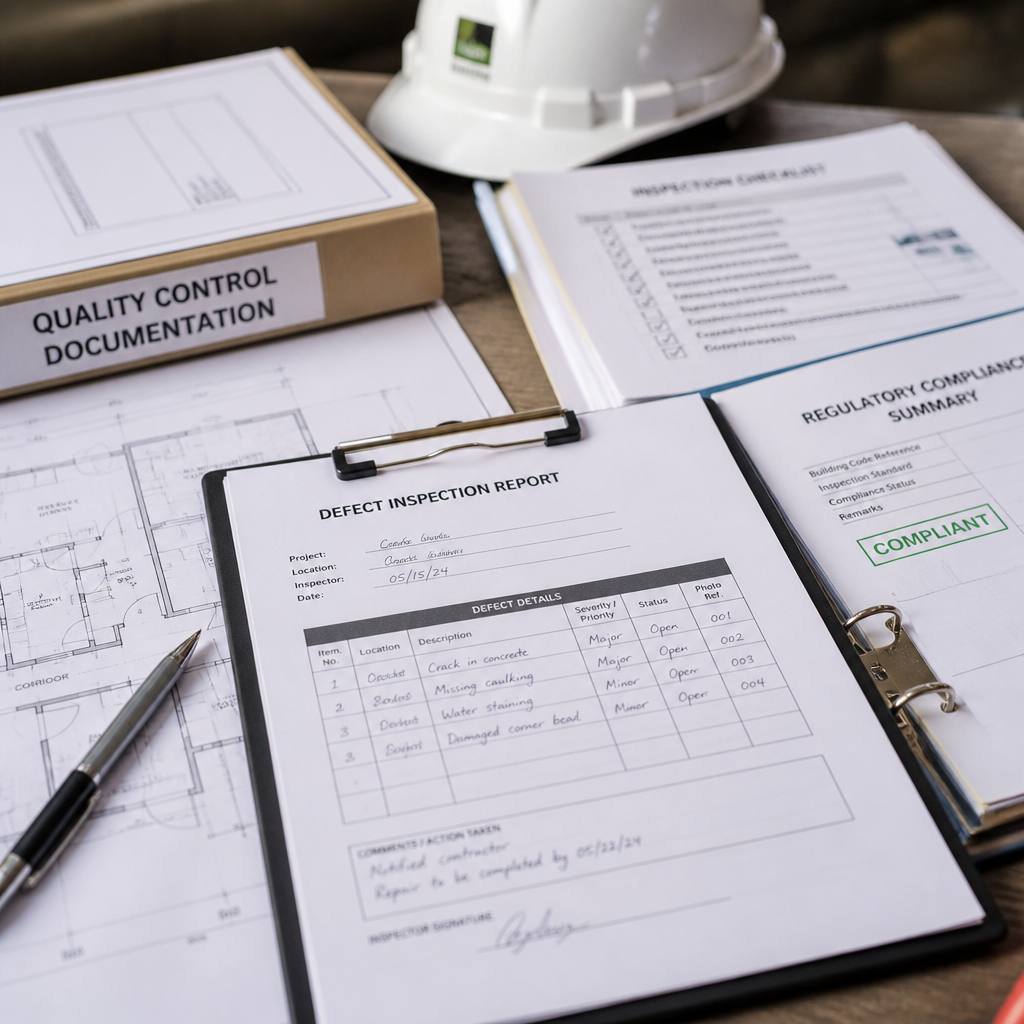
What separates a genuine multi-residential inspection from a tick-and-flick walk-through is documentation discipline. Every defect must be photographed, located precisely within the lot or common area, and assigned to the trade responsible for that element of work. Without that specificity, the report becomes a list that everyone ignores because no one is clearly accountable for fixing it.

How It Differs from a Standard New Home Inspection
A standard new home inspection is designed around a detached house: four walls, a roof, a slab, and the internal fit-out. When you apply that same checklist to an apartment or townhouse complex, you miss roughly half of what matters. The building systems that define multi-residential construction, and that generate the most expensive defects, simply do not exist in a detached dwelling.
Common Property Is Not in the Standard Checklist
Lobbies, corridors, car parks, stairwells, lifts, rooftop terraces, and pool areas are all common property. A buyer’s inspection of their individual lot tells them nothing about the condition of these shared spaces. Developers who only arrange per-lot inspections hand over a building where the common areas have never been independently assessed. Body corporate committees discover the defects later, at which point rectification costs are shared across all owners and the original trades are often already off-site.
Fire Safety and Mechanical Systems Require Specialist Checks
Class 2 and Class 3 buildings under the National Construction Code have mandatory fire safety requirements that include fire doors, smoke exhaust systems, sprinkler coverage, and fire-rated inter-tenancy walls. A licensed building inspector working on a high-rise building inspection must be familiar with these requirements. An inspector whose background is purely residential housing will not reliably identify non-compliant fire door gaps, missing intumescent strips, or inadequate compartmentation.
Waterproofing Failures Are the Most Expensive Defect in Multi-Residential Builds
Balcony junctions, bathroom substrates, planter boxes, and podium decks are high-risk waterproofing zones in apartment construction. Failures in these areas cause progressive damage to structural elements and to the lots below, and they are disproportionately common in Southeast Queensland given the volume of multi-residential construction across Brisbane, Gold Coast, and Logan. Catching a waterproofing failure at practical completion costs a fraction of what it costs to rectify post-settlement when finishes are in place and other trades have completed their work above or around the failed membrane.
Pro tip: Always request confirmation that your inspection provider uses a checklist specifically adapted to the NCC classification of your building, not a modified residential housing checklist. Class 2 apartment buildings have materially different compliance requirements, and the inspection report should reflect them.
What a Multi-Residential Inspection Actually Covers
The scope of a properly structured townhouse development inspection or apartment inspection breaks down across four domains: the building envelope, internal fit-out, wet areas and waterproofing, and building services and common property. Each domain has defect types that are most common and most likely to be contested between the developer, builder, and individual subcontractors.
Building Envelope
External cladding alignment and fixing, window and door flashings, roof drainage and overflow systems, balcony balustrade heights and structural fixings, and external render or face brick alignment all fall within the envelope check. These are the defects most visible to buyers at handover and the most likely to generate a formal complaint if not addressed before settlement.
Internal Fit-Out Per Lot
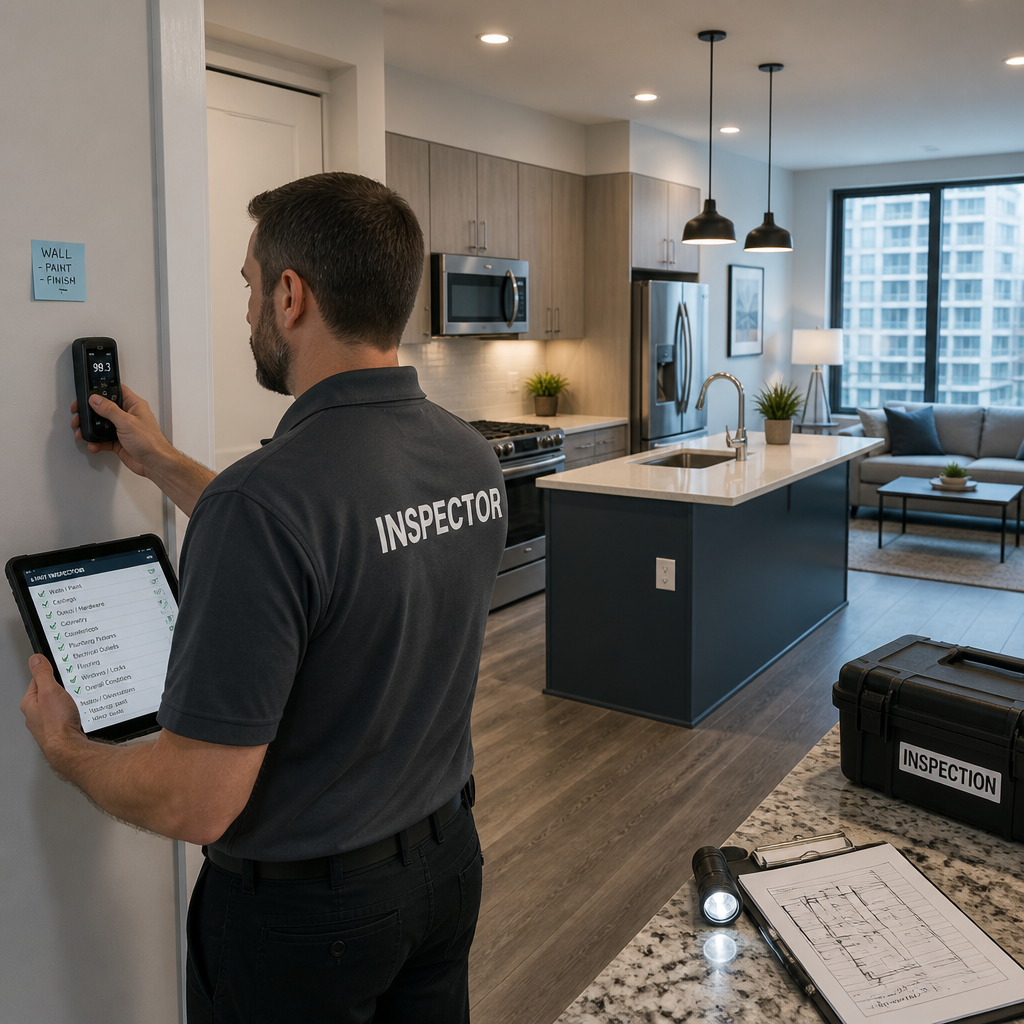
Paint finish quality, floor covering installation, kitchen joinery alignment, door hardware function, fixture and fitting installation, electrical switch and socket placement, and the general standard of internal finishes are assessed against both the contract specifications and the NCC minimum standards. Importantly, the inspection must compare what was built against what was promised in the contract documents and any variations agreed during construction.
Wet Areas and Waterproofing
Bathroom, laundry, and ensuite waterproofing membranes and their terminations, shower screen installation, bath and vanity silicon joints, and balcony drainage falls are critical areas. Inspectors should check drainage falls physically, not just visually, and document any areas where the fall is insufficient to drain pooled water away from junctions and wall bases.
Building Services and Common Property
Fire doors and their self-closing mechanisms, corridor finishes, car park line marking, lift lobbies, mechanical ventilation to common areas, and external landscaping to common property are assessed at the building level rather than the lot level. For larger developments, this phase of the inspection is often scheduled separately from the individual lot inspections to allow the right access arrangements for each area.
Why Developers Need One Before Handover
Developers sometimes treat the practical completion inspection as the builder’s problem rather than their own. That is a mistake that creates avoidable exposure. When a developer hands over a lot without an independent inspection, they are relying entirely on the builder’s own quality assurance process to catch every defect. Construction sites are high-pressure environments, and builders have a financial incentive to declare practical completion and move to the next project.
An independent inspection creates a documented baseline at the moment of handover. If a buyer raises a defect claim three months after settlement, the developer can refer to the inspection report to determine whether the defect was present at handover or arose from the buyer’s own use. Without that documented baseline, every post-settlement claim becomes a dispute about what existed at handover and what did not.
A defect found before handover is a construction issue. A defect found after settlement is a legal dispute. The difference between the two is often a single inspection at the right moment.
QBCC Warranty Obligations Create Long-Term Exposure for Developers
Under QBCC statutory warranties in Queensland, builders are responsible for minor defects for 12 months from practical completion, and for major structural defects for 6 years and 6 months from practical completion. This means a developer who completes a 50-lot townhouse project carries exposure across a significant period after the last key is handed over. An independent inspection report for each lot at practical completion creates contemporaneous evidence of the building’s condition. That evidence is valuable if a dispute is lodged with the QBCC later.
Buyer Expectations in New Developments Are High and Rising
Buyers purchasing new apartments and townhouses in Southeast Queensland are paying premium prices and expect a premium result. The days when a new home buyer accepted minor defects as normal are largely over. Negative reviews, social media posts, and word-of-mouth between buyers in the same complex spread quickly in a market where multiple buyers often know each other from the sales campaign. Proactively inspecting and rectifying defects before handover is a reputational investment, not just a compliance cost.
Pro tip: For townhouse and apartment developments with multiple lots settling in sequence, ask your inspection provider to deliver reports in the same sequence as your settlement schedule. This allows your construction team to prioritise rectifications for the earliest-settling lots and avoid holding up any buyer’s settlement due to outstanding defects identified at the last minute.
Queensland’s Regulatory Framework: What Developers Must Know
Multi-residential construction in Queensland operates under a layered set of regulatory instruments that are distinct from the requirements applying to detached housing. Understanding these layers helps a developer know exactly what an independent inspection must verify, and where the regulatory risk sits if something is missed.
NCC Building Classifications
The National Construction Code classifies buildings by use. Class 2 buildings are multi-storey, multi-unit residential buildings where people live in separate dwellings within the same structure. Class 3 buildings cover residential buildings used for long-term accommodation of unrelated groups. Class 1b buildings cover some forms of townhouse and villa development. Each classification carries different performance requirements for fire safety, sound insulation, energy efficiency, and accessibility. An apartment inspection developer brief must specify the NCC classification so the inspector applies the correct compliance benchmarks.
QBCC Certificate of Occupancy
For multi-storey apartment buildings and townhouses in Queensland, a Certificate of Occupancy (Form 11) is required before the building can be legally occupied. This certificate is issued by a private building certifier and indicates that the building is fit for occupation. It is separate from a practical completion certificate, which is a contractual document rather than a regulatory one. The practical completion certificate signals that the builder considers the work substantially complete under the contract. Neither certificate is a substitute for an independent inspection by a licensed building inspector.
Defect Liability Periods and QBCC Claims
The QBCC’s defect claim periods apply to residential construction work carried out under a QBCC-licensed contractor. For minor defects, the claim window is 12 months from becoming aware of the defect, and no longer than 12 months from practical completion. For major defects, the window extends to 6 years and 6 months from practical completion. Developers should note that these periods run from practical completion of each lot, not from the developer’s own settlement date. Independent inspection reports with timestamped photographs establish a precise record of the building’s condition at that point in time.
Apartment Inspection Types Compared
| Inspection Type | When It Occurs | Who Benefits Most |
|---|---|---|
| Practical Completion Inspection (PCI) | At the point the builder declares works substantially complete, before any handover | Developers and builders: defects are identified while trades are still on site and can be rectified before buyers are involved |
| Pre-Handover Inspection | After the builder has completed their own PCI and issued practical completion, before keys are handed to the buyer | Buyers purchasing off-the-plan: gives the buyer independent verification that their lot meets contract specifications and NCC standards before they accept the keys |
| Pre-Settlement Inspection | Immediately before legal settlement, usually 1 to 5 days prior | Buyers and investors: confirms that defects identified at pre-handover have been rectified and that no new defects have been introduced since handover |
In practice, all three inspection types serve a different purpose and the most thorough approach to a multi-residential development is to run a developer-commissioned PCI first, followed by buyer-commissioned pre-handover inspections, with pre-settlement checks available if rectification work was required. Treating these as competing options rather than a sequence is a common mistake on large projects.
Choosing the Right Inspection Provider for Multi-Residential Projects
Not every building inspector is equipped to handle a multi-residential project competently. The skills and processes required for a high-rise building inspection or a townhouse development inspection are substantially more demanding than those needed for a detached dwelling. When evaluating an inspection provider for a multi-residential project, there are specific capabilities that must be confirmed before engaging.
Full Licensing and Insurance
The inspector must hold a current QBCC licence relevant to building inspection work. In Queensland, this is not optional, and developers who engage unlicensed inspectors expose themselves to professional liability issues if the inspection report is later relied upon in a dispute and the inspector’s credentials are challenged. Always confirm the licence number and verify it against the QBCC licence register before proceeding.
Photo-Enhanced Defect Reporting with Trade Responsibility Assignment
A defect list without photographs is nearly useless in a multi-residential project. Subcontractors routinely dispute defect claims when there is no photographic evidence of the issue at the time of inspection. A report that also assigns responsibility to the specific trade, for example identifying a silicone joint failure as the tiler’s scope versus the waterproofer’s scope, eliminates the circular argument that consumes rectification timelines on large projects.
GoInspect’s approach to multi-residential inspections across Brisbane, Gold Coast, Logan, Ipswich, and Redland Bay centres on photo-enhanced defect reports that do exactly this: each item is documented with photographs, located within the specific lot or common area, and assigned to the relevant trade. This is the structure that makes a defect report actionable rather than advisory.
Same-Day Reporting Capability
For developers managing settlements across multiple lots over a tight timeframe, a 48-hour or 72-hour reporting turnaround is not fast enough. Same-day reporting means that defects identified on Tuesday morning can be in the hands of the site supervisor by Tuesday afternoon, giving trades time to mobilise and rectify before a settlement date later in the same week. This is a practical operational requirement, not a luxury feature, on any project settling more than a handful of lots.
Customised Checklists for High-Rise and Mixed-Use Projects
A provider who applies the same checklist to a three-storey walk-up apartment block as they do to a detached house is not suited to multi-residential work. The inspection checklist for a high-rise development must address fire door compliance, mechanical ventilation to common areas, building envelope performance across multiple elevations, and common property finishes in addition to the individual lot items. Ask any prospective provider to show you a sample checklist for a Class 2 building before you engage them. The difference between a checklist designed for multi-residential and one adapted from a residential housing template is immediately obvious.
Pro tip: If you are a developer with multiple lots in the same complex, coordinate all inspections for a single building with one provider on the same day wherever possible. Coordinated scheduling reduces per-lot inspection cost, keeps the site disruption contained to a single access window, and ensures all reports are produced simultaneously so your rectification team has a complete picture of the building’s defect status at once.
Frequently Asked Questions
What is the difference between a practical completion inspection and a pre-handover inspection for apartments?
A practical completion inspection (PCI) is typically commissioned by the developer or builder at the point the builder declares works substantially complete under the construction contract. A pre-handover inspection is commissioned by the buyer and occurs before they accept the keys. Both types identify defects, but they serve different parties. In a well-managed multi-residential project, the developer runs a PCI first, rectifies identified defects, and buyers then conduct their own pre-handover checks to verify the result.
Does a Certificate of Occupancy mean my apartment building has already been inspected for defects?
No. A Certificate of Occupancy (Form 11) in Queensland is issued by a private building certifier and confirms that the building meets the regulatory requirements to be legally occupied. It does not assess the standard of finishes, the functionality of fixtures and fittings, or the minor and cosmetic defects that buyers care about. An independent multi-residential inspection is a separate, contractually focused assessment that the regulatory certification process does not replace.
How many inspections does a developer need for a 20-lot townhouse project?
At minimum, a developer should commission a single practical completion inspection covering all common property and all 20 lots before handover begins. Beyond that, each buyer is entitled to commission their own pre-handover inspection as a condition of accepting the keys, and many buyers purchasing in a new townhouse development will exercise that right. The practical approach for developers is to make a developer-commissioned PCI report available to buyers and also facilitate access for independent buyer inspections, rather than treating these as obstacles to settlement.
What defects are most commonly found during high-rise apartment inspections in Queensland?
Waterproofing failures in wet areas and on balconies are the most frequently identified and often the most expensive. After that, the most common defects include fire door non-compliance (gaps, missing seals, or self-closer failures), paint finish defects across walls and ceilings, silicon joint failures in kitchens and bathrooms, window and door adjustment issues, and mechanical ventilation problems in bathrooms without windows. In common areas, corridor finishes, car park line marking quality, and lobby fitout defects are regularly identified in Southeast Queensland projects.
How long does a multi-residential inspection take for a large apartment development?
The time varies significantly depending on the number of lots, the building classification, and whether common property is included. A single apartment lot inspection typically takes between 1.5 and 2.5 hours. A full building inspection covering all common property elements adds further time at the building level. For developers planning access windows, a realistic estimate is to allow a full day of site access for a building with 10 to 15 lots, or to split inspections across multiple days for larger projects. A provider experienced in multi-residential work will give you a realistic access schedule upfront rather than fitting it around their convenience.
Can a developer use the same inspection report to satisfy both their own quality control and the buyer’s pre-handover inspection?
In theory, a developer can share their PCI report with buyers as evidence of the building’s pre-handover condition. In practice, buyers are well advised to commission their own independent inspection because the developer’s report is produced on the developer’s instruction and buyers cannot verify its completeness. Some buyers will accept a developer’s report as a starting point, but sophisticated buyers and their legal advisors will almost always insist on an independent inspection from a licensed provider of their own choosing. Developers who resist this create unnecessary friction at a point in the settlement process where goodwill matters.
If you have been through a multi-residential handover as a developer, investor, or buyer in Southeast Queensland, share what the inspection process looked like for your project and what you would do differently next time.
We would love your feedback and any insights you would share with others. What perspective would you add?
References
- Queensland Building and Construction Commission: practical completion inspection guidance for homeowners and developers in Queensland
- Queensland Building and Construction Commission: handover and final documentation requirements including certificates of occupancy and practical completion
- Mahoneys Lawyers: explanation of QBCC defect claim periods and statutory warranty obligations for builders and developers in Queensland
- NSW Government: Building Commission powers to investigate serious defects in Class 2, 3, and 9c residential buildings
- Independent guide to building defect investigations in Australia: what triggers an investigation, what a report contains, and common defect types in multi-unit buildings