
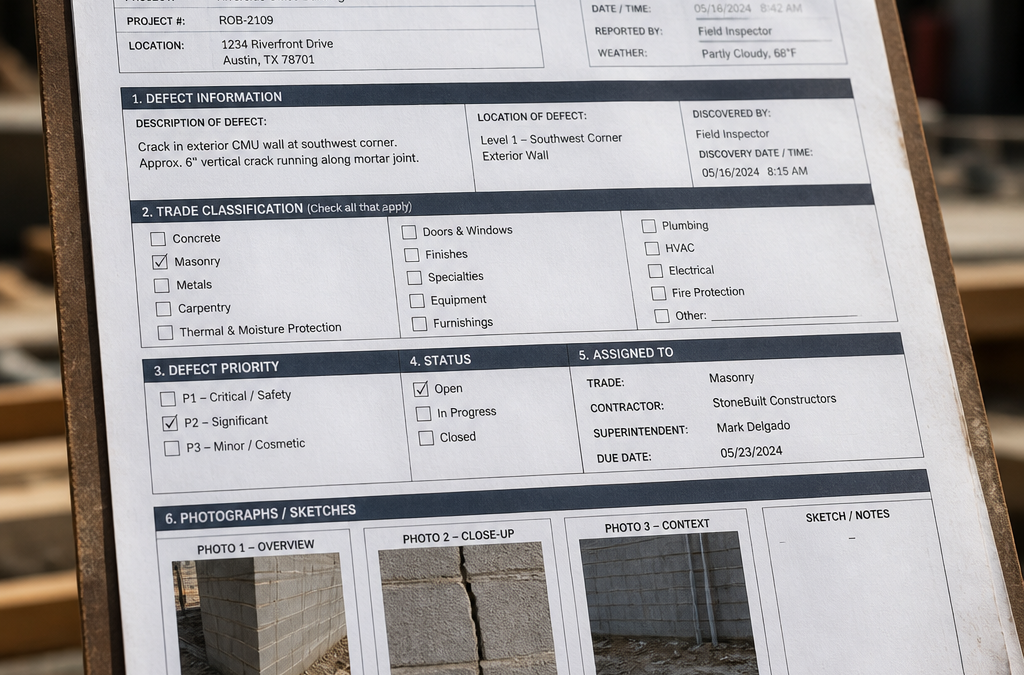
A defect report that says “paint finish is poor in bedroom two” tells a builder almost nothing useful. A defect report that says “paint finish is poor in bedroom two, assigned to the painting subcontractor, photographed with location context and timestamp” tells the builder exactly who needs to return, what they need to fix, and gives them documented evidence for the subcontractor conversation. That difference, between a vague list and a structured, trade-allocated defect report, is where most rectification delays actually start. Building defect trade allocation is not a formatting detail. It is the mechanism that converts an inspection finding into a resolved construction issue.
Table of Contents
- Why Trade Allocation Matters in a Defect Report
- How Inspectors Assign Defects to the Right Trade
- Common Trades and Their Defect Categories
- What a Trade-Allocated Defect Report Looks Like in Practice
- Comparison: Report Formats and Their Real-World Impact
- Legal and Warranty Implications of Trade-Specific Defect Documentation
- Frequently Asked Questions
- References
Why Trade Allocation Matters in a Defect Report
New home construction in Southeast Queensland involves a large number of separate subcontractors, each responsible for a defined scope. A residential build in Brisbane or on the Gold Coast might involve concreters, framers, bricklayers, waterproofers, tilers, plasterers, painters, carpenters, plumbers, and electricians, all working across overlapping stages. When defects appear at practical completion, those defects belong to one or more of those trades. A report that does not say which trade is responsible creates a coordination problem before rectification has even started.
The builder’s site supervisor receives a defect list. If each item is tagged to a trade, the supervisor makes one phone call per trade and schedules returns. If no trade is specified, the supervisor must first diagnose each defect, determine ownership, and then make the call. On a list of 40 or 50 items, that diagnostic step adds days to the rectification timeline and introduces the risk that some items are misallocated internally, or quietly deprioritised.
From the homeowner’s perspective, the absence of trade allocation shifts responsibility onto them. They received a report, handed it to the builder, and now must wait and follow up without any way to hold a specific party accountable. A construction defect responsibility framework built into the report itself removes that ambiguity entirely.
A report that assigns each defect to a specific trade, whether that is the concretor, the carpenter, the waterproofer, or the painter, gives the builder a clear action plan. This is particularly important for large builds where multiple subcontractors are involved and the site supervisor needs to coordinate returns efficiently.
How Inspectors Assign Defects to the Right Trade
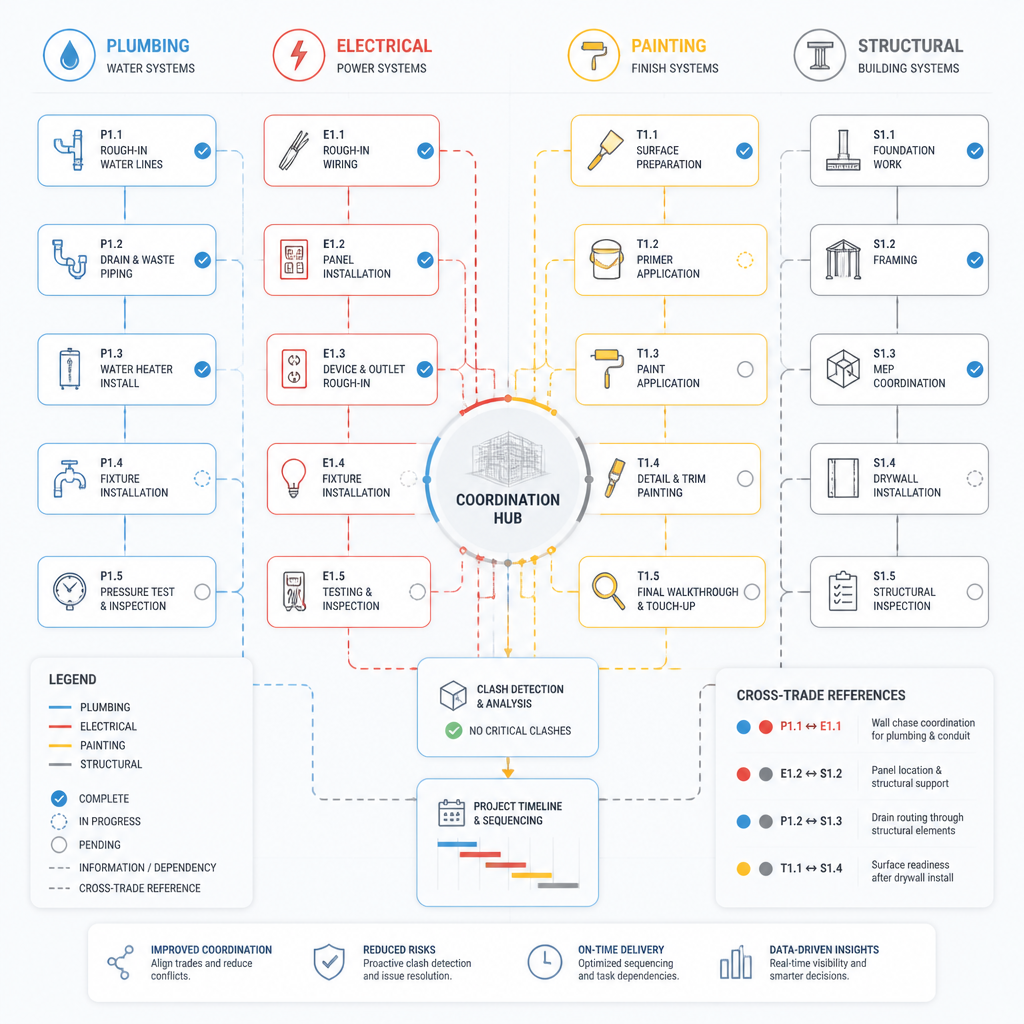
Trade allocation is a construction knowledge task, not just an observation task. An inspector who can identify that a surface finish is defective is doing half the job. The inspector who can identify that the defect was caused by the plasterboard installer rather than the painter, or by the waterproofer rather than the tiler, is doing the full job.

Reading the Defect to Identify the Cause
Experienced inspectors work backwards from the visible defect to the trade that caused it. A cracked tile over a wet area may look like a tiling defect, but if the substrate was not properly prepared or if another trade caused impact damage after the tiles were laid, the fault belongs elsewhere. A paint finish that is bubbling or lifting may indicate a painter’s application error, but it might also indicate a moisture issue that belongs to the waterproofer or the plumber. Assigning the wrong trade does not help the builder, and it does not help the subcontractor who receives a rectification instruction for work that is not their responsibility.
Using Physical Markers on Site
Some inspection methods combine the written report with physical markers placed directly on defects during the inspection. Coloured tape applied to a paint or plaster defect, for example, makes it immediately obvious to the relevant trade what needs to be addressed when they return to site, without requiring them to cross-reference a report and locate the item. This approach eliminates the “I couldn’t find it” response that sometimes delays rectification on busy sites with multiple active areas.
Pro tip: When reviewing a pre-handover inspection report, check whether each defect entry names a specific trade, not just a location or a symptom. If the report says “defect in bathroom” without specifying whether it belongs to the waterproofer, tiler, or plumber, the builder has no clear direction for scheduling the return visit.
Handling Defects with Overlapping Responsibility
Not every defect has a single clear owner. A common scenario is a wet area that has both tile grout failure and evidence of water ingress, where the waterproofer and tiler both have potential liability. In these cases, the best practice is to document the defect with full photographic evidence, note the visible symptoms that point to each trade, and assign a primary responsibility while flagging the overlap. The alternative, leaving it unassigned, guarantees delay. Assigning it with a note about the overlap gives the builder the information they need to manage the conversation with both subcontractors.
Common Trades and Their Defect Categories
Understanding which defects belong to which trade is what separates a thorough pre-handover inspection from a surface walkthrough. In Southeast Queensland new home builds, the trades most frequently associated with defects at practical completion include the following categories.
Painting subcontractors are responsible for finish quality across all painted surfaces, including runs, holidays (missed spots), poor cut-in lines, and uneven sheen levels. Tilers are responsible for correct lippage (height variation between adjacent tiles), grout consistency, correct fall in wet areas, and cracked tiles. Plumbers carry responsibility for correct fixture installation, proper sealing around penetrations, and functional water pressure. Carpenters are responsible for door alignment, hardware installation, cabinetry fit, and skirting and architrave installation.
Waterproofers are responsible for membrane continuity, correct flashing installation, and adequate coverage in wet areas and balconies. Concreters carry responsibility for slab finish quality, correct falls for drainage, and crack management. Framers are responsible for structural alignment, correct fixing, and plumb and level tolerances. Electricians are responsible for correct fixture installation, switch plate alignment, and functional testing of all points.
Pro tip: A defect report structured by trade rather than by room allows a builder to extract and forward each trade’s section directly. The painter gets only the painting items. The plumber gets only the plumbing items. No builder mediation required, no risk of a trade missing items buried in another trade’s section.
What a Trade-Allocated Defect Report Looks Like in Practice
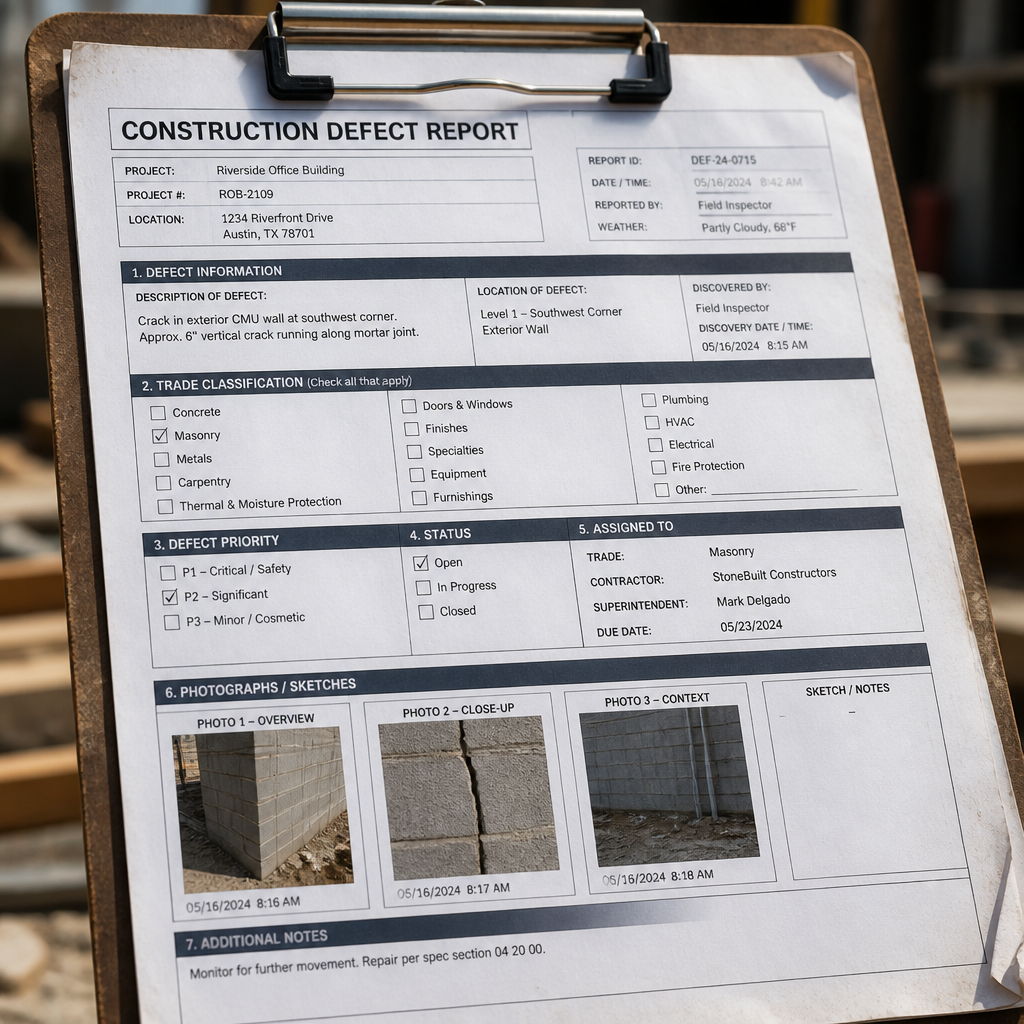
The building inspection report format used by GoInspect is built around trade allocation as a core output, not an optional extra. Each defect entry includes a photograph of the defect, the location within the property, a description of the issue, and the trade assigned. Reports are delivered the same day as the inspection, which matters when pre-handover timelines are tight.
For a typical new home build in Brisbane or Logan, a pre-handover inspection report might include 30 to 60 defect items across eight to twelve trades. Without trade allocation, that report lands on a builder’s desk as a task list that still requires significant internal work to convert into subcontractor instructions. With trade allocation, each subcontractor can be contacted directly with their specific section, reducing the time between report delivery and first rectification action.
For high-rise apartment and multi-unit developments across Brisbane and the Gold Coast, the same principle applies at larger scale. A development with 80 units and a shared rectification schedule benefits enormously from a report format that can be sorted and filtered by trade across all units, rather than requiring a supervisor to manually parse 80 separate room-by-room lists.
The Role of Photographic Evidence
Photographic evidence does two things in a trade-allocated report. First, it removes any dispute about whether the defect exists, because the image is contemporaneous and timestamped. Second, when the photograph clearly shows the defect in context, an experienced trade can assess scope before returning to site, which improves the efficiency of the return visit. A painter who can see that a holiday covers a 300mm section of cornice in the master bedroom arrives with the right materials. A painter told only that “there is a paint defect in the master bedroom” does not.
Australian building tribunals, including the Queensland Building and Construction Commission dispute resolution process, weigh photographic evidence from independent inspectors heavily. A defect that is photographed, timestamped, assigned to a trade, and documented as open at the time of inspection is a defect with a documented evidentiary basis. A defect that was mentioned verbally, or noted on a handwritten list without images, is significantly harder to pursue if the builder does not rectify it.
Comparison: Report Formats and Their Real-World Impact
Not all defect reports are structured the same way. The format of a defect report directly affects how quickly defects are resolved and how useful the report is if a dispute arises. The three approaches most commonly encountered in the Queensland new home market are a basic defect list, a photo-enhanced report without trade allocation, and a full trade-allocated photo-enhanced report.
| Report Format | Key Characteristics | Practical Impact on Rectification |
|---|---|---|
| Basic Text Defect List | Written descriptions only, no photographs, no trade assignment, often room-by-room | Builder must diagnose each defect, identify responsible trade, and risk disputes about whether defects were actually present. High follow-up burden on homeowner. |
| Photo-Enhanced Report Without Trade Allocation | Photographs accompany each defect, but no trade is specified. Location and description provided. | Removes the “does this defect exist” argument, but leaves trade identification to the builder. Reduces disputes about existence, does not reduce coordination delays. |
| Trade-Allocated Photo-Enhanced Report | Each defect is photographed, described, located, and assigned to the responsible trade. Same-day delivery where available. | Builder can forward directly to each subcontractor. No internal diagnosis required. Creates a clear open-item record for warranty and QBCC purposes. Fastest path to rectification. |
The difference between the first and third formats is not minor. A basic text list asks the builder to do the inspector’s analytical work. A trade-allocated, photo-enhanced report converts the inspector’s findings directly into a subcontractor action plan. For homeowners and investors who need a resolved defect list before settlement or occupancy, the format of the report is as important as the thoroughness of the inspection itself.
Legal and Warranty Implications of Trade-Specific Defect Documentation
In Queensland, the defect liability period for new residential construction is typically 12 months from practical completion under most standard contracts, with statutory warranty periods extending significantly beyond that for structural defects under the QBCC Act. The defect liability period has a hard end date. Homeowners who do not have a formally documented defect record before that period expires lose the straightforward contractual mechanism for requiring rectification.
A trade-allocated, photo-enhanced defect report produced by a licensed independent inspector is the strongest form of defect documentation available to a homeowner in this context. It demonstrates that the defect existed at or near practical completion, identifies the responsible party, and establishes a baseline that can be compared against a re-inspection if the builder claims to have rectified items that are still outstanding.
Open and Closed Status Tracking
A defect report is most powerful when it supports an open-and-closed tracking process. Each defect is logged as open at the time of inspection. After the builder’s rectification round, a re-inspection closes items that are resolved and keeps open items that remain outstanding. This cycle creates a documented rectification history that is far more useful in a formal dispute than a single original report. The defect report by trade format makes this tracking practical, because items can be filtered by trade to assess each subcontractor’s rectification performance separately.
The Queensland Building and Construction Commission can be engaged if a builder fails to rectify within the defect liability period, and a formal complaint is supported by documentary evidence. A report produced by a licensed independent inspector, showing the defect with photographic evidence, the date it was identified, its open status, and any subsequent re-inspection findings, provides the documented basis for that complaint. Verbal records and builder-issued documents alone carry far less weight in a formal dispute process.
GoInspect’s inspectors are fully licensed under the QBCC framework, which means the reports they produce carry the appropriate standing for use in formal dispute processes. For homeowners in Brisbane, Gold Coast, Logan, Ipswich, and Redland Bay preparing for handover or settlement, this distinction matters. An inspection report produced by an unlicensed inspector has no formal standing in a QBCC process, regardless of how thorough the underlying inspection was.
Frequently Asked Questions
What does trade allocation mean in a building defect report?
Trade allocation means that each defect identified during a building inspection is tagged to the specific subcontractor responsible for that scope of work, such as the painter, tiler, plumber, or waterproofer. Rather than listing defects by room or area alone, the report specifies who is accountable for each item. This allows the builder to forward relevant sections directly to each subcontractor rather than conducting their own internal diagnosis of every entry on the list.
Does every defect have a clearly identifiable responsible trade?
Most defects can be allocated to a specific trade based on the nature of the defect and the construction methodology. Paint finish failures belong to the painter. Tile lippage belongs to the tiler. Incorrect door alignment belongs to the carpenter. Some defects involve overlapping responsibilities, such as a wet area failure that could involve both the waterproofer and the tiler. In those cases, a well-structured report documents both contributing factors and assigns primary responsibility while noting the overlap, rather than leaving the item unallocated.
Why does the report format matter for QBCC complaints?
The Queensland Building and Construction Commission relies on documented evidence when assessing defect complaints. A photo-enhanced report produced by a QBCC-licensed independent inspector, with defects identified, timestamped, and assigned to responsible trades, provides a strong evidentiary basis for a formal complaint. A verbal report or a basic text list without photographs is significantly harder to rely on if the builder disputes whether defects existed at the time of practical completion.
How does trade allocation in a defect report benefit builders and developers?
Trade allocation benefits builders by removing the internal diagnostic work that would otherwise be required before scheduling subcontractor returns. A site supervisor who receives a 50-item defect list with each item already assigned to a trade can begin coordinating return visits immediately. Without that allocation, the supervisor must review every item, determine responsibility, and risk disputes with subcontractors who dispute their allocation. For developers managing multi-unit projects, a trade-sortable defect report is an essential coordination tool across a large number of units and trades.
Can trade allocation be wrong, and what happens if it is?
Trade allocation can be incorrect in cases where the defect cause is not immediately apparent, or where one trade’s work has been damaged by another. A responsible inspection report handles this by noting the visible evidence and the basis for the allocation, rather than asserting absolute fault. If a subcontractor disputes their allocation and demonstrates that another trade caused the damage, the builder adjusts the instruction accordingly. The report’s role is to initiate the rectification process, not to serve as the final determination of legal fault. Photographic evidence of the defect’s condition at the time of inspection remains valid regardless of how the internal responsibility question is later resolved.
What is the difference between a pre-handover inspection and a pre-settlement inspection at GoInspect?
A pre-handover inspection takes place before the keys are handed to the owner, typically at practical completion, and identifies defects the builder must address before or shortly after handover. A pre-settlement inspection is conducted for buyers purchasing a property that is already built but not yet settled, allowing defects to be identified and negotiated before the purchase is finalised. Both inspection types produce trade-allocated, photo-enhanced reports through GoInspect, and both serve as formal documentation for rectification purposes. The distinction matters because the leverage available to the owner differs depending on which stage the inspection occurs.
How quickly should a builder act on a trade-allocated defect report?
Under most Queensland residential construction contracts, the builder is expected to rectify items identified at practical completion within a defined period, often between 14 and 30 days for the initial rectification round. For items identified during the defect liability period, the builder has a contractual obligation to address defects raised in writing within that period. A trade-allocated defect report delivered on the same day as the inspection gives the builder and their subcontractors the maximum available time within that window to complete rectification before any formal escalation is required.
Have you received a building inspection report that left you unsure who was responsible for fixing each defect? We would like to hear about your experience with the rectification process and what made it easier or harder to resolve.
References
- Queensland Building and Construction Commission guidance on lodging a defective work complaint
- Construction defect management practices in Australia including practical completion and trade coordination
- Overview of what a building defect report covers and how it is used in dispute resolution
- How the construction defect list process works and the roles of builders, owners, and subcontractors
- How to document building defects to support a legal claim or warranty process in Queensland