

Most new home buyers sign handover documents without truly understanding what happened in the hour before. A practical completion inspection is your one structured opportunity to walk through your new home, document every defect on record, and hold your builder contractually accountable before you hand over the final payment. Miss it, rush it, or skip independent verification, and you are managing problems at your own cost for years. This guide covers everything Queensland buyers, investors, and owner-builders need to know about the PCI inspection process, including what gets checked, what your legal rights are, and how to make sure your report actually produces results.
Table of Contents
- What Is a Practical Completion Inspection?
- Quick Takeaways
- When Does a PCI Happen and Who Triggers It?
- What a PCI Inspector Actually Checks
- Your Legal Rights in Queensland
- PCI Inspection Types Compared
- Common Defects Found at Practical Completion
- What Happens After the PCI Report?
- Frequently Asked Questions
- References
What Is a Practical Completion Inspection?
A practical completion inspection, also referred to as a PCI inspection or handover inspection, is the formal assessment of a newly built home immediately before handover. It takes place when the builder issues a notice that the property has reached practical completion, meaning construction is essentially finished and the home is fit for occupation, even if a small number of minor items remain outstanding.
In Queensland, the Queensland Building and Construction Commission (QBCC) defines practical completion as work completed to the contract, plans, and specifications, with only minor defects or omissions, and suitable for habitation and compliant with statutory requirements. That definition matters because your builder will use it to argue that handover is due and your final payment is owed.
The PCI inspection sits between the builder’s notice of practical completion and the moment you sign handover documents and accept the keys. It is the last point at which you hold clear contractual leverage. After signing, defect rectification becomes a warranty process, and warranty processes are slower, more disputed, and less certain.
The practical completion inspection is not a formality. It is the only moment in the entire building process where an independent set of eyes can document defects while the contract is still fully active and the builder’s obligation to fix them is at its strongest.
Quick Takeaways
| Key Insight | Explanation |
|---|---|
| Book the PCI before handover, not after | Once you sign handover documents and accept the keys, your legal position to force builder rectification weakens significantly. The inspection must happen before you sign. |
| Use an independent licensed inspector, not the site supervisor | Your builder’s supervisor works for the builder. An independent inspector works for you. In Queensland, inspectors must hold a valid QBCC licence to carry out building inspections lawfully. |
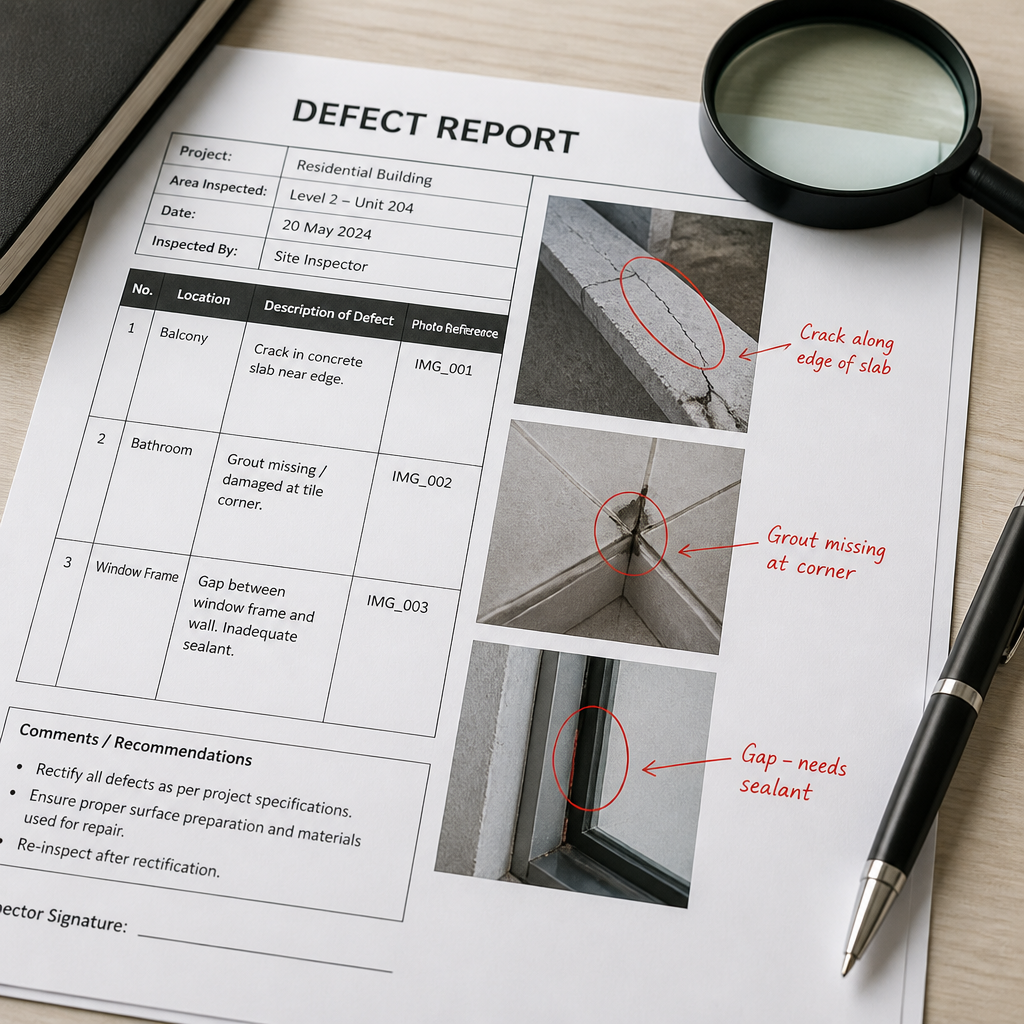
| Photo-enhanced reports are faster to act on | A report that assigns each defect to a specific trade, with timestamped photos and room locations, removes ambiguity. Builders cannot dispute what has been photographed and documented clearly. |
| The QBCC non-structural defect warranty period is 3 years from practical completion | For non-structural defects, QBCC complaints must be lodged within this period. Structural defects have different timeframes. Documenting defects at PCI stage gives you a clear dated record from day one. |
| The PCI applies to houses, townhouses, apartments, and duplexes | Any new residential build in Queensland, from a freestanding house in Logan to a high-rise apartment on the Gold Coast, benefits from an independent practical completion inspection. |
| Never accept a builder’s defect list as sufficient | Builders typically present a short internal checklist at PCI. This list is rarely complete and is not independent. An independent report will almost always identify additional items the builder’s list missed. |
| Same-day reports allow you to negotiate before settlement | Receiving a detailed defect report the same day as the inspection means you can use the findings in your handover discussions immediately, rather than waiting days for documentation while time pressure mounts. |
Understanding the practical purpose of each of these insights is what separates buyers who sail through handover from those who spend the first year of ownership chasing trades for repairs they should never have had to manage themselves. The PCI is not a defensive move. It is simply the correct way to close out a construction contract.

When Does a PCI Happen and Who Triggers It?
The builder triggers the PCI process by issuing a Notice of Practical Completion. This document is your signal that handover is approaching and that you should arrange your independent inspection as soon as possible. In most Queensland residential contracts, you have a set number of days to respond to this notice, so urgency matters.
Timing Your Independent Inspection
Book your independent inspector the moment you receive the builder’s notice, not after you have toured the property informally with the site supervisor. The informal walkthrough builders offer before handover is not a PCI. It is a sales process designed to create positive sentiment, not a systematic defect check. Your independent inspection is the real check.
If your builder pushes you to attend handover before your inspector has been able to visit, resist that pressure. Request a short delay. Builders who pressure buyers to skip independent inspections or rush handover are a warning sign in their own right. A competent builder with a well-finished home has no reason to object to an independent check.
High-Rise and Multi-Unit Developments
For apartments and high-rise developments, the process works slightly differently. The body corporate or developer typically manages the common areas separately, while individual lot owners are responsible for inspecting their own apartments or units. Independent inspectors with experience in high-density builds can assess both your individual dwelling and flag visible issues in common access areas that affect your lot.
Pro tip: If you are an investor purchasing off-the-plan in a development across Brisbane, Gold Coast, Logan, Ipswich, or Redland Bay, the notice of practical completion can arrive with very little warning. Keep contact details for your inspector on hand from the moment construction enters its final stages, so you can book immediately when the notice lands.
What a PCI Inspector Actually Checks
A qualified PCI inspector works systematically through every accessible area of the home. The inspection is visual and non-invasive, meaning the inspector will not break into walls or lift flooring, but will check everything that is visible and accessible at the time of inspection.
Interior Checks
Inside the home, inspectors assess the quality of all finishes and workmanship throughout every room. This includes plasterwork for cracking, hollows, and inconsistent finishing; paintwork for coverage, runs, drips, and missed areas; tiling for lippage, grout consistency, cracked tiles, and correct alignment; joinery including doors, windows, cabinetry, and wardrobes for operation, alignment, and finish; wet areas including bathrooms, ensuites, laundries, and kitchens for waterproofing integrity and fixture installation quality; and all fixtures and fittings including tapware, power outlets, light switches, and appliances for correct installation and operation.
Structural and External Checks
Externally, the inspector reviews the structural integrity of the building, drainage and stormwater provisions, driveways and paths for cracking and finish, retaining walls and fencing, roof covering and visible roof elements, termite barrier systems if present, and the condition of the garage including doors, floor, and seals.
What the Inspector Does Not Check
A PCI is not a pest inspection, a pool inspection, or an engineering assessment. It covers visible and accessible building work. If your property includes a pool, a separate pool inspection by a licensed pool inspector should be arranged. Similarly, if specific engineering concerns exist about the slab or structure, a structural engineer’s assessment is a separate engagement.

Your Legal Rights in Queensland
Queensland homeowners are protected by the Queensland Home Warranty Scheme, administered by the QBCC. This is a mandatory insurance scheme that licensed contractors must participate in for residential building work, and it provides cover if a builder fails to complete work or fails to rectify defective work.
Defect Liability and Warranty Periods
The defects liability period (DLP) under most Queensland residential building contracts runs for 12 months from practical completion. During this period, the builder is contractually obliged to return to the property and rectify identified defects. This is separate from, but related to, the broader QBCC warranty protections.
Under the QBCC framework, non-structural defects have a 3-year warranty period from practical completion, within which a complaint must be lodged with the QBCC. Structural defects have different timeframes and different notification requirements. The QBCC also notes that a contractor must repair defects noticed at handover or within 12 months of when the work is finished, and the owner must notify the contractor within 12 months of noticing them.
For homeowners relying on the Queensland Home Warranty Scheme for non-structural defects, the QBCC complaint must be lodged within 7 months of the completion date. For structural defects, you must notify within 3 months of first noticing the defect. These are strict timeframes, and missing them can affect your coverage.
Why Documenting Defects at PCI Matters for Legal Purposes
A dated, photo-enhanced inspection report from a licensed inspector gives you a concrete record of when each defect was first identified. If a builder disputes responsibility for a defect later, a report showing that issue was photographed and documented on the day of practical completion removes all ambiguity about timing. That evidence is invaluable if the matter progresses to QBCC dispute resolution or QCAT.
Pro tip: Do not wait until defects become urgent problems before notifying your builder in writing. Send the PCI report to your builder by email immediately after receiving it, so there is a clear record of notification date and content. Keep all correspondence in writing.
PCI Inspection Types Compared
Not all practical completion inspections deliver the same value. The format, detail level, and independence of the inspection determine how useful the report is when it counts most, which is the moment you are trying to get a builder to fix something before settlement or during the defect liability period.
| Inspection Type | What It Covers | Best For |
|---|---|---|
| Builder’s internal walkthrough | Brief visual check by the site supervisor. Typically produces a short internal checklist. Not independent and not legally useful as evidence. | The builder’s own quality control, not buyer protection. Do not rely on this alone. |
| Independent PCI with standard report | Systematic inspection by a licensed independent inspector covering all visible and accessible areas. Written report with defect descriptions and locations. | Buyers who want a documented record of defects before handover. A solid baseline for most new homes. |
| Independent PCI with photo-enhanced trade-assigned report | Full inspection plus timestamped photos of every defect, with each item assigned to the responsible trade. Same-day delivery. Covers houses, townhouses, units, duplexes, and high-rise developments. | Buyers, investors, and developers who need a report that drives action, not just documents problems. The most effective tool for builder rectification and QBCC proceedings. |
The difference between a standard report and a photo-enhanced, trade-assigned report is not cosmetic. Builders respond faster to reports that remove all interpretation. When a defect is photographed, located, described, and assigned to the relevant trade, there is no room for the builder to claim confusion about what needs to be fixed or who should fix it. That specificity is what gets results.
Common Defects Found at Practical Completion
New homes across Queensland consistently produce a predictable range of defects at practical completion stage. None of these should be surprising. They reflect the realities of multi-trade builds, tight construction schedules, and the number of handoffs between subcontractors across a typical residential project.
Finishes and Workmanship
Paint defects are among the most frequently documented items at PCI. These include insufficient coverage, runs, drips, areas of missed paint, inconsistent sheen levels between adjoining surfaces, and damage caused by other trades working after the painters left. Plaster defects, including cracking, hollow sections, and uneven finishing that becomes visible under raking light, are also common.
Tiling issues are a persistent problem in Queensland new builds. Tile lippage, inconsistent grout lines, grout colour variations, cracked tiles from subfloor movement, and inadequate waterproofing membrane application in wet areas all appear regularly. Waterproofing defects are particularly important to identify at PCI stage because they cause significant damage over time if water penetrates behind tiles.
Joinery and Fixtures
Doors that do not close properly, cabinetry with misaligned doors or drawers, window frames that are difficult to operate, and loose or incorrectly installed tapware and fixtures all appear regularly in PCI reports. These are items that a site supervisor may overlook precisely because they have been living with them during the construction process and no longer notice them.
External and Structural Items
Cracking in concrete driveways and paths, poor drainage around the perimeter of the building, inadequate landscaping as specified in the contract, damaged roof tiles or ridge capping, and gaps in termite barrier systems are all items that experienced inspectors find at practical completion across Brisbane, Gold Coast, Logan, Ipswich, and Redland Bay builds. Moisture readings elevated in walls or ceilings can also indicate drainage or waterproofing issues that are not yet visible to the naked eye.
What Happens After the PCI Report?
Receiving your report is the start of the rectification process, not the end of it. The next steps determine whether the inspection produces real outcomes or just generates paper.
Sending the Report to Your Builder
Send the PCI report to your builder by email immediately after you receive it. Do not wait to discuss it verbally first. The email creates a timestamped record of notification that is important for both the defect liability period and any future QBCC proceedings. Include a clear request that the builder confirm receipt and provide a rectification timeline.
Delaying Handover or Final Payment
If significant defects are identified that prevent the home from meeting the practical completion standard, you have grounds to defer the handover and withhold the final payment until those items are rectified. Your contract will specify the precise process, and it is worth reading that section carefully before handover approaches. Do not assume your builder will volunteer this information.
Re-Inspection After Rectification
Once the builder advises that defects have been rectified, arrange a re-inspection before accepting settlement. Builders sometimes address items superficially, or fix one element while introducing new damage nearby. A follow-up inspection by the same licensed inspector confirms that the original defect list has been genuinely addressed, not just marked off internally. This step is as important as the original PCI, particularly on larger builds or projects with extensive defect lists.
GoInspect’s photo-enhanced reports assign each defect to the responsible trade, making re-inspection straightforward. The original photos and descriptions provide a direct benchmark against which the rectification work can be measured. If an item was not fixed to the required standard, the comparison is unambiguous.
Frequently Asked Questions
What is the difference between a practical completion inspection and a pre-settlement inspection?
A practical completion inspection happens when the builder declares the home is finished and before you sign handover documents. A pre-settlement inspection typically refers to an inspection carried out before final payment and settlement on a property, which may be a new build or an established property. For new builds in Queensland, these terms are often used interchangeably because both refer to the inspection that occurs at the end of the build cycle before legal ownership transfers and the final payment is made. In practice, the PCI is the most critical of the two because it is conducted while the builder’s contractual obligations are at their strongest.
Do I legally have to use an independent inspector for my PCI in Queensland?
You are not legally required to hire an independent inspector for your PCI in Queensland. The QBCC notes that owners can engage a building inspector to check building work on their behalf, at their own cost. However, not using one is a significant risk. Your builder’s site supervisor is not independent, and their internal checklist is not designed to protect your interests. An independent inspection by a QBCC-licensed inspector is the only way to get an unbiased, legally useful record of the home’s condition before handover.
How long does a practical completion inspection take?
For a standard single-level house, a thorough PCI inspection typically takes between two and four hours depending on the size of the property, the number of rooms, and the volume of defects found. Larger homes, multi-level houses, and apartments in high-rise developments may take longer. The inspection time is less important than the thoroughness of the process. A rushed inspection that misses defects is worse than no inspection at all, because it gives you false confidence before handover.
What happens if my builder refuses to fix defects identified in the PCI report?
If a builder refuses to fix defects identified in your PCI report, you have several options. First, ensure you have sent the report formally by email so there is a written record. If the builder continues to refuse, you can lodge a complaint with the QBCC, which can direct the builder to rectify the work. If the builder still fails to comply, the QBCC has the power to take enforcement action including suspending or cancelling the builder’s licence. For complex or high-value disputes, engaging a building and construction lawyer alongside the QBCC process is advisable. The key is that your PCI report, with its dated photographs and clear defect descriptions, forms the evidential foundation for any formal dispute.
How much does a practical completion inspection cost in Queensland?
The cost of a professional practical completion inspection in Queensland varies depending on the size and type of property and the level of reporting detail. For a comprehensive, photo-enhanced inspection with same-day reporting, you should expect to pay from around $550 including GST for a standard house. This is a small fraction of the value of your property and an even smaller fraction of what builder rectification would cost if defects are signed off at handover without being documented. The cost of an independent PCI is one of the most straightforward value-for-money decisions in the entire building process.
Can I attend my own practical completion inspection?
Yes, you can and often should attend the inspection alongside your independent inspector. Being present allows you to ask questions in real time, understand the defects being documented, and see the condition of the property with your own eyes before committing to handover. Bring a copy of your building contract, the plans and specifications, and any correspondence from your builder about outstanding items. Do not bring young children if you can avoid it, as a PCI requires sustained attention and the inspection period is not the time for distractions.
Have you recently gone through a practical completion inspection for a new home in Brisbane, Gold Coast, Logan, Ipswich, or Redland Bay? Share your experience in the comments, including what you found and whether your builder responded well to the defect report.
References
- QBCC guidance on finalising building work and practical completion in Queensland
- What to do when the builder’s PCI defect list is missing items
- How to make a building defect claim through the QBCC in Queensland
- Queensland defects liability period: homeowner rights and legal remedies guide
- Understanding pre-handover inspections: a guide for Queensland homebuyers