
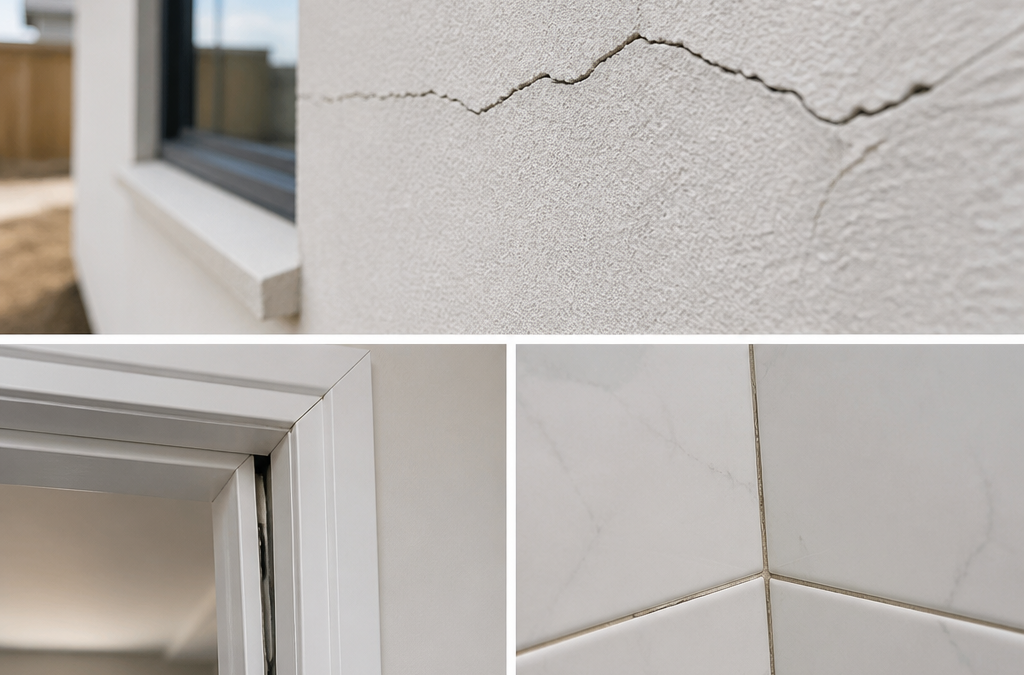
You receive your builder’s notice of practical completion, walk through your new home, and spot problems. A cracked render panel here, a poorly fitted door frame there, uneven tiling in the ensuite. You mention it to the builder and get a shrug, a promise to “sort it out later,” or a flat denial that anything is wrong. This scenario plays out constantly across Brisbane, the Gold Coast, Logan, Ipswich, and Redland Bay. The reason it keeps happening is simple: without a photographic building defect report prepared by an independent, licensed inspector, you have an opinion. With one, you have a documented, timestamped, trade-attributed record that changes the entire dynamic of the rectification conversation.
Table of Contents
- Quick Takeaways
- Why Photos Change the Defect Conversation
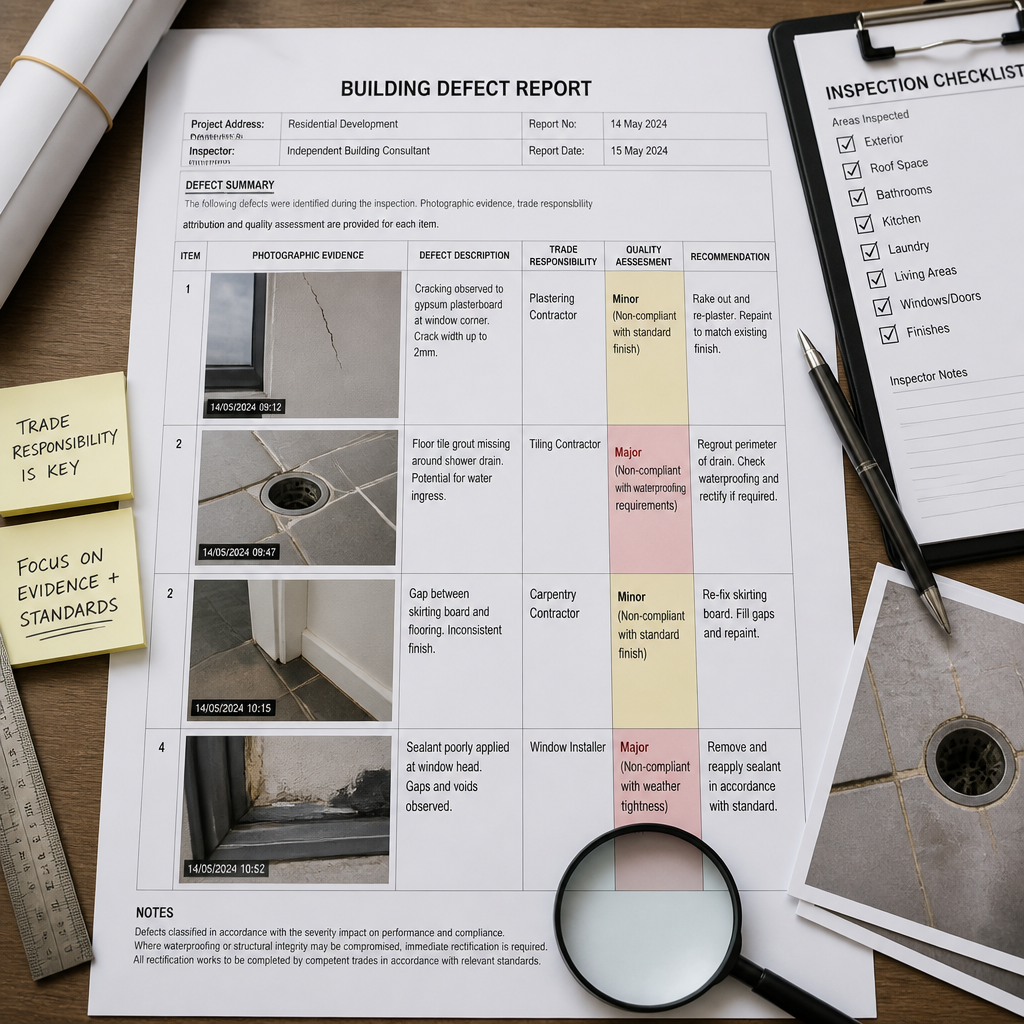
- What a Photographic Defect Report Actually Contains
- Trade Responsibility Assignment: The Detail Most Reports Miss
- Using Your Report in the QBCC Process
- Report Formats Compared
- Timing: When to Commission Your Inspection
- Frequently Asked Questions
- References
Quick Takeaways
| Key Insight | Explanation |
|---|---|
| Photos turn opinions into evidence | A verbal description of a defect is easy for a builder to dispute. A referenced close-up photograph of the exact defect, timestamped and labelled by location, is not. |
| Trade attribution speeds up rectification | Knowing which trade is responsible for each defect means your builder can call back the right subcontractor immediately, rather than spending days re-inspecting and debating scope. |
| Same-day reports matter at handover | Builders schedule final payments around handover milestones. A report delivered the same day keeps rectification on the agenda before final settlement pressure disappears. |
| QBCC complaints require documented evidence | If a builder refuses to rectify, a photographic defect report is the primary supporting document for a QBCC complaint and any subsequent QCAT application. |
| Generic checklists carry almost no weight | A text-only defect list with no photos, no location references, and no trade attributions is difficult to act on and easy for a builder to push back against. |
| Sign-off cannot be undone without evidence | Once you accept handover, your rectification rights still exist under warranty law, but your negotiating position is far weaker than it was before final payment. |
| Independent inspection is not the builder’s job | A builder’s own completion checklist serves the builder’s interests. An independent photographic inspection serves yours. They are not the same thing. |
Why Photos Change the Defect Conversation
The core problem with a verbal defect list, or even a typed list with no images, is that it creates a dispute about perception. The builder’s site supervisor walks through the same property and sees something different to what you described. Or they agree the issue exists but argue it meets the relevant standard. Without photographic documentation, you are comparing memories and interpretations, which rarely resolve in the homeowner’s favour.
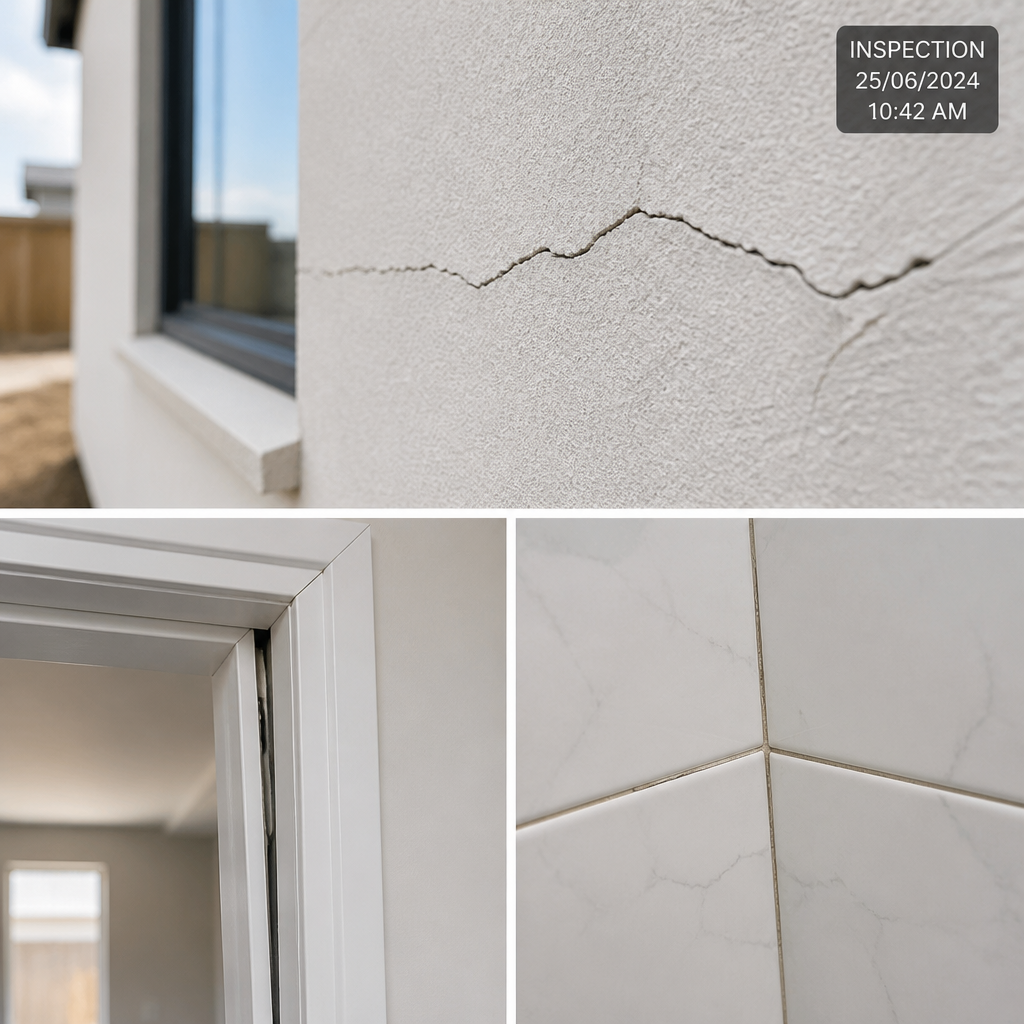
A photo defect report for a builder removes this ambiguity. Each defect entry includes a referenced photograph showing the exact condition, cross-referenced to a specific location within the home. There is no room to claim the issue was not present at handover, that the photograph shows a different area, or that the defect description is exaggerated. The image is the record.
This matters especially for surface defects in plastering, painting, tiling, and joinery, where acceptable finish standards involve some degree of professional judgment. When a licensed inspector photographs a paint run at a noted location, references it to the Australian Standard for painting of buildings, and assigns it as incomplete work by the painting trade, that entry carries a weight no verbal complaint can match.
A photographic building defect report is not just a list of problems. It is a structured legal document that assigns responsibility, references standards, and creates a chain of evidence the builder must respond to in writing or risk formal escalation.
Pro tip: Ask your inspector to photograph defects at a consistent distance and with a scale reference where possible. This ensures the severity of the issue is clear in the image, and that size-based disputes, such as tile lippage or gap widths, cannot be argued away in a rectification meeting.
What a Photographic Defect Report Actually Contains
Not every inspection service produces the same quality of documentation. Understanding what a high-quality photographic building defect report contains helps you judge whether you are getting documentation that will hold up, or a simplified summary that creates more arguments than it resolves.
The minimum standard: referenced photos per defect
Every individual defect entry should have its own photograph. Not a general photo of a room with five defects circled, but a close-up image of the specific fault, clearly labelled with its location within the build. This means if your new home has 40 defects documented, the report contains at least 40 referenced photographs.
Generic room-level photos attached as appendices are not the same thing. They do not create a clear connection between a specific fault and a specific location, and they are much harder to use in a formal dispute or QBCC complaint.
Location referencing within the report
Each defect should be referenced to a specific area of the home, at a minimum the room and surface (for example, “Master bedroom, north wall, top 300mm of plaster”). Some reports also use a floor plan reference system to mark defect locations, which is particularly useful on multi-storey or high-rise projects where room identification across floors can become confusing.
Standard and contract references
A credible report does not just describe what the inspector saw. It references the relevant Australian Standard, the QBCC’s Defective Work Guidelines, or the specific clause in your building contract that the work fails to satisfy. This transforms the report from a personal opinion into a document grounded in enforceable requirements.
Pro tip: When you receive your report, check that each defect entry includes a reference to the applicable standard or guideline. If the report simply lists items without explaining why they fall short of requirements, it will be harder to use in any formal process.
Trade Responsibility Assignment: The Detail Most Reports Miss
Most homeowners think about defect reports as a list of what is wrong. The more important question is: wrong according to whose work? A new home involves dozens of subcontractors. The concretor, the framer, the bricklayer, the plasterer, the tiler, the painter, the electrician, the plumber, the joiner. When a defect crosses trade boundaries or results from one trade’s work affecting another’s finish, the builder can spend considerable time determining who is responsible before any rectification even begins.
A report that assigns trade responsibility to each defect eliminates that delay. When your builder receives a report that states, for a specific door frame issue, that this is a joinery trade defect at a particular location, the site supervisor does not need to re-examine the property to work out who to call. They call the joiner.
This is one of the most practical differentiators between a quality inspection and a basic checklist service. On a home with 30 to 50 defects spread across multiple trades, the time saved in routing rectification work directly cuts weeks off the process for both you and your builder. It is also far harder for a builder to argue that a defect is not their responsibility when the inspector has already provided a professional assessment of which trade produced the fault.
Using Your Report in the QBCC Process
Most defect disputes are resolved before they reach a formal complaints process. A well-documented photographic report, delivered the same day as the inspection, usually produces a written rectification schedule from the builder within days rather than weeks. The builder knows what the report contains, knows you have a formal record, and has a financial and reputational incentive to address the items before they escalate.
When that does not happen, the Queensland Building and Construction Commission (QBCC) provides the formal pathway. Under Queensland law, homeowners can lodge a complaint with the QBCC about defective building work, and the QBCC can issue a Direction to Rectify that compels the builder to address identified defects within a specific timeframe. Failure to comply with a Direction to Rectify can result in fines and the direction appearing permanently on the builder’s licence history.
The key requirement at every stage of the QBCC process is documentation. The QBCC’s own guidance, and legal practitioners who handle QCAT building disputes, consistently identify new home defect evidence in the form of photographs and expert reports as the foundational material for any complaint. A formal photographic defect report from a licensed inspector is the strongest possible foundation for this process, far more persuasive than personal photos taken on a phone without professional context or standards references.
What happens if the builder disputes the report
Builders occasionally push back on specific items in a defect report, arguing that a particular issue meets the required standard or resulted from owner-side activity rather than defective construction. A report prepared by a fully licensed inspector, with clear photograph references and standards citations, places the burden of that argument squarely on the builder. They need to provide an equal or better technical basis for their position, which most substandard work cannot support.
If the matter proceeds to QCAT, the Queensland Civil and Administrative Tribunal, the same documentation becomes exhibit material. QCAT has considered photographic evidence and expert building reports in building dispute cases, and the presence of thorough, professionally prepared documentation consistently strengthens a homeowner’s position at tribunal.
Pro tip: Keep a copy of your defect report, all written correspondence with the builder, and any rectification schedules or responses in a single folder from the day of inspection. If the matter escalates to QBCC or QCAT, having this chronological record ready significantly reduces the time and cost of progressing your claim.
Report Formats Compared
Not all inspection documentation is created equal. The table below shows the practical difference between three approaches to defect reporting that Queensland homeowners and investors encounter, and how each performs when the builder pushes back.
| Report Format | Strengths | Weaknesses in a Builder Dispute |
|---|---|---|
| Builder’s own completion checklist | Convenient, included with handover, quick to receive | Produced by the party responsible for the defects. No independent basis. No evidentiary weight. Often minimises or omits items the builder prefers not to fix. |
| Text-only independent defect list | Provides an independent record, better than nothing | Easy to dispute without photographic evidence. No trade attribution. Standards references often absent. Difficult to use in a QBCC complaint or QCAT application without supplementary evidence. |
| Photo-enhanced report with trade attribution (same-day delivery) | Timestamped photographs per defect, location references, trade responsibility assigned, standards cited, delivered the same day as inspection | Higher upfront cost than a basic checklist service, but the cost difference is negligible compared to the cost of unresolved defects post-handover. |
The practical reality is that the format of your report largely determines what happens next. A builder who receives a photo-enhanced report from a licensed inspector on the same day as your walkthrough knows the documentation is complete and defensible. A builder who receives a typed list three days later has significantly more room to negotiate, delay, or dispute individual items.
Timing: When to Commission Your Inspection
The practical completion inspection, also called a PCI or pre-handover inspection, sits at the most important moment in your new home journey. It happens after the builder notifies you that construction is complete and before you make your final payment and accept the keys. This window is when a photographic building defect report carries the most weight.
For Queensland work, contractual defect arrangements, QBCC rectification assistance and Queensland Home Warranty Scheme claims have different eligibility rules and deadlines. Notify your builder promptly in writing and check the current QBCC time limits and eligibility and Home Warranty Scheme claim requirements. Do not assume a maintenance period extends every complaint or insurance deadline.
Pre-handover versus post-handover inspections
A pre-handover inspection with a same-day photo-enhanced report gives you maximum influence: the builder still needs final payment, the defects are freshly documented, and the cost of rectification before handover is lower than mobilising trades back to a completed and occupied home. A post-handover defect inspection is still worth doing if you discover issues after moving in, but the negotiation dynamic is different and the process is typically slower.
Investors and developers on volume builds
For property investors acquiring multiple new builds, or developers managing staged handovers across a high-rise or housing estate, the value of a photographic report with tracked defect status extends beyond the individual handover. Defect statistics across a project reveal which trades are consistently underperforming, which allows developers and builders to make informed decisions about subcontractor engagement on future work. GoInspect’s defect statistics reporting with open and closed tracking is specifically designed for this use case.
For those buying or investing in high-rise developments, the inspection approach differs from a standard house and land package. GoInspect provides customised inspection reports for high-rise apartments and multi-dwelling projects, where defect documentation must account for common areas, individual units, and shared infrastructure across multiple floors.
Frequently Asked Questions
What makes a photographic building defect report different from a standard inspection report?
A photographic building defect report includes a referenced photograph for every individual defect, with each image cross-referenced to a specific location within the home. Standard reports often use written descriptions only, or attach generic room photos that do not clearly identify individual faults. The photographic format creates an unambiguous record that is far harder for a builder to dispute and far more useful in any formal complaints or tribunal process.
Can I use my builder’s completion checklist instead of commissioning an independent inspection?
No. A builder’s completion checklist is produced by the party who is financially responsible for fixing the defects. It reflects what the builder is prepared to acknowledge, not an independent assessment of what is actually present. An independent photographic inspection is the only way to obtain documentation that has no conflict of interest and that carries weight in a QBCC complaint or QCAT application.
Do I need a licensed inspector or can I hire anyone?
In Queensland, your inspector must hold a current QBCC contractor or inspector licence. Unlicensed inspectors have no formal standing, and reports they produce carry no weight in a QBCC complaint, QCAT application, or formal builder negotiation. Always verify the inspector’s licence before engaging them. GoInspect’s inspectors are fully licensed under Queensland requirements.
What should I do if my builder refuses to rectify defects identified in the report?
Start by sending the report to the builder in writing with a formal request for a rectification schedule. If the builder does not respond or refuses to address items, lodge a complaint with the QBCC. The QBCC can issue a Direction to Rectify, which compels the builder to fix defective work within a specified timeframe. Your photographic defect report is the primary evidence supporting that complaint. If the builder fails to comply with the Direction to Rectify, the matter can be escalated to QCAT.
How long after handover can I still make a defect claim in Queensland?
Document the concern and raise it with the builder promptly. Check the current QBCC requirements linked above and obtain advice about the contract and any approaching deadlines.
Does GoInspect cover properties outside Brisbane?
Your GoInspect price depends on the inspection service, property type, size and location. Use the current online quote calculator for your property rather than relying on an old starting price. Builder and developer projects need a project-specific quote.
What is the difference between a pre-handover inspection and a pre-settlement inspection?
A pre-handover inspection (also called a practical completion inspection or PCI) takes place when your builder notifies you that construction is complete, before you accept the keys and make final payment. A pre-settlement inspection typically refers to a final check on an established property or off-the-plan apartment immediately before legal settlement, to confirm condition matches the contract. GoInspect provides both, with the same standard of photographic documentation in each case. You can read more about what to expect in a pre-handover inspection in Brisbane.
Have you used a photographic defect report when dealing with your builder? Share your experience in the comments, we would like to hear what worked and what you would do differently.
References
- Queensland Building and Construction Commission: how the defective work resolution process works
- Guide to making a building defect claim in Queensland, including QBCC warranty periods and complaint steps
- Complete guide to QCAT building disputes in Queensland, including photographic evidence requirements
- Legal aspects of pre-handover inspections and the role of photographic documentation in defect disputes
- Defective building work in Queensland: homeowner rights, QBCC complaints, and rectification options