
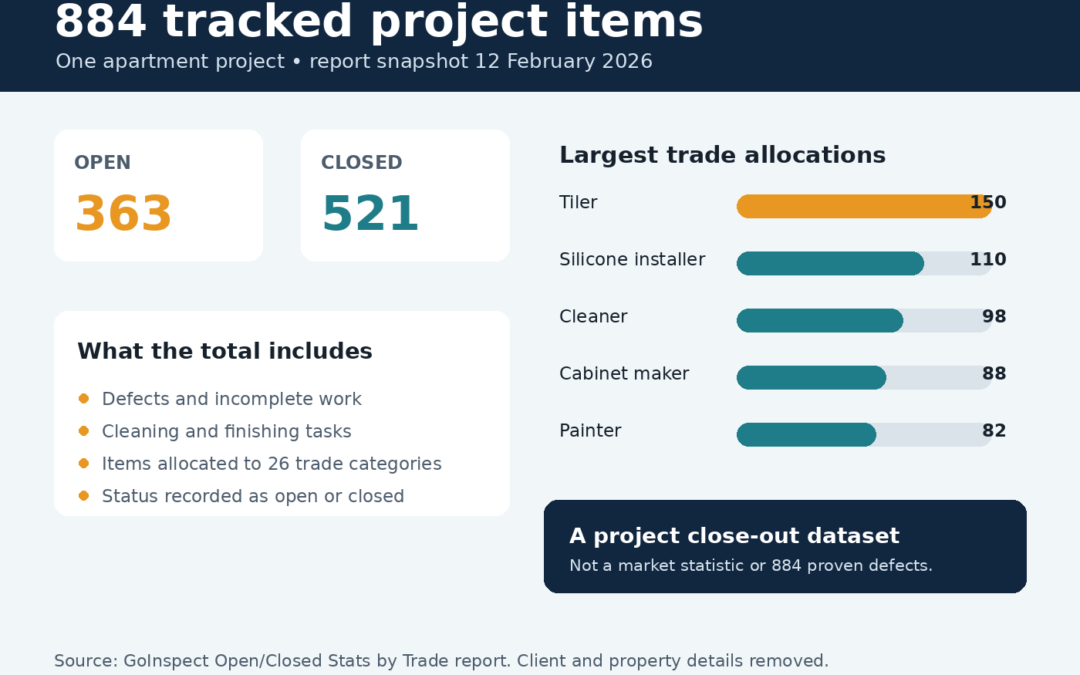
The number that first catches attention is 884. But the useful lesson is what sits behind it. A GoInspect report dated 12 February 2026 recorded 884 trade-allocated work items across one multi-residential project: 363 open and 521 closed at that snapshot.
That does not mean the project had 884 individually proven construction defects. The total combined photographed defects, incomplete work, cleaning and finishing tasks assigned across 26 trade categories. It is a project close-out dataset, not a market statistic or a current outstanding tally.
Takeaway: an apartment defect report becomes more useful when every item can be viewed by trade, location and status. The headline count shows workload; the underlying records show what needs action, who should review it and whether it has been closed.
What did the 884-item report actually reveal?
The project-level report grouped items by the trade responsible for reviewing or rectifying them. The five largest allocations were:
| Trade allocation | Open | Closed | Total |
|---|---|---|---|
| Tiler | 31 | 119 | 150 |
| Silicone installer | 67 | 43 | 110 |
| Cleaner | 49 | 49 | 98 |
| Cabinet maker | 28 | 60 | 88 |
| Painter | 42 | 40 | 82 |
The cleaner allocation is an important clue. It shows why the total cannot simply be relabelled as a defect count. A close-out list can contain construction defects alongside incomplete cleaning, minor finishing and other tasks that still affect readiness. The report also shows progress: 521 items were recorded as closed and 363 remained open on that date.
The level view showed where the workload sat
A companion report grouped the same 884 items by project level. It recorded 293 items on Level 1, 260 on Level 2 and 245 on Level 3, with another 51 at ground level and 35 in external areas. Those totals add a second operational view: the project team can see where access, supervision and return visits may need to be concentrated, while the trade report shows who needs the worklist.
Again, the largest level total does not automatically identify the worst construction outcome. A level may contain more apartments, more completed inspections or more minor finishing tasks. The report supports planning only when the team can open the underlying records and review the location, description, photograph and status of each item.
What did individual apartment findings look like?
The statistics only become actionable when they connect back to a specific, photographed record. The source reports for this project included items such as poorly finished silicone at a shower, chipped balcony tiles around an overflow and a damaged cabinet edge strip.
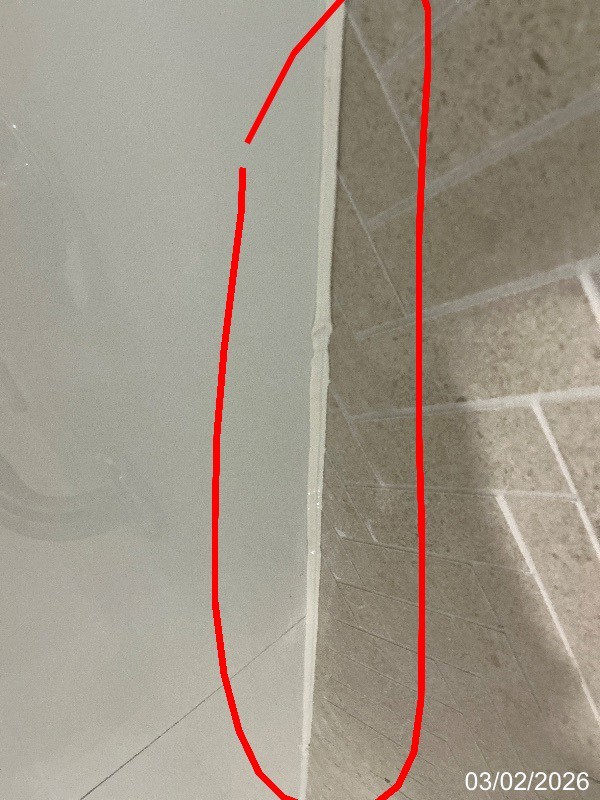
A useful record should say more than “silicone issue”. It should identify the room or area, show the observed condition and allocate the item so the right trade can respond. That reduces interpretation when hundreds of records are being coordinated across multiple apartments.
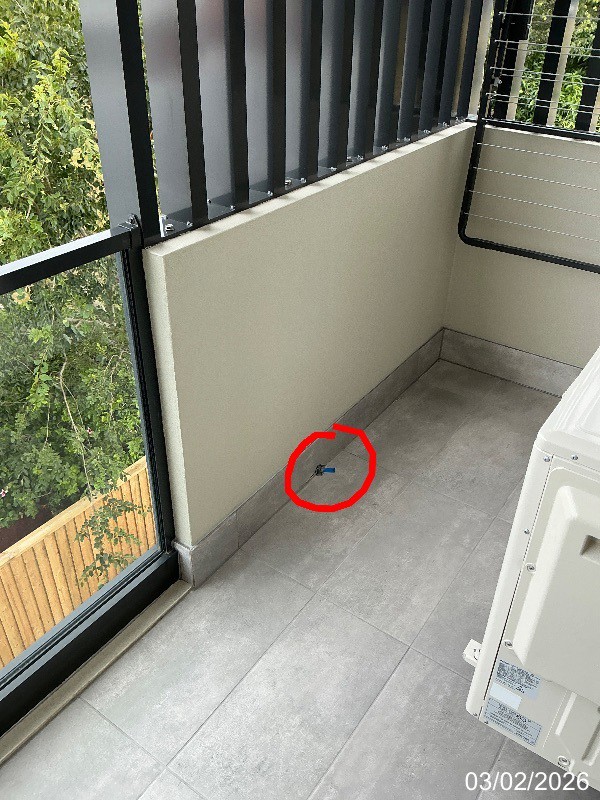
This photograph supports the recorded visible tile finding. It does not establish the condition of concealed waterproofing or drainage components. Where access is limited, an inspection report should keep that distinction clear.
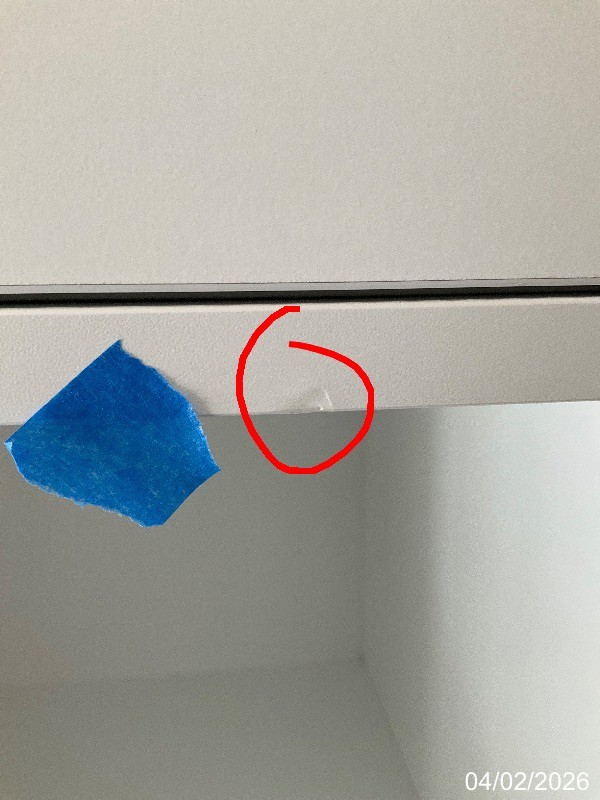
These examples are genuine findings from the project reports, but they are examples rather than a claim that every item was the same type or severity. One safety-related or water-management issue can demand more attention than many minor finishing items, so item counts should never replace technical assessment and prioritisation.
Why trade and status reporting matters on multi-residential projects
A long apartment building inspection list is difficult to manage if it remains one undifferentiated document. For a builder, developer or superintendent, the practical questions are:
- Which apartments, levels and common areas contain open work?
- Which trade should review each item?
- Which items have evidence of rectification?
- Are repeated findings appearing across several units?
- What still needs verification before close-out?
GoInspect uses InspectaMate in its reporting workflow so recorded items can support different views of the same project information. Depending on the agreed scope, this can include apartment or area reports, trade-specific worklists, level summaries and open/closed status reports. The original photographs and locations remain connected to the underlying items rather than being reduced to a spreadsheet total.
This structure also supports sensible batching. A tiler can receive relevant tile items, a cabinet maker can work through joinery records, and the project team can review remaining open work without circulating every unrelated observation to every contractor.
Closing an item should preserve the evidence trail
An open/closed percentage is useful only when “closed” has a defined project meaning. The source report shows status at a point in time; it does not tell a public reader what contractual approval, reinspection or supporting evidence sat behind every closure. That process should be agreed by the project team.
For a workable developer QA process, each close-out item should retain its original location and description, record who is responsible, and show what changed before its status is updated. Some projects use a rectification photograph or reinspection; others require additional sign-off for specified items. The appropriate method depends on the agreed scope and project controls. What matters is that a summary total remains traceable to the individual record rather than becoming an unsupported tick in a spreadsheet.
Where a practical completion inspection fits
A practical completion inspection (PCI), often called a handover inspection, can record visible and accessible incomplete work and defects near project completion. The report can support a close-out process, but it does not grant occupancy approval, prove concealed work or guarantee compliance. The inspection scope, access and project documents still matter.
Queensland’s building regulator places responsibility for supervision and quality control on the contractor and explains that work should be checked as construction proceeds, not left entirely to the end. See the QBCC guidance on supervision and quality control and its information about practical completion.
The decision the 884-item snapshot helps answer
The value of this apartment defect report is not the shock of a large number. It is the ability to turn a complex set of project observations into defined work, organised responsibility and visible progress. At the report date, almost 59 per cent of the tracked items were closed. The remaining 363 still required attention or verification within the project workflow.
For teams planning multi-residential handover, the useful question is therefore not “How many defects will our project have?” This single project cannot answer that. A better question is “Will our inspection and reporting process let us locate, allocate and close each item without losing the evidence behind it?”
GoInspect provides builder and developer QA inspections for apartment and multi-residential projects, with reporting shaped around the agreed project scope. To discuss unit inspections, common-area reporting, trade worklists or staged close-out, request a builder and developer inspection quote.