

Most new homeowners assume their builder will hand over a flawless property. In practice, defects are almost universal in new construction, and the Queensland Building and Construction Commission (QBCC) consistently records thousands of defect complaints each year. The critical question is not whether defects exist, but which ones actually matter. Misclassifying a structural defect in a new home as a cosmetic issue, or vice versa, has real financial and legal consequences. Understanding the difference before your handover inspection determines whether you get proper rectification or walk away with problems that compound over time.
Table of Contents
- Quick Takeaways
- What Are Structural Defects in New Homes?
- What Are Cosmetic Defects in Building Inspections?
- Why the Distinction Matters Legally and Financially
- Types of Building Defects in Queensland: A Practical Breakdown
- Structural vs Cosmetic vs Functional Defects: A Comparison
- How Pre-Handover Inspectors Identify and Classify Defects
- Common Mistakes Homeowners Make When Assessing Defects
- Frequently Asked Questions
- References
Quick Takeaways
| Key Insight | Explanation |
|---|---|
| Structural defects affect safety and integrity | These include foundation cracking, roof framing failures, and load-bearing wall issues that compromise the physical soundness of the building. |
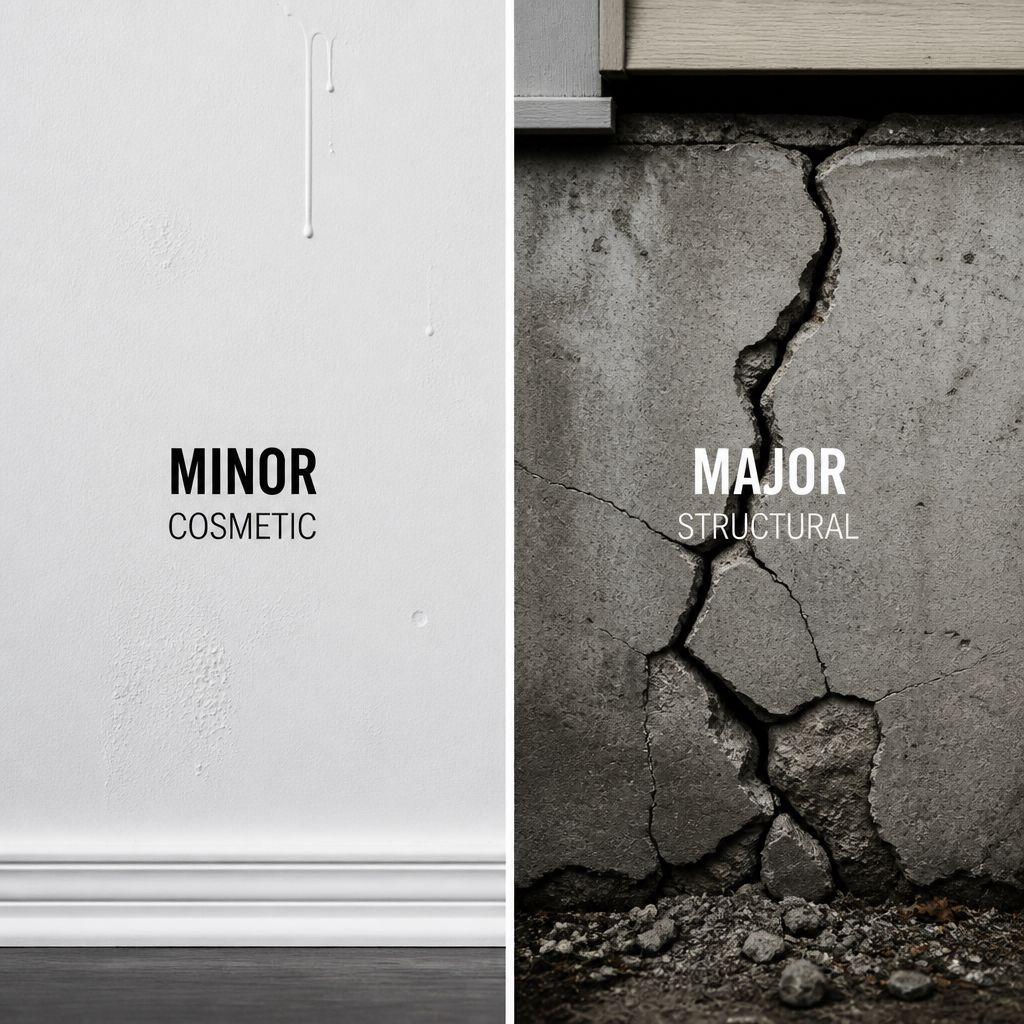
| Cosmetic defects are finish-level problems | Paint runs, minor scratches, and surface-level blemishes fall here. They are still defects but carry no structural risk. |
| Queensland law treats them very differently | Under the QBCC Act, statutory warranties for structural defects run for 6 years and 6 months, while category 3 defects (cosmetic) must be identified at handover. |
| Misclassification is the builder’s advantage, not yours | Builders sometimes present structural issues as cosmetic to limit their rectification obligation. A licensed inspector prevents this. |
| Photo-enhanced reports create an auditable record | Defect reports with timestamped photos assign responsibility to specific trades and make disputes with builders far easier to resolve. |
| Pre-handover is the best time to catch both types | Once you sign off at settlement, your leverage to demand rectification drops significantly, especially for cosmetic items. |
| Functional defects sit between structural and cosmetic | A door that will not close, a drain that pools water, or a window that leaks is functional, meaning it affects liveability even if not structural. |
What Are Structural Defects in New Homes?
A structural defect in a new home is any flaw that impairs the structural integrity or load-bearing capacity of the building. This goes beyond what you can see on a surface. It involves the bones of the property: footings, slabs, framing, roof trusses, retaining walls, and load-bearing structural elements.
In practice, structural defects can be subtle at the point of handover. A slab crack that runs diagonally from a corner of a window or door opening is not just a cosmetic concern. It is a textbook indicator of differential settlement, which means the footing is moving unevenly. Similarly, roof truss members that have been incorrectly cut or notched by a tradesperson during plumbing installation can compromise the entire roof’s load distribution.
The data consistently shows that structural defects, when left unaddressed, always get worse. Moisture ingress through structural gaps accelerates rot in timber framing. Foundation movement widens cracks and distorts door frames progressively. Catching these issues at the pre-handover stage, before you own the problem legally, is the single most valuable thing a homeowner can do.
Common Structural Defects Found in Queensland New Builds
Queensland’s climate creates specific structural risks. Expansive clay soils in Brisbane’s western suburbs cause reactive ground movement that stresses footings. Cyclone-rated construction requirements in parts of South East Queensland mean roof tie-down failures are a genuine structural concern, not a minor oversight.
The most frequently documented structural defects in new Queensland homes include: diagonal cracking in brickwork above openings, inadequate roof tie-down fixings, incorrectly spaced or undersized floor joists, retaining walls without adequate engineering, and slab edge exposure that allows moisture to wick into the structure. GoInspect’s inspectors across Brisbane, Gold Coast, Logan, Ipswich, and Redland Bay see these patterns repeatedly because they are endemic to the volume building sector.

What Are Cosmetic Defects in Building Inspections?
Cosmetic defects are finish-level imperfections that affect the appearance of a property but not its structural soundness, safety, or function. In a cosmetic defect building inspection, an inspector is looking at things like paint finish quality, tile grout consistency, minor surface scratches on fixtures, and small gaps in silicone sealing at skirting boards.
This does not mean cosmetic defects are trivial. On a brand-new home costing $600,000 or more, a homeowner has every right to expect a finish that meets the standard of a reasonably competent tradesperson. Queensland’s QBCC Minimum Construction Requirements provide the benchmark for acceptable workmanship, and many cosmetic defects constitute genuine breaches of that standard.
Where Cosmetic Defects Appear Most Often
Paint and plasterwork are the most common sources. Runs in gloss paint on skirting boards, roller stipple inconsistency on ceilings, and plaster joins that ghost through the paint finish are all common on new builds. Tiling is another hotspot: lippage (unevenness between adjacent tiles), inconsistent grout lines, and grout colour variation are cosmetic but are legitimate defects under AS 3958.1.
A common mistake is dismissing cosmetic defects because they seem minor individually. A single paint run is minor. Fifteen paint runs across eight rooms, combined with inconsistent ceiling texture and cracked cornice joins, represent a workmanship failure pattern. A detailed report that catalogues each item forces the builder to address them systematically rather than selectively.
Pro tip: Document every cosmetic defect in writing before handover. Verbal agreements with site supervisors about touching up paint or re-grouting tiles rarely survive the post-settlement period when trades have moved to the next project.
Why the Distinction Matters Legally and Financially
Queensland’s statutory warranty framework under the Queensland Home Warranty Scheme and the QBCC Act creates tiered protection based on defect category. Structural defects carry a warranty period of 6 years and 6 months from the date of completion. Non-structural defects (which covers functional and many cosmetic items) must generally be notified within a much shorter window.
“The definition of a structural defect under the Queensland Home Warranty Scheme is specific: it must cause, or be likely to cause, the inability to inhabit or use the home for its intended purpose, or it must require significant remediation of the home.” Source: Queensland Building and Construction Commission (QBCC), Home Warranty Scheme documentation.
The financial stakes are substantial. Rectifying a structural defect like a failed footing or non-compliant roof frame can cost tens of thousands of dollars. If you have already settled and the defect is disputed, the cost of legal proceedings through QCAT (Queensland Civil and Administrative Tribunal) adds time and money on top of that. A pre-handover inspection for $550 is not a luxury. It is risk management with a measurable return.
How Builders Use Misclassification to Limit Exposure
Experienced inspectors see this regularly. A builder’s site supervisor will describe a diagonal crack in a brick wall as “normal settlement” and offer to fill it with flexible sealant as a cosmetic fix. That response is inappropriate if the crack is a symptom of a structural movement issue. Filling it cosmetically does not address the underlying cause and may void any claim later if you accepted the “fix” in writing.
This is precisely why having an independent, licensed inspector with no commercial relationship to the builder is non-negotiable. GoInspect’s inspectors identify defects, assign them to the responsible trade, and document them in same-day photo-enhanced reports. That paper trail is what protects homeowners when a builder pushes back.

Types of Building Defects in Queensland: A Practical Breakdown
The types of building defects in Queensland are generally understood across three categories in practice, even if the QBCC warranty framework uses slightly different terminology. Understanding all three helps homeowners and investors approach a handover inspection with realistic expectations about what they are looking for.
Category 1: Structural Defects
These affect the load-bearing or weather-resistant integrity of the building. Examples include footing movement, structural framing non-compliance, roof structure failures, retaining wall failures, and waterproofing failures to wet areas (which are treated structurally because of the damage moisture causes to the building fabric over time).
Category 2: Functional or Non-Structural Defects
These affect the liveability or intended use of the home without necessarily compromising structural integrity. A door that will not latch, a window that does not seal properly, a bathroom fan that is wired to the wrong switch, or a shower base that retains water rather than draining are all functional defects. They are not cosmetic because they affect how the home operates, but they are not structural because they do not compromise the building’s physical integrity.
Category 3: Cosmetic Defects
Finish-level workmanship issues that affect appearance only. These must be identified and documented at the pre-handover inspection because builders are generally not obligated to return post-settlement to address cosmetic items that were not raised at handover. Builders often include a clause in their handover documentation that treats sign-off as acceptance of the finish.
Pro tip: At a pre-handover inspection in Queensland, bring a torch and a straight edge. Many cosmetic and functional defects in plasterwork, tiling, and flooring are only visible under raking light or with a physical check for level and plumb.
Structural vs Cosmetic vs Functional Defects: A Comparison
| Defect Type | Definition and Examples | Queensland Warranty Period and Action Required |
|---|---|---|
| Structural Defect | Foundation cracking, roof truss failures, non-compliant load-bearing walls, waterproofing failures to wet areas, retaining wall collapses | 6 years and 6 months under QBCC Home Warranty Scheme. Must be notified in writing. Claim requires independent evidence. |
| Functional (Non-Structural) Defect | Doors that will not close, drains that pool water, windows that do not seal, electrical circuits wired to incorrect switches, HVAC not cooling to specification | Generally covered under the contractor’s defects liability period (typically 12 months post-completion). Must be documented at or shortly after handover. |
| Cosmetic Defect | Paint runs, plaster joint ghosting, tile lippage, grout colour variation, surface scratches on fixtures, minor silicone gaps at skirting | Must be identified and formally noted at pre-handover or practical completion inspection. Post-settlement cosmetic claims are rarely successful without prior written documentation. |
How Pre-Handover Inspectors Identify and Classify Defects
A licensed pre-handover inspector does not simply walk through a property with a checklist. In practice, the process involves systematic assessment of each trade’s work against the relevant Australian Standards, the QBCC Minimum Construction Requirements, and the specific engineering or architectural drawings for the property.
Identifying structural defects requires knowledge of building physics, not just visual recognition. An inspector looking at a crack must assess its orientation (vertical, horizontal, or diagonal), its width, whether it is active or dormant, and where it sits in relation to structural elements. That analysis determines whether the crack is cosmetic, functional, or structural.
The Role of Photo-Enhanced Defect Reports
A defect report that simply lists “crack to external wall, bedroom 2” is nearly useless in a dispute. A photo-enhanced report shows the crack’s location, dimensions, orientation, and context within the building. It assigns the defect to the relevant trade (masonry, concrete, framing) and specifies the rectification standard required.
GoInspect’s same-day reporting model means homeowners and builders receive detailed, photo-evidenced defect documentation on the day of inspection. This is critical because in the Queensland construction market, handover timelines are often compressed and builders push for sign-off quickly. Having a report in hand before that conversation changes the dynamic entirely.
High-Rise and Multi-Dwelling Inspections
For investors buying off-the-plan apartments in Brisbane or Gold Coast high-rise developments, the defect classification process has additional complexity. Common property defects (waterproofing to podium levels, structural elements in car parks, fire separation walls) must be distinguished from lot-specific defects. A customised inspection scope that accounts for the specific building type is essential. Generic residential inspection templates miss significant defect categories in multi-storey construction.
Common Mistakes Homeowners Make When Assessing Defects
The most costly mistake is conducting your own defect walk-through without professional support. New homeowners are emotionally invested in the property and often distracted by the excitement of the handover. They notice the kitchen splashback colour and miss the shower waterproofing membrane that was not correctly turned up to height.
A second common error is accepting verbal assurances from the site supervisor that items “will be fixed after settlement.” Builders have no contractual obligation to return post-settlement for items not documented in the handover defect schedule. Every item must be in writing, with a specific rectification commitment, before keys change hands.
Trusting Builder-Supplied Inspection Reports
Some builders offer their own pre-handover inspection as part of the process, or present a quality assurance report as a substitute for an independent inspection. This is a conflict of interest. A builder’s QA process is an internal quality control tool, not an independent assessment. It has no evidentiary weight in a QCAT dispute and is not a substitute for a licensed independent inspector.
The investment in an independent pre-handover inspection through GoInspect, starting from $550 including GST, is a fraction of the cost of any single significant rectification item. The value is not just in finding defects. It is in creating a legally useful, trade-specific, photo-evidenced record that puts the homeowner in a position of informed authority at handover.
Frequently Asked Questions
What qualifies as a structural defect in a new home under Queensland law?
Under the QBCC Home Warranty Scheme, a structural defect is one that causes, or is likely to cause, the inability to use the home for its intended purpose, or that requires significant structural remediation. This includes footing failures, load-bearing wall non-compliance, roof structure defects, and waterproofing failures to wet areas that compromise the building fabric. The warranty period is 6 years and 6 months from the date of completion.
Can a cosmetic defect become a structural problem over time?
Yes, and this is one of the most important reasons to document cosmetic defects carefully. A small crack in external render classified as cosmetic at handover can allow moisture ingress that, over months or years, causes corrosion of steel reinforcement or rot in timber framing. What started as a cosmetic item becomes a structural repair. Catching and documenting it at handover ensures the builder is on notice from the beginning.
How do I know if a builder’s site supervisor is misclassifying a defect?
If a site supervisor describes a diagonal crack, a deflecting floor, a roof leak, or a wet area waterproofing issue as cosmetic or minor, treat that as a red flag. Structural defects do not require visible collapse or dramatic failure to be genuine. Get an independent assessment from a licensed inspector before accepting any builder’s classification. A photo-enhanced report from a third party carries far more weight in a dispute than a site supervisor’s verbal opinion.
When is the best time to get a pre-handover inspection in Queensland?
The optimal time is approximately one to two weeks before the scheduled handover date. This gives the builder enough time to rectify identified defects before you are asked to sign off, while ensuring the property is complete enough for a comprehensive inspection. Inspecting too early means trades are still working and the defect picture is incomplete. Inspecting on handover day leaves no time for negotiation or rectification.
Do cosmetic defects need to be in writing to be enforceable?
Yes. Post-settlement cosmetic defect claims without prior written documentation are extremely difficult to enforce. Builders routinely argue that items not raised at handover represent the homeowner’s acceptance of the finish. Every cosmetic defect should appear in a written inspection report, ideally with photographic evidence, and be acknowledged in writing by the builder as a condition of handover sign-off.
Is a pre-handover inspection different from a practical completion inspection?
In Queensland, these terms are often used interchangeably but there is a practical distinction. A practical completion inspection (PCI) is typically the builder’s own walk-through to confirm the home is ready for handover. A pre-handover inspection is an independent assessment conducted by a licensed third-party inspector on behalf of the homeowner. Always commission an independent pre-handover inspection in addition to, not instead of, any PCI offered by the builder.
Have you recently gone through a handover inspection in Queensland? Share what defects surprised you most, whether structural, functional, or cosmetic, in the comments below.
References
- Queensland Building and Construction Commission: Home warranty scheme, defect categories, and statutory warranty periods for Queensland homeowners
- Queensland Legislation: Queensland Home Warranty Scheme Act and QBCC Act provisions governing structural defect definitions and rectification obligations
- Australian Building Codes Board: National Construction Code requirements underpinning structural compliance standards for new residential construction
- Australian Competition and Consumer Commission: Consumer rights and statutory guarantees applying to building contracts and defect rectification in new home construction
- Standards Australia: Australian Standards including AS 3958.1 for ceramic tiling and other workmanship benchmarks used to assess cosmetic and functional defects