
Most builders and developers in South East Queensland hand over new homes with a stack of compliance paperwork and assume that covers them. It does not. A quality assurance certificate from an independent licensed inspector is a separate document entirely, and the gap between statutory certification and a genuine construction QA report is exactly where defect disputes live. The QBCC recorded 962 disputes lodged before completion in the 2022-2023 period alone. That number tells you one thing clearly: relying on the builder’s own quality checks and a certifier’s sign-off is not enough protection for anyone in the construction chain.
Table of Contents
- What Is a Quality Assurance Certificate in Construction?
- QA Reports vs. Statutory Compliance Certification
- What a Construction QA Report Actually Contains
- Why Builders and Developers Need QA Certificates
- Practical Completion, Handover, and the QA Certificate’s Role
- QA Certificates for High-Rise and Multi-Lot Developments
- Choosing the Right Builder Inspection Certificate Provider
- Frequently Asked Questions
- References
What Is a Quality Assurance Certificate in Construction?
| Key Insight | Explanation |
|---|---|
| A QA certificate is not a compliance document | It records workmanship quality at a specific stage, separate from the certifier’s statutory inspection forms. |
| It must be produced by a licensed inspector | In Queensland, the inspector must hold a QBCC building inspection licence. Qualifications typically include a Certificate IV in Building and Construction or equivalent. |
| Trade responsibility is assigned in the report | A properly structured QA report names the trade responsible for each defect, making rectification faster and reducing disputes between subcontractors. |
| Builder-commissioned QA reports are confidential | When a builder commissions a QA inspection, the report is internal. It is not automatically shared with homeowners, which protects builders from findings being used in disputes while still driving rectification. |
| A QA report is strongest before final payment | Defects listed before practical completion give the builder contractual leverage to require trades to fix work before being paid. |
| Statutory certifier inspections do not replace QA | Building certifiers confirm compliance at prescribed hold points. They do not assess trade-by-trade workmanship quality. |
| Same-day reporting changes the rectification timeline | When a QA report arrives the same day as the inspection, builders can assign trades for rectification immediately rather than waiting days for documentation. |
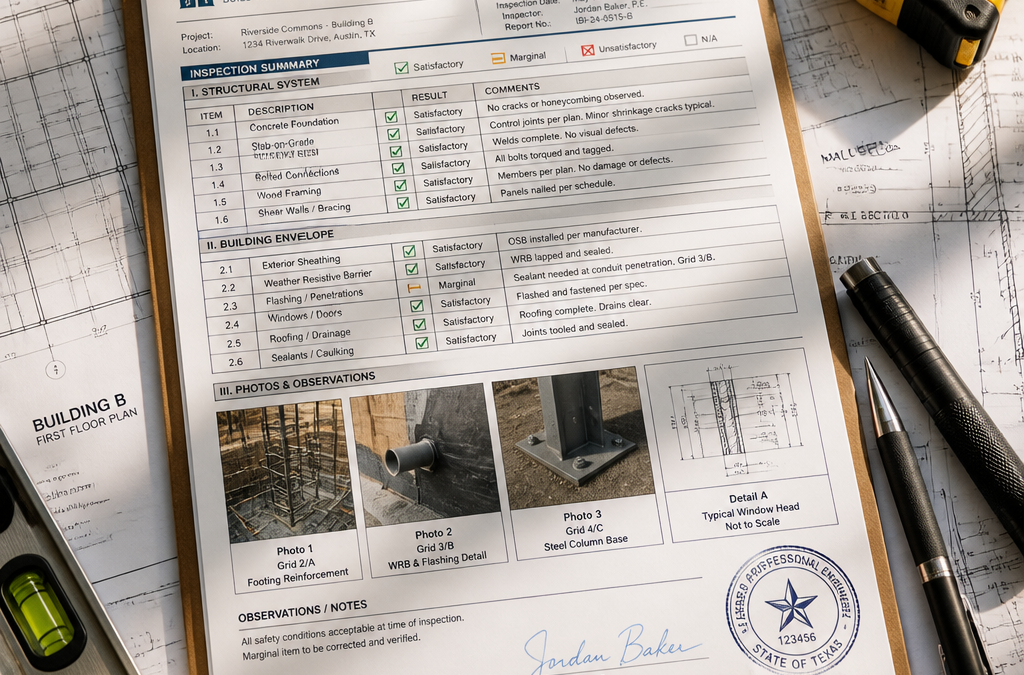
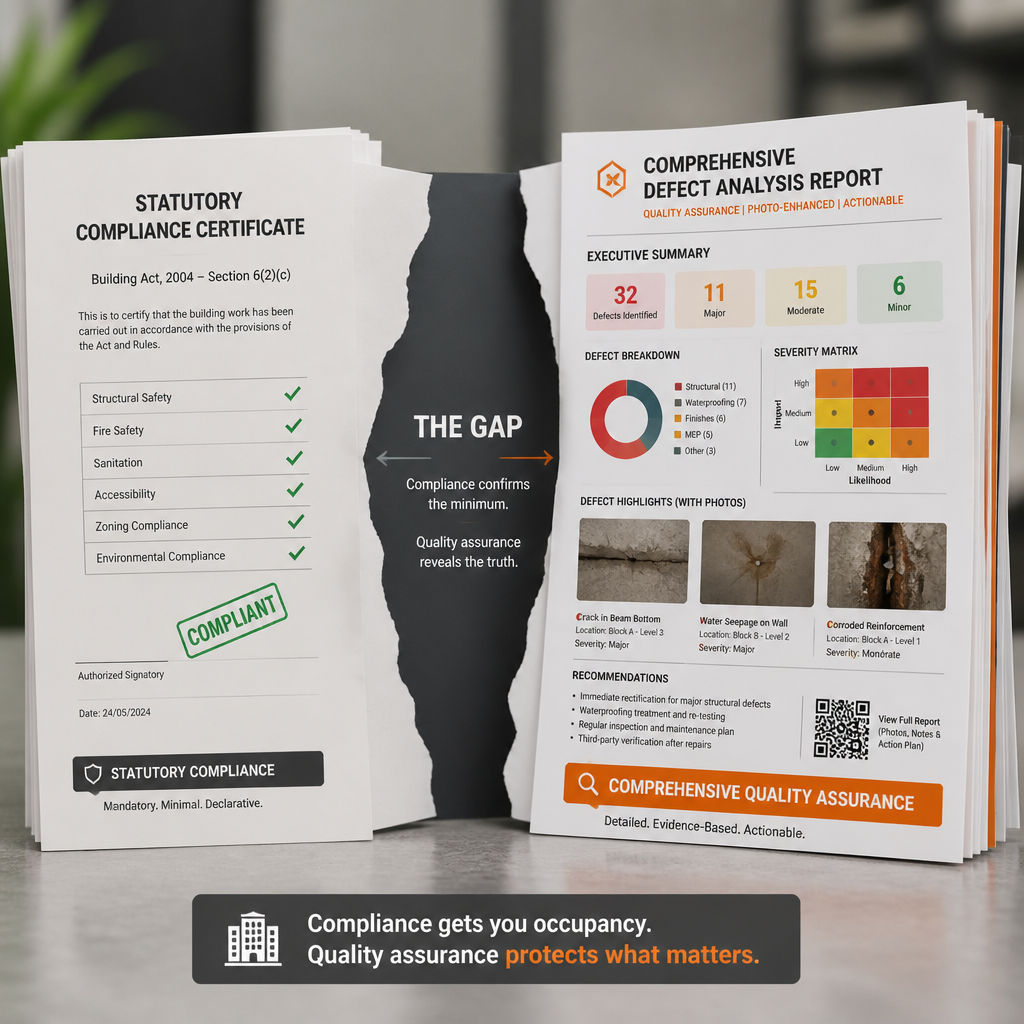
A quality assurance certificate in construction is a formal document produced by an independent licensed building inspector confirming the standard of workmanship at a defined stage of a build. It differs from a compliance certificate in a fundamental way: compliance certificates confirm that construction meets approved plans and the National Construction Code. A QA certificate records whether the actual work quality, finish, and installation detail meets industry standards and contractual specifications, including items a certifier is never asked to check.
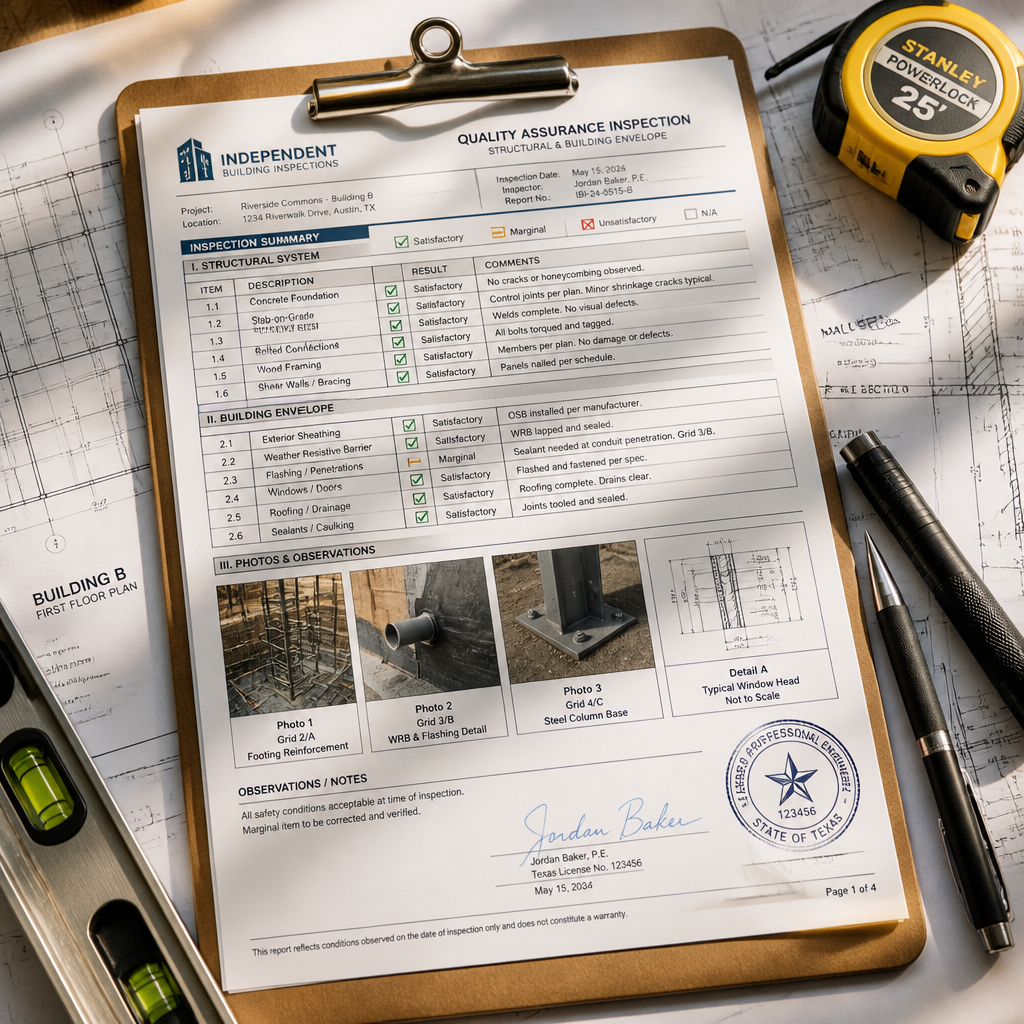
In practice, a QA certificate for a new home or apartment will document specific defects, identify which trade is responsible for each item, and provide photographic evidence. That combination makes it usable as a direct instruction document to subcontractors, not just an audit trail for lawyers.
QA Reports vs. Statutory Compliance Certification
This distinction matters enormously, and it gets misunderstood constantly on building sites. In Queensland, the mandatory certification process involves a licensed building certifier conducting inspections at prescribed stages and issuing forms under the Building Act 1975. These include Form 16 Inspection Certificates during or after construction, Form 15 Compliance Certificates covering design or specification, and Form 11 Certificate of Occupancy for buildings that require one. For detached houses and smaller structures, a Form 21 Final Inspection Certificate is the relevant document.
What statutory certifiers inspect and what they skip
A building certifier’s mandate is to confirm that structural framing, bracing, tie-down connections, and the build’s compliance with approved plans are satisfactory at set hold points. They conduct personal inspections at critical stages, including excavation and slab works. What they do not do is assess trade-by-trade workmanship quality across finishes, joinery, waterproofing installation detail, paint, plaster, or the dozens of coordination items between trades. That work is simply outside their scope.
A construction QA report covers the ground the certifier never walks. It looks at cabinetry installation, window and door operation, waterproofing application, tile and flooring finishes, external cladding, and the full internal and external envelope of the building, producing a defect-by-defect record with photographic evidence and trade attribution.
Certificates support compliance but are not substitutes for active oversight, due diligence, and contractual protections. Errors or omissions in certification may only surface after occupancy, handover, or sale. By that stage, rectification can be costly, disruptive, and sometimes practically impossible.
The timing risk nobody talks about
One of the most damaging patterns in Queensland new home construction is the late discovery of defects. A waterproofing failure identified during construction may cost a few hundred dollars to fix. The same defect discovered after tiles, cabinetry, and flooring are installed can cost $15,000 or more to rectify. QA inspections exist to catch these problems while the fix is straightforward and inexpensive.
Pro tip: If you are a builder, commission your QA inspection at pre-lining stage, not just at practical completion. Catching waterproofing and frame issues before walls are closed is where QA pays for itself most dramatically.
What a Construction QA Report Actually Contains
A quality construction QA report is not a checklist with tick boxes. It is a structured, itemised document that a builder or developer can hand directly to a site supervisor and have acted on the same afternoon. Here is what a properly prepared report includes.
We would love your feedback and any insights you would share with others. What perspective would you add?
Defect descriptions referenced to standards
Each defect is described with reference to the relevant building code, Australian Standard, or QBCC Standards and Tolerances Guide. This is not optional detail. Without the reference, a trade can argue the point. With it, the instruction is unambiguous.
Trade responsibility assignment
Each item in the report is attributed to a specific trade. Plasterboard gaps are a plasterer item. Out-of-square door frames are a carpenter item. Silicone voids at a wet area junction are a tiler or waterproofer item. This attribution eliminates the time wasted when defects are listed without ownership and every subcontractor points at someone else.
Photo-enhanced documentation
Photographs embedded in the report against each defect item serve two purposes. First, they remove any dispute about whether a defect exists or what it looks like. Second, they give the trade a visual target for rectification, so there is no ambiguity about exactly where the work needs to happen.
Rectification sign-off pathway
A well-structured report includes a mechanism for sign-off once items are rectified. This creates a formal trail, which is useful if a defect reappears later or if a dispute reaches the QBCC. Builders who can show a documented rectification cycle have a considerably stronger position than those relying on email threads.
Pro tip: For multi-lot or high-rise developments, insist that the QA report format is customised by lot number and trade package. A single PDF covering 30 apartments with no lot indexing is almost unusable on site. The report format is as important as its content.
Why Builders and Developers Need QA Certificates
There is a persistent belief among volume builders that their own site supervisors handle quality control adequately. Some do. But a site supervisor is employed by the builder, under pressure to meet programme dates, and has no structural incentive to produce a document that could slow a stage claim or trigger a trade revisit. That is not a personal failing. It is a systemic conflict of interest.
Internal quality management without legal exposure
When a builder commissions an independent QA inspection, the resulting report is confidential. It is not automatically shared with homeowners, subcontractors, or third parties unless the builder chooses to release it. This confidentiality is a deliberate feature. It allows builders to identify and fix problems internally without creating a paper trail that can be used against them in a dispute. If builders knew every QA report would be handed to the homeowner on the same day, many would commission fewer inspections, which would ultimately result in more defects reaching completion.
Trade accountability and pattern tracking
Builders who commission QA inspections across multiple projects accumulate data on recurring defect patterns by trade. If the same waterproofing subcontractor is generating defect items across three separate sites, that information surfaces in a way it never would from site supervisor notes. This allows builders to make informed decisions about which trades they continue to engage, and at what oversight level.
Pre-handover leverage over trades
An inspection report records findings, but rights about practical completion, settlement, trade payments or retention depend on the contract and applicable law. Discuss disputed items with the other party and obtain advice from a construction solicitor or conveyancer before delaying settlement or withholding money. The report alone does not establish a right to do so.
QBCC dispute protection
When a QBCC complaint is lodged, the commission can send a Building Inspector to assess whether work is defective. A builder who has internal QA records, including documentation of defects identified and subsequently rectified, is in a materially better position than one who has no such records. The QBCC can issue a Direction to Rectify, and in disputed cases, disputes before completion can escalate to QCAT or court. Documentation is everything at that point.
Practical Completion, Handover, and the QA Certificate’s Role
Under Queensland building contracts, practical completion is reached when a contractor has fulfilled their obligations under the contract, except for minor defects that are documented in a defects list. The builder provides written notice, generally at least two to three weeks out, and the homeowner then has the right to conduct or commission an inspection. All defects, incomplete work, and items not built to specification are recorded in a defects list, usually signed by both parties.
What the QBCC says about documentation at handover
The QBCC recommends that contractors provide all certificates of inspection, including the final certificate, before receiving final payment. For new homes, handover documentation typically includes the practical completion certificate, a Form 21 Final Inspection Certificate, compliance certificates for plumbing, electrical, gas, and waterproofing work, product warranties, and the QBCC Form 6 Defects Document signed by both parties. A quality assurance certificate or builder inspection certificate produced by an independent licensed inspector sits alongside this documentation as evidence of workmanship standard at completion.
The defects liability period and why QA documentation matters after handover
For Queensland work, contractual defect arrangements, QBCC rectification assistance and Queensland Home Warranty Scheme claims have different eligibility rules and deadlines. Notify your builder promptly in writing and check the current QBCC time limits and eligibility and Home Warranty Scheme claim requirements. Do not assume a maintenance period extends every complaint or insurance deadline.
Pro tip: Homeowners and investors who commission their own independent pre-handover inspection before signing the defects list are in a far stronger position than those who rely on the builder’s walk-through. Once you have signed, the defects list is the record. Make sure it is comprehensive before your signature goes on it.
QA Certificates for High-Rise and Multi-Lot Developments
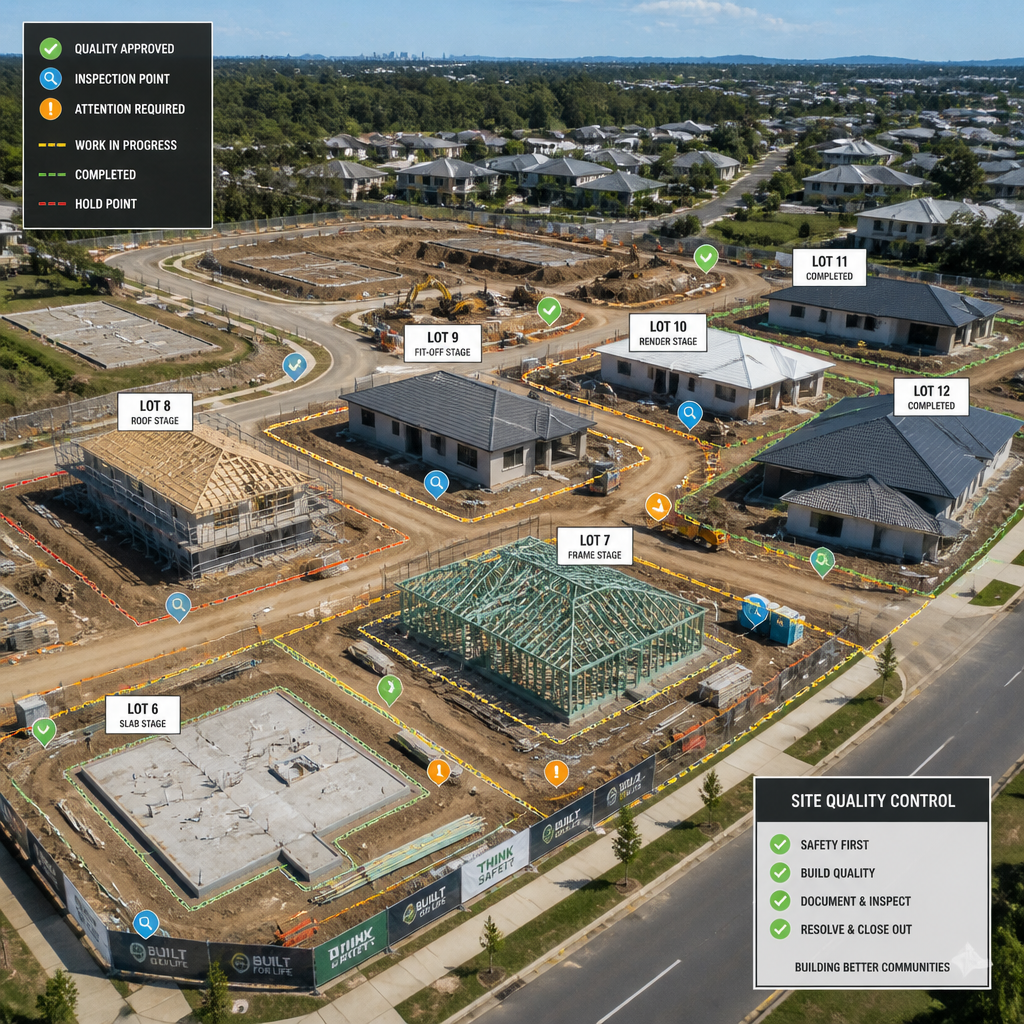
Developers managing apartment buildings or housing estates face a different scale of QA challenge compared to single dwelling builders. On a 60-lot townhouse development, having a single inspector walk each lot and produce a consolidated report with lot-by-lot defect attribution is not a minor administrative convenience. It is the difference between a rectification programme that runs efficiently and one that generates cross-lot confusion, missed items, and delayed settlements.
High-rise developments require inspection reports that are customised by apartment number, floor level, and trade package. The inspection must account for shared areas, facade elements, and common property, all of which fall outside the scope of any single lot holder’s inspection. Developers who use a generic residential inspection format for a multi-storey building typically end up with reports that cannot be actioned efficiently, because the format does not match the site structure.
Settlement risk for developers
An inspection report records findings, but rights about practical completion, settlement, trade payments or retention depend on the contract and applicable law. Discuss disputed items with the other party and obtain advice from a construction solicitor or conveyancer before delaying settlement or withholding money. The report alone does not establish a right to do so.
| Approach | Scope | Best Used For |
|---|---|---|
| Builder-commissioned internal QA inspection | Confidential to builder. Trade-by-trade defect attribution. Photo evidence. No homeowner access unless builder releases. | Builders wanting to catch and fix defects before homeowner inspection or final trade payment |
| Independent pre-handover inspection (homeowner-commissioned) | Produced for the homeowner. Documents defects before signing the defects list. Covers full internal and external envelope. | Homeowners and investors at practical completion, before signing off |
| Developer multi-lot QA inspection | Customised by lot number and trade package. Covers common property and shared elements. Structured for staged settlement programmes. | Developers managing high-rise buildings, townhouse estates, or housing projects with multiple settlements |
Choosing the Right Builder Inspection Certificate Provider
Not every building inspection company is equipped to provide a builder inspection certificate that actually serves its purpose on a construction site. The most common failure is a report that reads well but cannot be actioned. Trade attribution is missing, photographs are not embedded against the relevant defect items, and the format requires someone in the office to translate it before it reaches the site supervisor. That is not a QA report. That is a document that creates more work than it saves.
Licensing and qualifications to check
In Queensland, QA inspectors must hold a QBCC building inspection licence. Appropriate qualifications include a Certificate IV or Diploma in Building and Construction, a relevant degree in building surveying or construction management, or equivalent industry experience combined with formal licensing. Inspectors should carry professional indemnity insurance and public liability insurance. These are not negotiable requirements. If a provider cannot confirm QBCC licensing, do not engage them for work that may need to withstand a dispute.
Report format and turnaround time
Same-day reporting is operationally significant, not just a marketing claim. On a development site where multiple trades are moving simultaneously, a two-day delay between inspection and report means the site has moved on before rectification can be scheduled. Builders managing tight programmes need the report in hand the same day the inspector leaves the site. Formats that include embedded photographs, clear defect descriptions referenced to standards, and trade-specific item lists are the benchmark.
Familiarity with the local market
An inspector who works exclusively across Brisbane, Gold Coast, Logan, Ipswich, and Redland Bay understands the specific construction methods, local building conditions, and trade patterns in South East Queensland. Local expertise shows up in the specificity of defect references, knowledge of common local construction sequences, and the ability to assess work against the QBCC Standards and Tolerances Guide with confidence. A national service with no specific local presence is unlikely to bring that depth of market knowledge to a Brisbane or Gold Coast development project.
Your GoInspect price depends on the inspection service, property type, size and location. Use the current online quote calculator for your property rather than relying on an old starting price. Builder and developer projects need a project-specific quote.
Frequently Asked Questions
What is the difference between a quality assurance certificate and a compliance certificate in Queensland?
A compliance certificate, such as a Form 16 Inspection Certificate or Form 21 Final Inspection Certificate, is issued by a licensed building certifier and confirms that specific construction stages comply with approved plans and the National Construction Code. A quality assurance certificate is produced by an independent licensed building inspector and documents workmanship quality, defects, and trade accountability across areas that statutory certifiers are not mandated to assess, such as internal finishes, cabinetry, waterproofing installation detail, and external cladding.
Do builders in Queensland have to provide a QA certificate to the homeowner?
No. When a builder commissions an internal QA inspection, the resulting report is confidential to the builder and is not required to be shared with the homeowner. The builder is required to provide statutory documentation at handover, including the Form 21 or Form 11 certificate, compliance certificates for plumbing, electrical, and gas work, and the QBCC Form 6 Defects Document. A separate independent inspection commissioned by the homeowner produces a report owned by the homeowner.
At what stages of construction should a QA inspection be conducted?
For maximum value, QA inspections should be conducted at pre-lining stage, when waterproofing and framing are visible before walls are closed, and again at practical completion before the defects list is signed. For large developments, inspections at slab, frame, and fixing stages allow defects to be caught and rectified before they are concealed by subsequent trades. The practical completion inspection is the minimum, but pre-lining stage is where the most expensive latent defects are preventable.
Can a homeowner use a builder’s internal QA report in a dispute?
Only if the builder chooses to release it. Builder-commissioned QA reports are confidential by design. A homeowner who wants independent documentation for dispute purposes should commission their own pre-handover inspection with a licensed inspector before signing the defects list at practical completion. That report is owned by the homeowner and can be used in QBCC complaints, mediation, or QCAT proceedings.
How is a construction QA report different from a snagging list?
A snagging list is typically a walkthrough record of visible defects noted at practical completion, often produced by the builder’s site supervisor or the homeowner during a walk-through. A construction QA report produced by a licensed independent inspector is more structured, references applicable building codes and Australian Standards, includes embedded photographic evidence, assigns trade responsibility per item, and carries professional standing because it is produced by a licensed inspector with professional indemnity insurance. In any dispute, a licensed inspector’s QA report carries significantly more weight than an informal snagging list.
What should I look for in a builder inspection certificate provider in Brisbane or the Gold Coast?
Confirm the inspector holds a current QBCC building inspection licence, carries professional indemnity and public liability insurance, and produces reports with embedded photographs, defect descriptions referenced to the QBCC Standards and Tolerances Guide, and trade-specific attribution. Same-day report delivery is operationally important if you are managing a live construction programme. For multi-lot or high-rise developments, confirm the provider can customise report formats by lot number and trade package rather than producing a single generic document.
If you have had experience with QA inspections on a Queensland build, whether as a builder, developer, or homeowner, share what made the difference in your project below.
References
- Queensland building certification explained: why developers cannot rely on certificates alone
- QBCC official guidance on handover documentation and certificates of inspection
- QBCC practical completion inspection process and defects list requirements
- Quality assurance in construction: best practices for inspections and defect management
- Practical completion in Queensland: QBCC rules, defects liability, and dispute resolution