
Before your practical completion inspection (PCI) or new-home handover, check that the air conditioning and ventilation equipment matches your agreed inclusions, ask for an operating demonstration and record visible damage, leaks, missing parts or unusual noise. If cooling, drainage or airflow is a concern, ask the installer to investigate. A visual building inspection and specialist air-conditioning commissioning answer different questions.
A new unit switching on is useful information, but it does not establish its capacity, refrigerant charge, concealed duct condition or performance in every weather condition. This guide explains what to record and which questions to put to the builder or installer.
Takeaway: Record the symptom, location and operating conditions. Ask for the installed model’s instructions and a clear response from the appropriate trade. Avoid dismantling equipment or improvising tests.
Air-conditioning checks for practical completion and handover
1. Compare the equipment with your inclusions
Check the installed indoor and outdoor units, controller and scheduled rooms against the contract, approved variations and equipment schedule. Record missing units, missing controls, damaged housings or unfinished work. For ducted air conditioning, ask the builder to explain the zones and identify which rooms each zone serves.
If the model differs from the specification, ask for the agreed variation or explanation. A model number is more useful than a general description such as “large split system”. Keep serial numbers and private installation records with your own documents rather than posting them publicly.
2. Ask for an operating demonstration
Ask the installer or builder to demonstrate the controller, available modes, fan settings and zone controls using the manufacturer’s instructions. Check that you receive the remotes and user information needed to operate the installed equipment.
If a unit does not respond, record the display, selected mode, settings and any error message. A delay after changing modes can be part of normal operation on some models. Follow the actual manual rather than applying a universal run time or repeatedly changing settings.
3. Record rooms that do not cool as expected
Describe the room and what you noticed: for example, a bedroom remained warm while the system was operating. Note the selected zone, open or closed doors and windows, and the approximate time of the observation. Ask the installer to assess the concern against the system design and operating conditions.
Weak airflow does not, by itself, prove a crushed duct, a refrigerant leak or an undersized unit. Those are possible investigation questions, not conclusions an owner should make from feeling the outlet. Daikin’s troubleshooting guidance, for example, asks users to check settings, airflow obstructions and other operating conditions before requesting service.
4. Flag water leakage and staining
Record water escaping from an indoor unit, staining below it or visible pooling associated with the installation. Photograph the area and tell the builder or installer promptly. Do not assume every drip around an outdoor unit is the same problem; the operating mode and manufacturer’s drainage arrangements matter.
Leave internal drain-tray tests to the appropriate technician. Do not pour water into an air conditioner, remove service covers or enter the roof cavity to trace drainage. The installer should establish whether a drainage test or repair is needed and carry it out using the relevant instructions.
5. Look at accessible outdoor equipment
From a safe position, record visible damage, unfinished pipe covers, apparent obstructions or concerns about the unit’s support. Ask the installer to confirm installation clearances and drainage against the instructions for the actual model. Do not copy a clearance from another brand or system.
If noise is a concern, record where it is heard and when it occurs. A photograph of an outdoor unit cannot establish a noise breach or the cause of vibration. Those questions may require the installer’s assessment and the applicable local requirements.
Bathroom exhaust fans and rangehoods need their own checks
Air conditioning, ceiling fans and exhaust ventilation serve different purposes. A ceiling fan moving room air does not establish that a bathroom exhaust system is working properly. Likewise, an exhaust fan running does not prove the concealed duct route or measured airflow meets the design.
Compare visible fans, grilles and controls with the plans and inclusions. Record missing grilles, damage, rattling, an unresponsive control or a concern about extraction. Ask the builder to explain the intended discharge arrangement and arrange further assessment where needed.
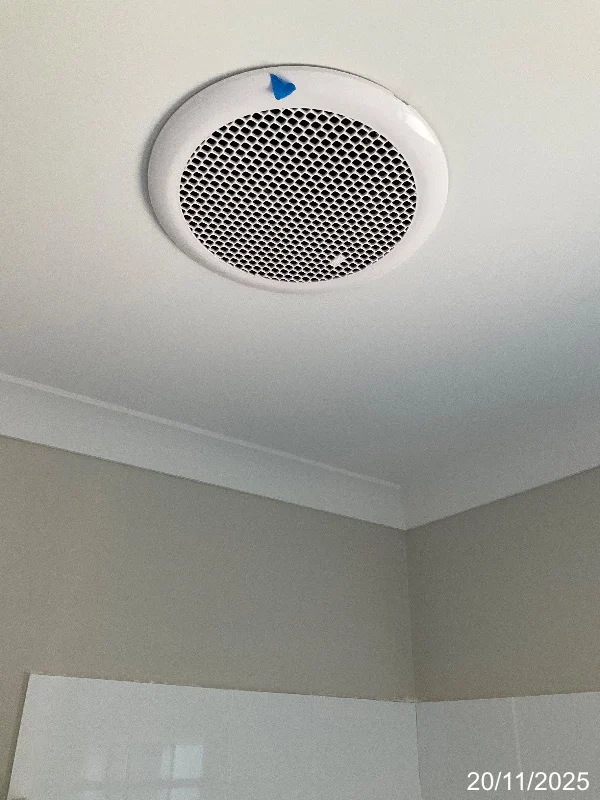
In this GoInspect report example, the inspector recorded debris causing the bathroom exhaust fan to rattle and asked for it to be removed. That is a specific observation. It should not be turned into a general claim that every noisy fan has disconnected ducting or that airflow was measured.
For a rangehood, check the supplied model and intended installation against the inclusions and manufacturer’s instructions. Ask whether it is intended to recirculate or discharge outside. The correct assessment depends on the installation, building requirements and product; a generic photograph cannot settle that question.
What should the installer check?
Where performance is disputed, ask for the relevant commissioning information and an installer’s response describing what was assessed. Questions may concern room temperatures, zone operation, drainage, controls, equipment selection or airflow. The technician should decide which measurements and tests are appropriate.
In Queensland, QBCC identifies testing and commissioning within mechanical-services work. Work involving regulated refrigerants also has refrigerant-licensing requirements. Use appropriately licensed trades for that work; an independent visual building report does not replace their commissioning or electrical certification.
What GoInspect’s practical completion inspection (PCI) covers
GoInspect’s practical completion and handover inspection service focuses on visible defects, workmanship and incomplete work in safely accessible areas within the agreed scope. A finding about a visible fitting or observed noise does not mean comprehensive air-conditioning performance testing was included.
Specialist testing, concealed duct inspection, refrigerant checks and engineering certification are separate from the standard visual inspection. GoInspect does not enter enclosed roof cavities as part of that standard scope. Raise any particular air-conditioning or ventilation concern when enquiring so the appropriate assessment can be discussed.
Turn a concern into a useful action item
- Name the room, unit or outlet.
- Describe what happened and the relevant settings.
- Attach a clear photograph or short recording where useful.
- Ask the builder to arrange the appropriate trade’s investigation.
- Keep the response and any follow-up result with the original item.
Report concerns promptly rather than waiting for the first hot spell or a maintenance anniversary. Contract obligations, complaint time limits and warranty arrangements differ. If there is a dispute about payment, settlement or responsibility, obtain advice about your actual agreement rather than relying on a general inspection checklist.
For the wider finished-home inspection, see our practical completion inspection and handover service or check the quote for your property.