
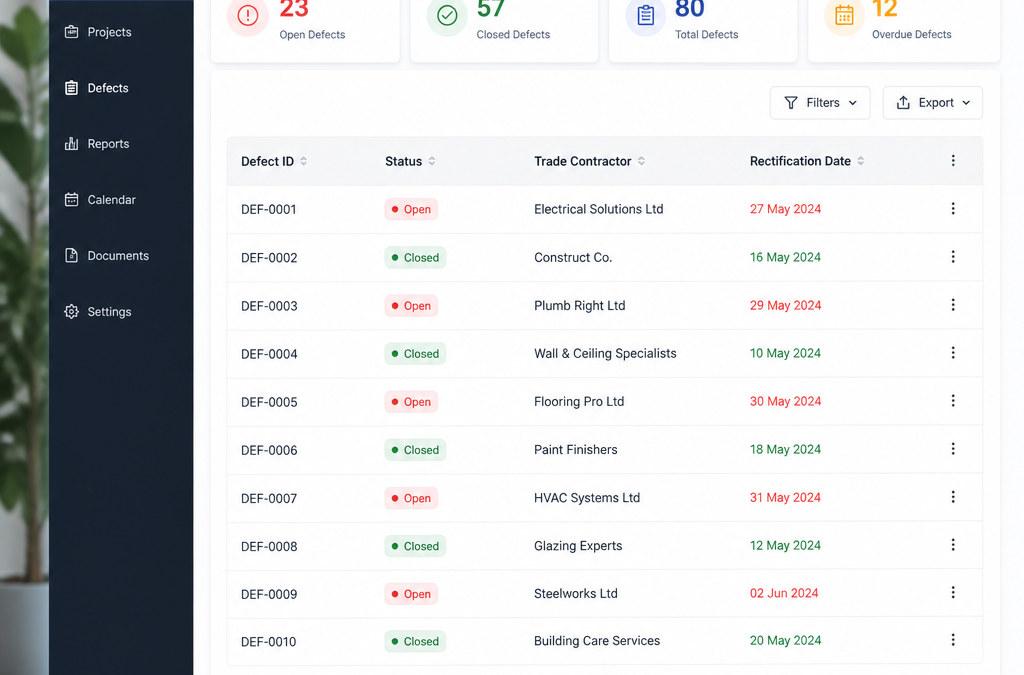
Most builders treating defect reports as a one-time handover document are flying blind. A list of issues handed over at practical completion tells you what went wrong. A defect statistics report with open and closed status tracking tells you who is underperforming, which trades repeat the same errors, and whether rectification is actually happening before your client escalates. That difference matters enormously on volume builds across Brisbane, the Gold Coast, Logan, Ipswich, and Redland Bay, where the same subtrades cycle through project after project. Without structured open/closed tracking, you cannot distinguish a builder who resolves defects promptly from one who simply buries them in paperwork.
Table of Contents
- Quick Takeaways
- What Is a Defect Statistics Report?
- Open vs. Closed Defect Status Explained
- How Open/Closed Tracking Drives Builder Performance
- Key Metrics Inside a Defect Statistics Report
- Comparing Defect Tracking Approaches
- Applying Defect Statistics to New Home Inspections
- Common Mistakes in Construction Defect Management
- Frequently Asked Questions
- References
Quick Takeaways
| Key Insight | Explanation |
|---|---|
| Open/closed status is the minimum viable metric | Without tracking whether each defect is open or closed, a defect report is simply a complaint log with no accountability mechanism attached to it. |
| Defect resolution time reveals builder responsiveness | How quickly a builder moves defects from open to closed signals whether their subcontractors are managed or left to self-supervise. Slow resolution times are a warning sign on future projects. |
| Trade-level assignment is non-negotiable | A defect statistics report must attribute each defect to a specific trade. Without this, patterns of recurring poor workmanship remain invisible and responsibility is diluted across the whole team. |
| Photo evidence anchors open/closed decisions | A defect marked closed without photo proof of rectification can be reopened or disputed. Photo-enhanced reports remove that ambiguity entirely. |
| Defect rate by project type benchmarks quality over time | Tracking defect density across house and land packages versus high-rise developments shows where builder performance deteriorates under complexity or volume pressure. |
| Pre-handover is the highest-value moment for open tracking | Defects identified and logged as open before settlement carry contractual weight. Defects discovered after the client takes possession are significantly harder and more expensive to resolve. |
| Repeated open defects from one trade indicate systemic failure | If the same trade consistently generates open defects across multiple projects, the issue is not individual error. It is a supervision or procurement problem that statistics will expose. |
What Is a Defect Statistics Report?
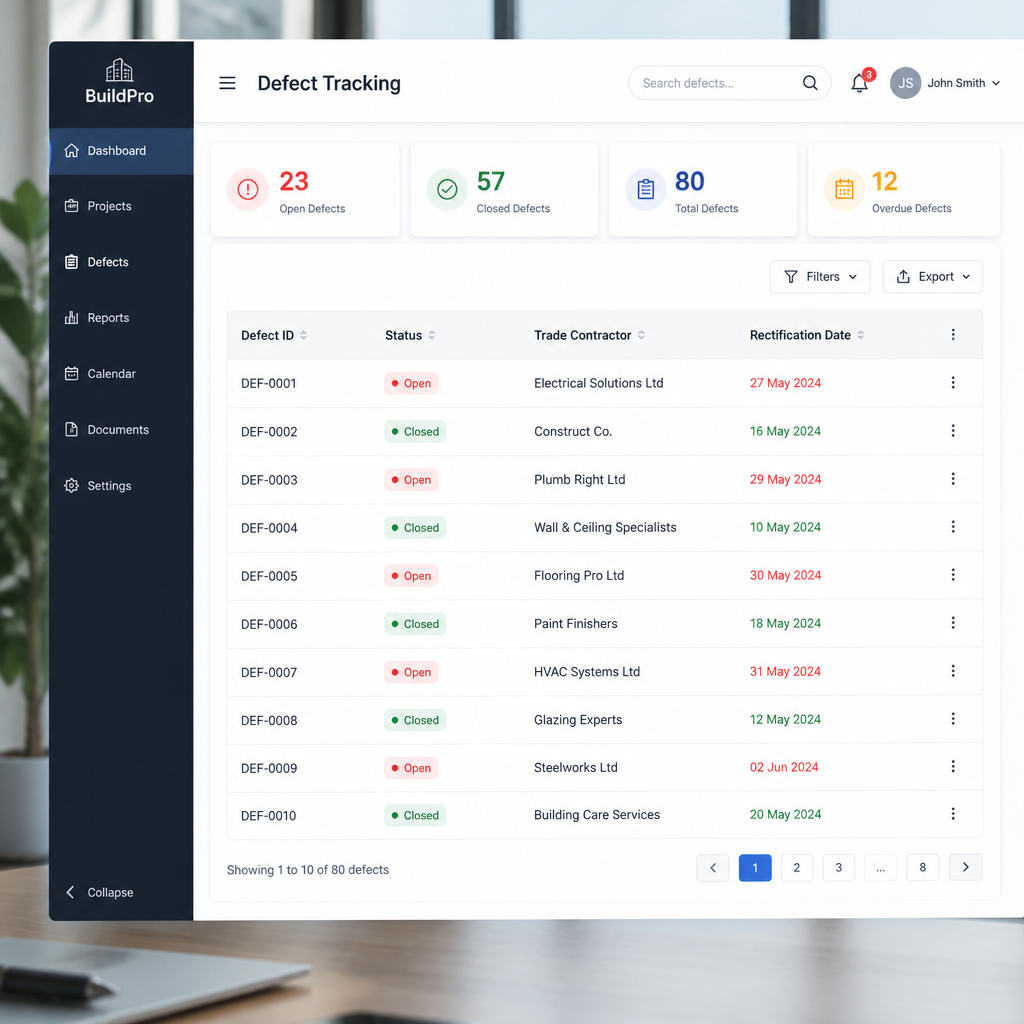
A defect statistics report is a structured summary of all defects identified across one or more construction projects, categorised by status, trade, severity, location, and resolution timeframe. It goes beyond a standard inspection report, which captures defects at a single point in time, and instead shows the lifecycle of each issue from discovery through to verified rectification.
For builders and developers managing multiple new home projects simultaneously, particularly across Southeast Queensland, the value is in aggregation. A single inspection report on a single lot tells you about that lot. A defect statistics report tells you whether your waterproofing subcontractor is consistently underperforming across every lot they touch. That is a fundamentally different level of insight, and one that only becomes possible when defect data is tracked over time with consistent status labelling.
Construction defect management at scale cannot rely on paper forms or disconnected site reports. The statistics layer, meaning the counts, trends, and resolution rates, is what separates reactive defect handling from a managed quality process.

Open vs. Closed Defect Status Explained
Every defect in a properly maintained report carries a status. The two baseline states are open and closed, though well-structured systems also include intermediate statuses such as assigned, in progress, and verified. Understanding what each status means, and who controls the transition, is where most builders go wrong.
What “Open” Actually Means in Practice
An open defect is any issue that has been identified, documented, and not yet verified as rectified. The word “verified” is doing critical work there. A builder marking a defect closed because a tradie told them it was fixed, without an independent check, is not closing defects. They are creating a paper record of closure that may not match physical reality on site.
On pre-handover inspections conducted by GoInspect across Brisbane, Gold Coast, Logan, Ipswich, and Redland Bay, a common finding is defects listed as internally resolved by the building company that are still physically present when an independent inspector walks the property. That gap between internal closed status and verified closed status is the single most important quality gap in residential construction defect management.
What Closes a Defect Properly
A defect should only move to closed status when three things exist: completed rectification work, photographic evidence showing the remedied condition, and sign-off from a qualified inspector rather than the trade who performed the work. This is not bureaucratic excess. It is the minimum standard required to use the closed status as meaningful data in a builder performance report.
Pro tip: Require photo documentation at the time of closure, not retrospectively. When photos are added after the fact, timestamps and site conditions become unreliable and the evidentiary value of the closure record is weakened.
How Open/Closed Tracking Drives Builder Performance
The direct mechanism through which open/closed tracking improves builder performance tracking is accountability visibility. When a builder knows that their defect close-out rate will be reviewed against other builders or against their own history on previous projects, their behaviour changes. Not always voluntarily, but it changes.
Defect Resolution Time as a Performance Signal
Resolution time, meaning the elapsed time from a defect being logged as open to it being verified as closed, is one of the most useful performance signals in a defect statistics report. A builder who closes defects within a few days of receiving a report is operating a functional rectification process. A builder where defects sit open for three or four weeks before any movement occurs is telling you something important about how they manage their subcontractors.
On high-volume residential developments, slow resolution times compound. If a defect in the plastering work on Lot 12 stays open while the plasterer moves to Lots 13, 14, and 15, the correction requires a return visit, materials remobilisation, and potential disruption to other trades who have already followed on. The cost of a late close is always higher than the cost of an immediate fix.
Trade-Level Performance Data Changes Procurement Decisions
When defect statistics are broken down by trade, the data becomes actionable at the procurement level. A tiling subcontractor who generates twice the open defects of any other tiler on the panel is visible in the statistics. A builder who reviews these reports before renewing subcontractor agreements has a rational, documented basis for their decisions. A builder who ignores them is making procurement decisions based on price alone and absorbing the rectification cost invisibly.
Accountability drives improvement more effectively than documentation alone. Tracking defect frequency by trade, material, or project phase reveals opportunities for improvement that might otherwise remain hidden within project-specific documentation.
This is why independent inspection providers, rather than builder-controlled internal quality teams, produce the most useful trade-level defect data. When the inspector has no commercial relationship with the subcontractors being assessed, the open/closed decisions reflect actual site conditions rather than relationship management.
Pro tip: When reviewing a defect statistics report for builder performance, look at the ratio of defects reopened after initial closure. A high reopen rate suggests defects are being marked closed prematurely to hit internal metrics, which is a supervision problem worth addressing directly.
Key Metrics Inside a Defect Statistics Report
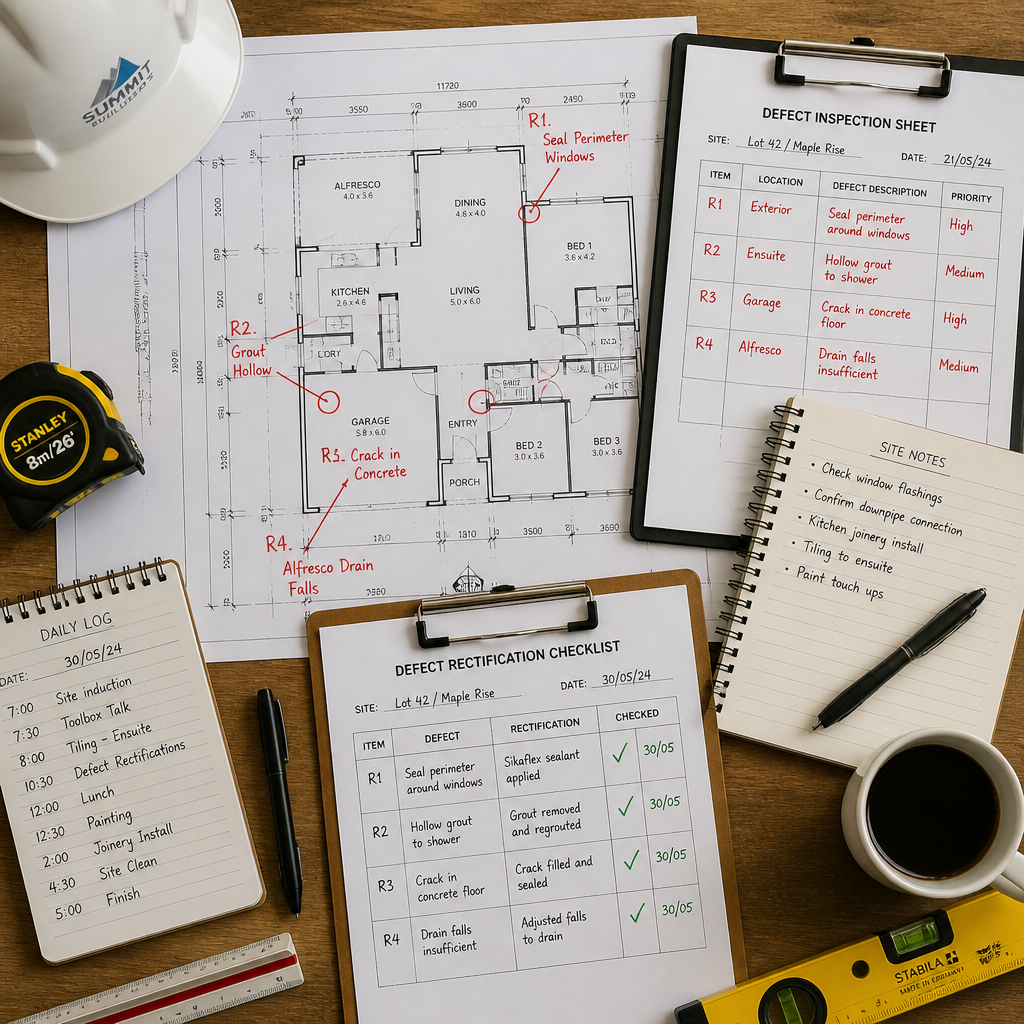
A well-constructed defect statistics report for new home construction should contain more than a count of issues. The metrics that deliver genuine insight into builder performance are the ones that show patterns across time, trades, and project types.
Defect Density
Defect density measures the number of defects per dwelling, per stage, or per square metre. This allows comparison across projects of different scales and types. A standalone house and a townhouse will naturally generate different defect volumes. Comparing raw defect counts without normalising for project scope produces misleading performance data. Defect density is the normalised version that makes comparison valid.
Open Defect Backlog
The open defect backlog is the total count of defects that remain unresolved at any given point. On active construction projects across Southeast Queensland, builders with a growing open backlog are heading toward a settlement dispute. The backlog metric, tracked weekly during the defect liability period, is an early warning indicator that a builder’s rectification capacity is being outpaced by the rate of new defect discovery.
Close-Out Rate by Trade
Close-out rate measures what percentage of defects assigned to a specific trade have been resolved within a defined period. A painting subcontractor with a 90% close-out rate within 14 days is performing very differently from one with a 40% rate. Without this metric, both appear in the same defect report as responsible parties, and no differentiation is possible.
Defect Recurrence Rate
Recurrence rate tracks how often the same category of defect reappears on subsequent projects or subsequent inspections of the same project after initial rectification. A high recurrence rate in a specific defect category, such as waterproofing at wet area junctions or paint finish on external cladding, points to a process or training failure rather than an isolated incident.
Comparing Defect Tracking Approaches
Not all defect tracking approaches deliver the same quality of performance data. The approach used has a direct effect on the usefulness of the statistics generated. Here is a direct comparison of the three most common approaches used in residential new home construction.
| Approach | What It Tracks | Limitations for Builder Performance Data |
|---|---|---|
| Builder’s own internal defect log | Defects self-reported by site supervisors, closure confirmed internally | No independent verification of closed status; commercial pressure to minimise open defect counts; trade relationships influence what gets recorded and when |
| Generic digital punch list app (e.g. SafetyCulture templates) | Defect items with location, photos, and assigned trades; status updated by app users | Status changes are controlled by the builder or their team; no structured statistics layer unless configured with custom reporting; photo-linking is manual and inconsistent in practice |
| Independent inspection with photo-enhanced defect statistics report | All defects identified, photographed, and attributed to specific trades; open/closed status verified by the inspector on re-inspection; trade-level and project-level statistics generated at each report | Requires scheduling an independent inspector at each stage; upfront cost per inspection, though substantially lower than post-settlement rectification disputes |
The independent inspection approach produces the most trustworthy defect statistics because the party recording open and closed status has no commercial interest in the outcome. For homeowners and investors, this is the approach that holds builders accountable. For developers, it also provides a documented quality assurance record that has value in dispute resolution and with financiers.
Applying Defect Statistics to New Home Inspections
For a homeowner or investor buying a new build in Brisbane, Gold Coast, Logan, Ipswich, or Redland Bay, the defect statistics report produced at practical completion inspection is the starting point for a defect liability claim, not just a snapshot of what needs fixing.
Pre-Handover Inspections as Data Collection Events
Every pre-handover or pre-settlement inspection is an opportunity to create a structured defect record. When the inspection report logs defects with clear open status, assigns each to a responsible trade, and provides photo evidence of the defect condition, it becomes the baseline for an open/closed tracking cycle. The builder receives the report, rectifies the issues, and then a re-inspection either closes each item or keeps it open with documented evidence of ongoing non-compliance.
This process protects homeowners in Queensland, where the statutory defect liability period and builder’s warranty obligations under the Queensland Building and Construction Commission framework depend on documented evidence. A verbal report of defects is worth nothing. A photo-enhanced defect statistics report with timestamped open status is the basis for a formal claim.
High-Rise and Multi-Lot Developments Need Aggregate Statistics
For developers managing high-rise or large housing projects, the value of a defect statistics report multiplies with scale. A 50-lot development with the same tiling subcontractor across all lots needs trade-level defect statistics to understand whether a problem on Lot 7 is isolated or systemic. The statistics aggregate what individual inspection reports cannot show in isolation.
GoInspect produces customised defect reports for high-rise developments and housing projects precisely because the standard single-property format does not surface the cross-project patterns that matter to developers and project managers. Same-day reporting across multiple lots, with consistent defect categorisation and trade attribution, is the minimum requirement for meaningful statistics at scale.
Pro tip: Ask your inspection provider whether their report format supports consistent defect categorisation across multiple lots. If each inspector uses different language to describe the same defect type, the statistics you generate from the reports will be impossible to aggregate meaningfully across a large project.
Common Mistakes in Construction Defect Management
The defect management failures that end up in disputes are almost never the result of unknown defects. They are the result of known defects that were tracked poorly, attributed incorrectly, or allowed to stay open past the point of practical resolution.
Treating the Inspection Report as the End, Not the Beginning
A common mistake among first-time owner-builders and investors is commissioning a pre-handover inspection, reading the report, and then verbally asking the builder to fix the items. There is no tracking, no re-inspection, and no verified closure. The builder’s internal record shows the job done. The homeowner’s position at settlement is that they received a verbal assurance. That is not defect management. That is hope.
The inspection report should initiate a formal open/closed cycle. Each item in the report is open until a re-inspection verifies it closed. Settlement should not occur until the open defect count is at a level both parties have formally agreed on and documented.
Relying on Builder-Controlled Defect Records for Dispute Evidence
Builders using their own internal defect management systems control who closes defects and when. When a dispute arises over whether an item was rectified, the builder’s own records are not independent evidence. An independent inspection report with timestamped photos and inspector sign-off is. This is why homeowners and investors who rely solely on the builder’s defect documentation consistently find themselves at a disadvantage in warranty disputes with the QBCC or in legal proceedings.
Ignoring Defect Patterns Across Multiple Inspections
Builders managing multiple projects often treat each inspection as a standalone event. The defect statistics report becomes useful when it is reviewed across inspections. If waterproofing defects appear as open items on five consecutive inspections across different lots, the waterproofing contractor’s performance is the issue, not the individual lots. Addressing the individual lots without addressing the contractor perpetuates the problem indefinitely.
Effective construction defect management means treating the statistics as a management tool, not just an administrative record. The patterns in the data are instructions. The question is whether the builder is reading them.
Frequently Asked Questions
What is the difference between a defect statistics report and a standard building inspection report?
A standard building inspection report documents defects found at a single point in time on a single property. A defect statistics report aggregates defect data across multiple inspections, properties, or projects, and tracks the status of each defect from open through to verified closure. The statistics layer, covering defect counts by trade, resolution times, and close-out rates, is what makes it a performance management tool rather than simply a snapshot of site conditions.
How does open and closed defect tracking help hold builders accountable?
When every defect is logged as open and only moves to closed after independent verification with photographic evidence, the builder cannot claim rectification without proof. The open defect count at any point in time is a direct measure of outstanding contractual obligations. Builders who know their close-out rate is being tracked and reviewed are more likely to manage subcontractor rectification promptly than those operating without that visibility.
At what stage of a new home build should defect statistics tracking begin?
Tracking should begin from the first formal inspection stage, which may be a frame inspection, lockup inspection, or practical completion inspection depending on the contract structure. The earlier defects are logged as open items with trade attribution, the more data exists for pattern analysis and the stronger the contractual foundation for requiring rectification before settlement or before the defect liability period expires.
Can a homeowner use a defect statistics report in a QBCC dispute or warranty claim?
Yes, and this is one of its most practical uses. A report produced by a licensed independent inspector, showing the defect with photographic evidence, the date it was identified, its open status, and any subsequent re-inspection findings, provides the documented basis for a Queensland Building and Construction Commission complaint or a statutory warranty claim. Verbal records and builder-issued documents alone carry far less weight in a formal dispute process.
How often should defect status be updated in a defect statistics report during the defect liability period?
Re-inspection should occur after the builder has had a reasonable opportunity to complete rectification works, typically two to four weeks after the initial defect report is issued. Each re-inspection generates an updated status for every open item: closed with evidence, still open with updated photos, or escalated if the builder has failed to respond. Monthly status reviews during the defect liability period are a reasonable standard for active projects.
What should a photo-enhanced defect report include to support open/closed tracking?
Each defect entry should include a reference number, a clear description of the defect, the responsible trade, the location within the property, the date identified, at least one photograph of the defect condition, and a status field set to open at the time of initial reporting. On closure, the same entry should be updated with a photograph showing the rectified condition, the date of verification, and the inspector’s sign-off. Without all of these elements, the report cannot function as a reliable tracking record across multiple re-inspections.
If you are currently managing defect rectification on a new home or development project, share what your biggest tracking challenge has been in the comments below. Your experience may help other homeowners and builders avoid the same pitfalls.
We would love your feedback and any insights you would share with others. What perspective would you add?
References
- Essential defect tracking metrics: open, closed, resolution time, and status management explained
- How snag list and punch list tracking drives trade accountability and quality improvement in construction
- What a construction warranty defect report covers and how it supports builder warranty claims in Australia
- Construction daily defects report templates for tracking trade responsibility and rectification status
- Digital defect management for construction: photo capture, trade assignment, and report generation