

Running a multi-lot housing development in Southeast Queensland means you are managing a pipeline of handovers, not a single event. The moment one practical completion notice goes out, two more are being prepared. When your inspection process is reactive, ad hoc, or dependent on a buyer showing up with a generic checklist, defects accumulate across lots, trades are recalled multiple times, and handover schedules slip. A structured housing development inspection program solves this. It creates a repeatable quality gate that catches defects before they become QBCC complaints, protects your licence, and keeps your settlement calendar on track.
Table of Contents
- Quick Takeaways
- Why Multi-Lot Inspections Are Different From Single-Home Inspections
- Queensland’s Mandatory Inspection Stages and What They Miss
- Scheduling Inspections Across a Housing Estate Without Losing Time
- Defect Tracking at Scale: From Individual Lots to Trade-Level Patterns
- High-Rise Developments vs House-and-Land Estates: Different Inspection Priorities
- Comparing Inspection Approaches for Multi-Lot Developments
- What Happens When Defects Are Missed at Handover
- Frequently Asked Questions
- References
Quick Takeaways
| Key Insight | Explanation |
|---|---|
| Coordinate multi-lot inspections on the same day where possible | Scheduling inspections across multiple lots in a single estate on the same day reduces inspector travel time, lowers per-unit cost, and produces consistent reports against a shared baseline. |
| Assign every defect to a responsible trade, not just to “the builder” | Photo-enhanced reports that name the responsible trade shorten rectification cycles because the right subcontractor is contacted first, not after a round of internal blame-shifting. |
| QBCC mandatory stage inspections are not a substitute for pre-handover inspection | The five mandatory certifier stages cover structural compliance. They do not capture finishing defects, incomplete fixtures, or cosmetic issues that buyers will dispute at settlement. |
| A defect statistics report is a management tool, not just a record | When defects are tracked as open or closed across multiple lots, patterns emerge at the trade level. A waterproofing subcontractor failing on Lot 7 and Lot 12 is a systemic risk, not bad luck. |
| QBCC can issue a Direction to Rectify within 12 months of practical completion for non-structural defects | Undocumented defects that surface after handover become the builder’s liability. Pre-handover inspection with photo evidence is the most effective way to prevent post-settlement disputes. |
| High-rise developments require a different inspection checklist than house-and-land estates | Common property interfaces, fire door compliance, balcony waterproofing, and inter-tenancy sound attenuation are not covered by standard residential inspection templates. |
| Same-day reporting matters for settlement timelines | When buyers receive a defect report the day of inspection, rectification notices can be issued immediately. Delays in reporting push out settlement dates and trigger buyer contract rights. |
Why Multi-Lot Inspections Are Different From Single-Home Inspections
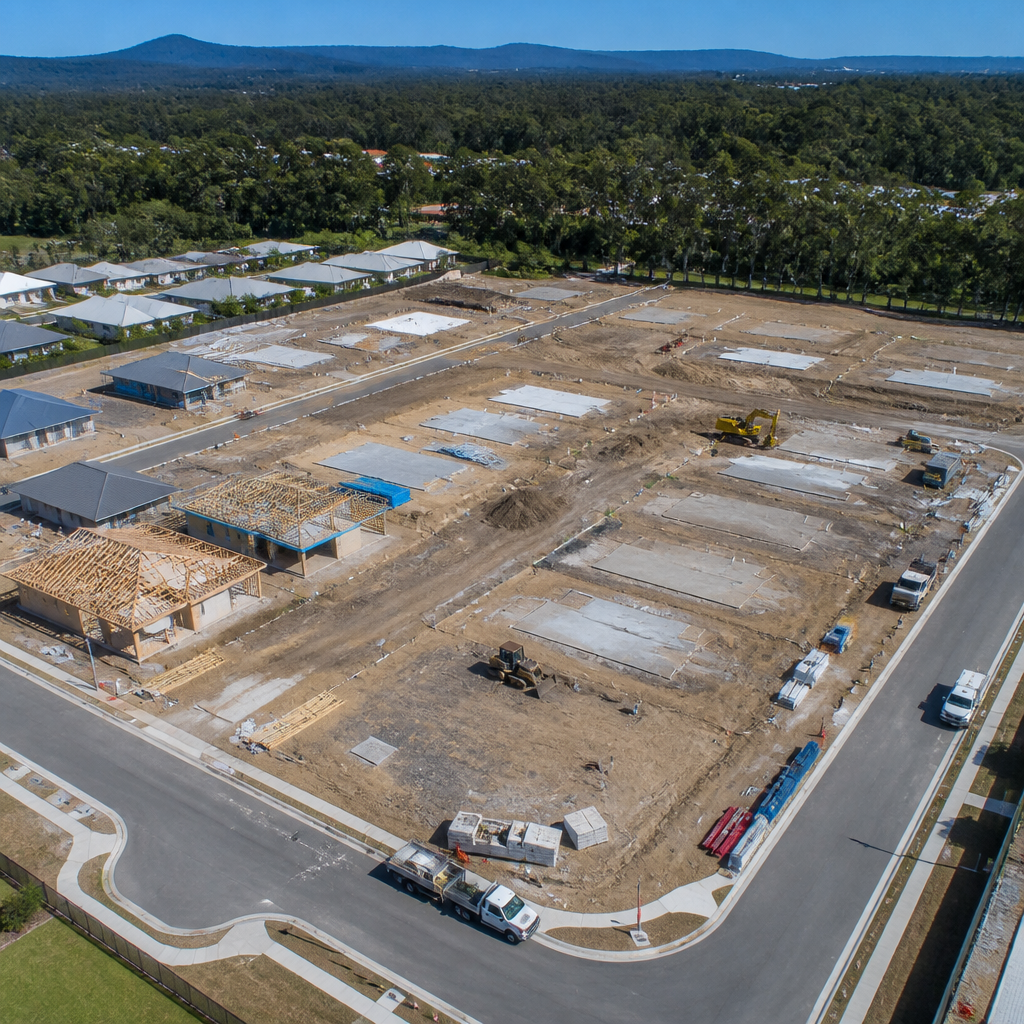
A single-home practical completion inspection is a straightforward event. One inspector, one property, one report. The buyer reads it, the builder rectifies, and settlement proceeds. Multi-lot developments operate on a completely different logic. Trades move between sites on tight schedules. A plasterer finishing one property at pace to meet a stage-payment deadline may miss finishing details on the next lot. A plumber finishing one property may be delayed starting the next. These are not hypothetical risks; they are recurring patterns in high-growth corridors like Ripley, Redbank Plains, and the northern Gold Coast.
The consequence is that defect patterns across a development are rarely random. They tend to cluster by trade, by stage in the build sequence, or by the specific supervisor on site that week. A housing development inspection program designed for multi-lot projects captures these patterns. A series of disconnected individual reports does not.
There is also the scheduling reality. When you are managing 20 or 50 lots moving toward practical completion across a rolling 12-month window, you cannot afford an inspection approach that treats each lot as an independent event. The builder who books inspectors lot by lot, on demand, as buyers request them, will spend more per inspection, wait longer for availability, and produce reports with no shared format. That inconsistency feeds disputes.
Queensland’s Mandatory Inspection Stages and What They Miss
The Queensland Building and Construction Commission (QBCC) requires licensed building certifiers to inspect single-detached homes at five prescribed stages: excavation, footing, slab, frame, and final. These inspections ensure construction work complies with the approved plans and recognised building standards, including the Building Code of Australia. They are mandatory, and they serve an important purpose. They are not, however, a complete quality assurance program.
What the mandatory stages cover
Certifier stage inspections focus on structural compliance. They check that footings are correctly installed, that framing meets the approved plans, and that the finished structure conforms to the development approval. At the final stage inspection, the certifier confirms the home is substantially complete under the approval, which is a legal and regulatory test, not a finishing quality test.
What the mandatory stages do not cover
Finishing defects, incomplete fixtures, painting quality, tiling alignment, silicone application, window operation, door hardware, waterproofing membrane continuity in wet areas, and dozens of other items that will appear in a buyer’s defect list are outside the scope of certifier stage inspections. This is not a criticism of the certifier system. It is simply a different purpose. The mandatory stages protect structural integrity. An independent multi-lot building inspection at practical completion protects the builder from post-handover disputes by documenting the property’s condition at the point the buyer takes possession.
Pro tip: Do not wait for buyers to organise their own independent inspectors and then present you with a defect list. Commission your own pre-handover inspection report for each lot. When you already have a documented baseline, the buyer’s list rarely adds anything you have not already scheduled for rectification.
A single inspection report on a single lot tells you about that lot. A defect statistics report tells you whether your waterproofing subcontractor is consistently underperforming across every lot they touch. That is a fundamentally different level of insight.
Scheduling Inspections Across a Housing Estate Without Losing Time
The biggest scheduling mistake builders make with multi-lot inspections is treating each inspection as a separate booking. By the time you are managing 10 or more lots in the same estate, the administrative overhead of independent bookings, separate reports, and uncoordinated rectification schedules becomes a real drag on project delivery. The smarter approach is to batch inspections by estate and by completion week.
Batch inspections by completion wave
Group lots that are reaching practical completion within the same two-to-three week window and book them together. A single inspector visiting a Gold Coast estate to complete three inspections in one day produces reports with consistent format, shared notation conventions, and comparable findings. When those reports go to the same project manager, the rectification workflow is unified rather than fragmented. For most South East Queensland builds, the practical completion notification should trigger an inspection booking approximately two weeks before the scheduled handover, giving time to receive the report and prepare before the handover meeting.
Use a fixed inspection partner, not a rotating roster
Switching inspection providers between lots in the same development introduces format inconsistencies that create disputes. If Lot 3 was inspected using one report template and Lot 9 uses a different one, comparing defect severity across lots becomes unreliable. Builders and developers managing housing estates across Brisbane, Logan, Ipswich, and Redland Bay benefit from a fixed inspection partner who can apply the same report structure across every lot in the development.
Pro tip: Ask your inspection provider whether they can schedule inspections for multiple lots in the same estate on the same day. Coordinating inspections this way significantly reduces per-unit cost, particularly for investors or developers buying multiple lots in the same project, and produces a consistent baseline for defect comparison across the estate.
Defect Tracking at Scale: From Individual Lots to Trade-Level Patterns
A standard inspection report captures what is wrong on a specific property at a specific point in time. For a single homebuyer, that is exactly what is needed. For a developer managing 50 lots with the same tiling subcontractor across all of them, a single-point report is the beginning of the story, not the whole picture.
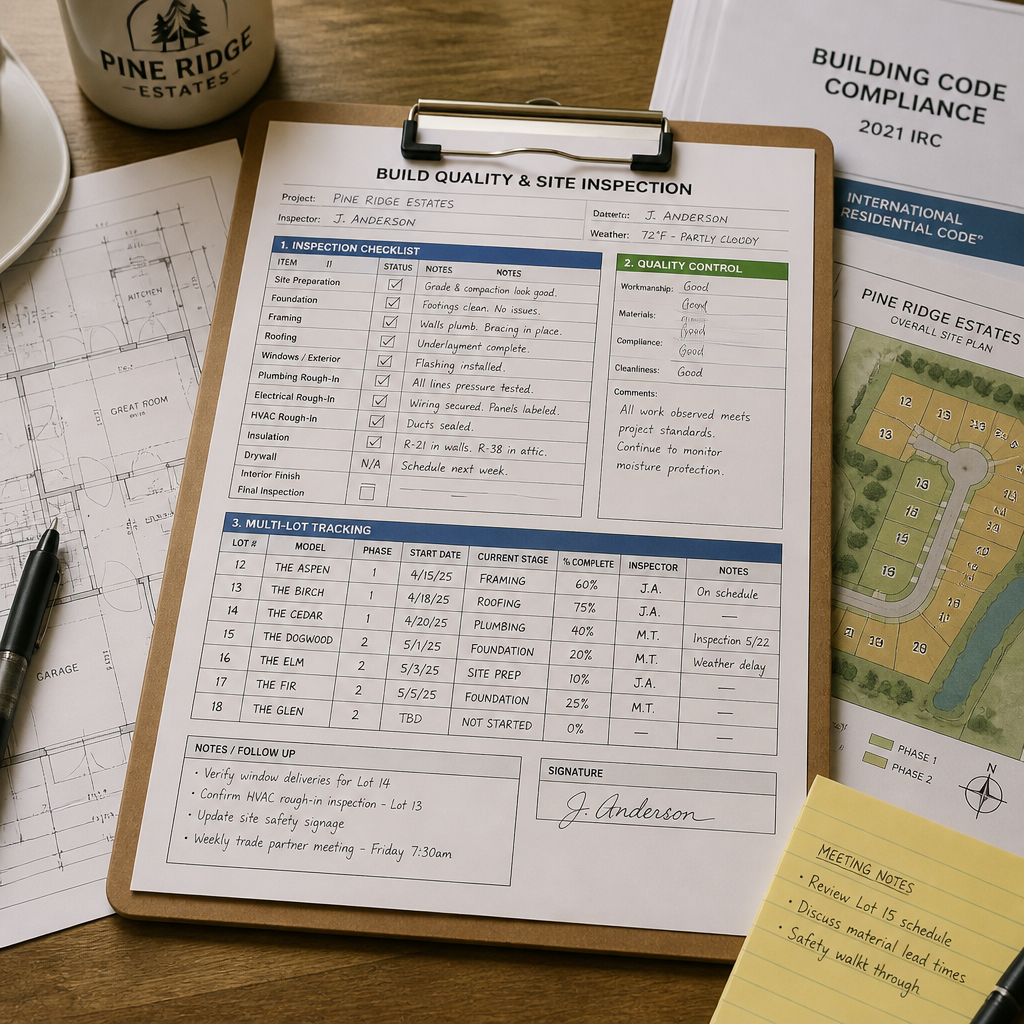
The tool that closes this gap is a defect statistics report: a structured summary of all defects identified across multiple construction projects, categorised by status, trade, severity, location, and resolution timeframe. It shows the lifecycle of each issue from discovery through to verified rectification, across every lot in the development simultaneously.
Open and closed defect tracking
When inspection reports log defects with clear open or closed status and assign each to a responsible trade with photo evidence, the report becomes the baseline for a managed rectification cycle. The builder receives the report, rectifies the issues, and a re-inspection either closes each item or keeps it open with documented evidence of ongoing non-compliance. For Queensland builders, this documented process matters because the QBCC’s Direction to Rectify framework depends on a clear record. A verbal report of defects is worth nothing in a dispute. A photo-enhanced defect statistics report with timestamped status is the basis for managing liability.
Trade-level analysis changes how you manage subcontractors
When defect data is aggregated across a 50-lot development, trade-level patterns become visible that individual reports cannot show in isolation. If your waterproofing subcontractor is generating defect findings across Lots 3, 7, 12, and 19, that is a performance problem requiring a direct conversation, a remediation plan, or a contract decision. If you are only reading individual lot reports as they come in, that pattern takes months to notice. Construction defect management at scale cannot rely on disconnected site reports. The statistics layer, meaning the counts, trends, and resolution rates, is what separates reactive defect handling from a managed quality process.

High-Rise Developments vs House-and-Land Estates: Different Inspection Priorities
Builders and developers active in both high-density and house-and-land sectors often make the mistake of applying the same inspection process to both. They are fundamentally different inspection environments, and using a residential housing checklist for a high-rise development will miss material defects that matter to buyers and to compliance.
House-and-land estate inspection focus
In a house-and-land estate across growth corridors such as Ripley in Ipswich or the northern Gold Coast, the inspection priorities cluster around finishing quality, waterproofing in wet areas, external drainage, structural tie requirements (particularly in coastal wind regions), and the condition of finishes at practical completion. Trades move quickly between sites in high-volume estates, and the most common defect categories reflect that pace: incomplete caulking, paint finish defects, hardware not fitted to specification, and drainage grading that will not pass a proper assessment.
High-rise development inspection focus
High-rise inspections require assessment of elements that simply do not exist in a detached dwelling. Common property interfaces, fire door compliance, balcony waterproofing, mechanical ventilation performance, and inter-tenancy sound attenuation are all relevant. Defects in high-density wet areas can affect multiple units and common property areas simultaneously. Trade coordination is more complex, defect volumes per unit are often higher, and the builder’s quality control across a large building floor plan is harder to manage without structured inspection data. A standard residential inspection checklist applied to a high-rise development is inadequate by design, not by accident.
For developer quality assurance Brisbane programs covering both development types, the inspection framework needs to be adapted to the building class rather than applying a single template across all projects.
Comparing Inspection Approaches for Multi-Lot Developments
Not all inspection approaches produce the same outcomes for builders and developers managing multiple lots. The table below compares three practical approaches based on how well they serve a multi-lot development program.
| Inspection Approach | Best For | Limitations for Multi-Lot Developments |
|---|---|---|
| Ad hoc buyer-commissioned inspections (one per lot, buyer arranges) | Single homebuyers protecting their own interests | No format consistency across lots. Builder receives different report styles from different inspectors. Defect comparisons across the development are unreliable. Rectification is reactive and lot-by-lot. |
| Builder-commissioned pre-handover inspections (coordinated, single provider) | Builders and developers managing estates of 10 or more lots with rolling handovers | Requires proactive booking and coordination, but this is a process investment, not a limitation. Same-day reporting allows immediate defect notice issuance. Trade-level defect data becomes available. |
| Staged development inspection programs with defect statistics reporting | Large-scale developers managing 20 to 100-plus lots or high-rise buildings with complex trade coordination | Requires an inspection provider with capacity to customise report formats for housing estates and high-rise developments simultaneously. Not all providers offer this. GoInspect’s customised reports for housing projects and high-rise developments are designed specifically for this use case. |
What Happens When Defects Are Missed at Handover
The consequences of missing defects at handover are not theoretical. Under the QBCC framework, a Direction to Rectify can be issued for non-structural defects within 12 months of practical completion, and for structural defects within six years and six months. Since July 2017, the QBCC no longer issues Requests to Rectify. If a QBCC inspector attends site following a complaint, there is a high likelihood a Direction to Rectify will be issued if a defect is detected. A Direction to Rectify is significant and must be treated seriously.
The cost of a reactive rectification cycle
When defects are discovered after handover rather than before, the rectification process is more expensive, more disruptive, and more damaging to your client relationship. The buyer is already in the property. Access for trades must be negotiated. The defect that would have taken a day to fix during construction now takes three, because the surrounding finishes need protection or replacement. The administrative overhead of managing post-handover rectification across multiple lots simultaneously is substantial, and it pulls project management capacity away from the next development.
The role of pre-handover inspection in protecting your licence
Independent inspection before handover creates a documented record of the property’s condition at the contractual milestone of practical completion. This record matters if a buyer subsequently claims defects that existed at handover or if a dispute proceeds to the QBCC or QCAT. Builders who can demonstrate they conducted proactive pre-handover inspections, issued rectification notices, and resolved documented defects before settlement are in a fundamentally stronger position than builders whose only record is their own completion checklist.
For builders and developers operating across Brisbane, Gold Coast, Logan, Ipswich, and Redland Bay, GoInspect provides pre-handover, pre-settlement, and practical completion inspections with same-day photo-enhanced reporting, trade-specific defect assignment, and customised formats for both housing estates and high-rise developments. Inspections start from $550 including GST.
Frequently Asked Questions
What is a housing development inspection and how is it different from a standard building inspection?
A housing development inspection is a pre-handover or practical completion inspection conducted specifically within a multi-lot or staged development program. Unlike a standard single-property inspection commissioned by a homebuyer, it is designed to be applied consistently across multiple lots, with report formats that allow defect comparison across the development and trade-level defect assignment that supports subcontractor performance management. The core inspection process, checking the property against the contract, approved plans, and Australian Standards, is the same. The difference is in how reports are structured, tracked, and used at scale.
How should a builder schedule inspections across a large housing estate to avoid settlement delays?
The most effective approach is to batch inspections by completion wave, grouping lots reaching practical completion within the same two-to-three week window and booking them together with a single provider. This creates format consistency, reduces per-unit cost, and allows the builder to manage rectification across a cluster of lots simultaneously rather than in a fragmented lot-by-lot sequence. Booking approximately two weeks before the scheduled handover for each lot gives enough time to receive the report, issue rectification notices, and resolve defects before settlement.
Do QBCC mandatory stage inspections replace the need for a pre-handover inspection?
No. The five mandatory QBCC certifier stages, covering excavation, footing, slab, frame, and final, address structural compliance against the approved plans and the Building Code of Australia. They do not assess finishing quality, incomplete fixtures, wet area waterproofing membrane continuity, hardware installation, or paint finish defects. These are exactly the categories that generate buyer disputes at handover. A pre-handover inspection by an independent licensed inspector is the appropriate tool for capturing finishing defects before the buyer takes possession.
What is a defect statistics report and why does it matter for a multi-lot development?
A defect statistics report is a structured summary of defects identified across multiple lots, categorised by status (open or closed), responsible trade, severity, and resolution timeframe. It goes beyond a single inspection report by showing the lifecycle of each defect from discovery to rectification, and by aggregating findings across lots to reveal trade-level patterns. For a developer with the same tiling or waterproofing subcontractor across a 50-lot estate, a defect statistics report will show whether an issue on one lot is isolated or systemic, which is the insight needed to manage subcontractor performance before the pattern affects settlement timelines.
Do high-rise development inspections require a different process than house-and-land estate inspections?
Yes, and the difference is material. High-rise inspections must cover common property interfaces, fire door compliance, balcony waterproofing, mechanical ventilation, and inter-tenancy sound attenuation, none of which appear in a standard residential house inspection checklist. Applying a residential housing template to a high-rise development will miss defects that are specific to multi-storey construction. Builders and developers managing high-rise projects in Brisbane and the Gold Coast need an inspection provider who can customise reports to the specific building class rather than applying a one-size-fits-all format.
How does trade-specific defect assignment in inspection reports help builders manage subcontractors?
When every defect in an inspection report is assigned to the responsible trade, the builder’s project manager can send a rectification notice directly to the correct subcontractor without an internal investigation phase. In a multi-lot development where the same subcontractors are working across multiple sites, this assignment also enables trade-level defect tracking. If a waterproofing subcontractor is generating defect findings across multiple lots, that pattern becomes visible quickly, allowing the builder to address performance before it affects the broader settlement schedule or triggers QBCC involvement.
What is the QBCC Direction to Rectify and how does pre-handover inspection reduce the risk of receiving one?
A Direction to Rectify (DTR) is a formal QBCC direction requiring a builder to rectify defective building work. In most cases, the rectification period is 35 days. The QBCC can issue a DTR for non-structural defects within 12 months of practical completion. Pre-handover inspection reduces the risk of a DTR by identifying and resolving defects before the buyer takes possession and before a QBCC complaint can be lodged. A documented inspection record showing defects were identified, rectification notices were issued, and defects were closed before handover is the strongest defence against a post-settlement dispute.
If you are a builder or developer managing a housing estate or high-rise project in Southeast Queensland, we would like to hear how your current inspection process handles the challenge of coordinating quality across multiple lots simultaneously. What has worked, and what has caused delays?
References
- QBCC mandatory building inspection stages and certifier requirements for Queensland residential construction
- QBCC Direction to Rectify: process, rectification periods, and builder obligations
- HIA guide to defective works for Queensland contractors: DTR process, warranty periods, and complaint handling
- Understanding mandatory stage inspections for new homes in Queensland across Brisbane, Logan, Moreton Bay, and Ipswich
- Effective defect rectification strategies for construction projects: scheduling, documentation, and subcontractor accountability