
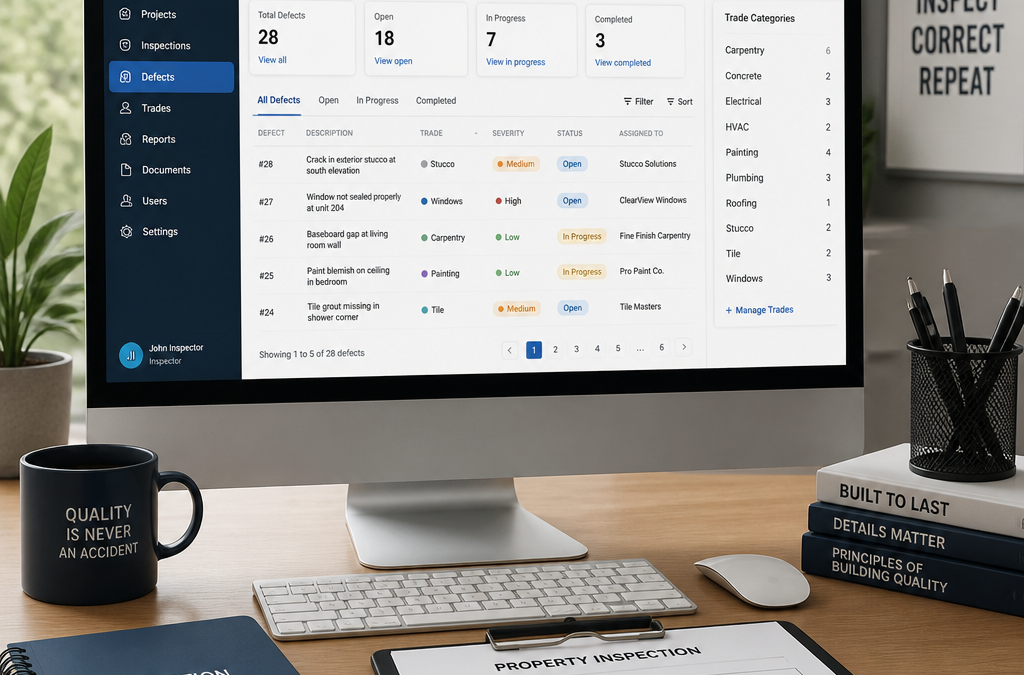
When a new home handover goes wrong, the most expensive mistake is not the defect itself. It is sending the wrong trade back to fix it. Defect trade assignment is the process of correctly identifying which subcontractor is responsible for each building issue, and in practice, most inspection reports skip it entirely. The result is a builder’s inbox full of disputes, tradespeople called back for work outside their scope, and homeowners waiting weeks for rectifications that should have taken days. GoInspect was built specifically to fix this problem across Brisbane, Gold Coast, Logan, Ipswich, and Redland Bay.
Table of Contents
- Quick Takeaways
- Why Trade Assignment Fails in Standard Inspection Reports
- How GoInspect Assigns Defects to the Correct Trade
- Photo-Enhanced Defect Reports and Why They Change Everything
- The Building Defect Rectification Workflow GoInspect Uses
- Comparing Defect Reporting Approaches
- Who Benefits Most from Accurate Trade Assignment
- What a Builder Inspection Report in Brisbane Should Actually Include
- Frequently Asked Questions
- References
Quick Takeaways
| Key Insight | Explanation |
|---|---|
| Trade assignment is a distinct step, not a side note | GoInspect treats each defect as a separate line item and names the responsible trade explicitly, rather than grouping all issues into a single narrative report. |
| Photo evidence removes ambiguity | Each identified defect is paired with a photo in the same-day report, so the builder and trade have no grounds to dispute what was observed or where it occurred. |
| Same-day reporting accelerates rectification | Sending reports the same day as the inspection means trades can be booked before the next business day, cutting average rectification time significantly. |
| High-rise developments need customized reports | GoInspect provides customized defect reports for multi-unit developments, with apartment-level trade breakdowns that generic templates cannot produce. |
| Incorrect trade assignment costs builders money | Sending a plasterer to fix a waterproofing failure wastes a call-out fee and delays the actual fix. Accurate assignment prevents double-handling. |
| Fully licensed inspectors reduce liability exposure | Reports produced by unlicensed inspectors may not hold up if a dispute reaches QBCC. GoInspect uses fully licensed inspectors throughout Queensland. |
| Pre-handover inspections protect investor returns | Investors who identify defects before settlement can require rectification at the builder’s cost rather than absorbing repair expenses post-purchase. |
Why Trade Assignment Fails in Standard Inspection Reports
The standard approach to a new home inspection report is a list of defects with descriptions. The inspector writes what is wrong. Nobody writes who is supposed to fix it. That single omission is responsible for most of the friction that follows a practical completion inspection.
A common mistake is assuming builders will automatically know which trade to dispatch for each defect. In practice, builders coordinate between five to fifteen subcontractors on a single project. When a defect report does not specify whether a watermark on a ceiling is a plumbing issue, a roofing failure, or a flashings problem, the builder has to investigate before they can even schedule rectification work. That investigation adds days or weeks to what should be a straightforward process.
The problem compounds on larger developments. A high-rise project with forty apartments and a single unassigned defect list creates a coordination bottleneck that can delay settlement for multiple buyers simultaneously. Builders working in Brisbane and the surrounding regions are under significant pressure from the Queensland Building and Construction Commission to meet defect rectification timelines, and an unclear report makes compliance harder, not easier.
Pro tip: If you receive a defect report that groups multiple issues under vague headings like “finishings” or “general works”, ask your inspector to reissue it with trade-specific line items before you forward it to your builder. A report that saves the builder time saves you time.
How GoInspect Assigns Defects to the Correct Trade
GoInspect’s approach is structured around a single principle: every defect in a report must name the trade responsible for rectifying it. This is not labeling for the sake of labeling. It is the mechanism that makes building defect rectification faster and more accountable.
The On-Site Assessment Method
During a pre-handover inspection, GoInspect’s licensed inspectors assess each defect against the Australian Standards and the relevant building code requirements. Part of that assessment is determining causation. A cracked render finish on an external wall, for example, could be a bricklayer’s issue, a renderer’s issue, or a movement joint design issue. Each has a different responsible trade and a different rectification path.
Inspectors are trained to distinguish between surface symptoms and root causes. This matters because fixing only the surface symptom without identifying the underlying trade responsible will produce a defect that reappears after the next inspection cycle.
How Trade Categories Are Applied
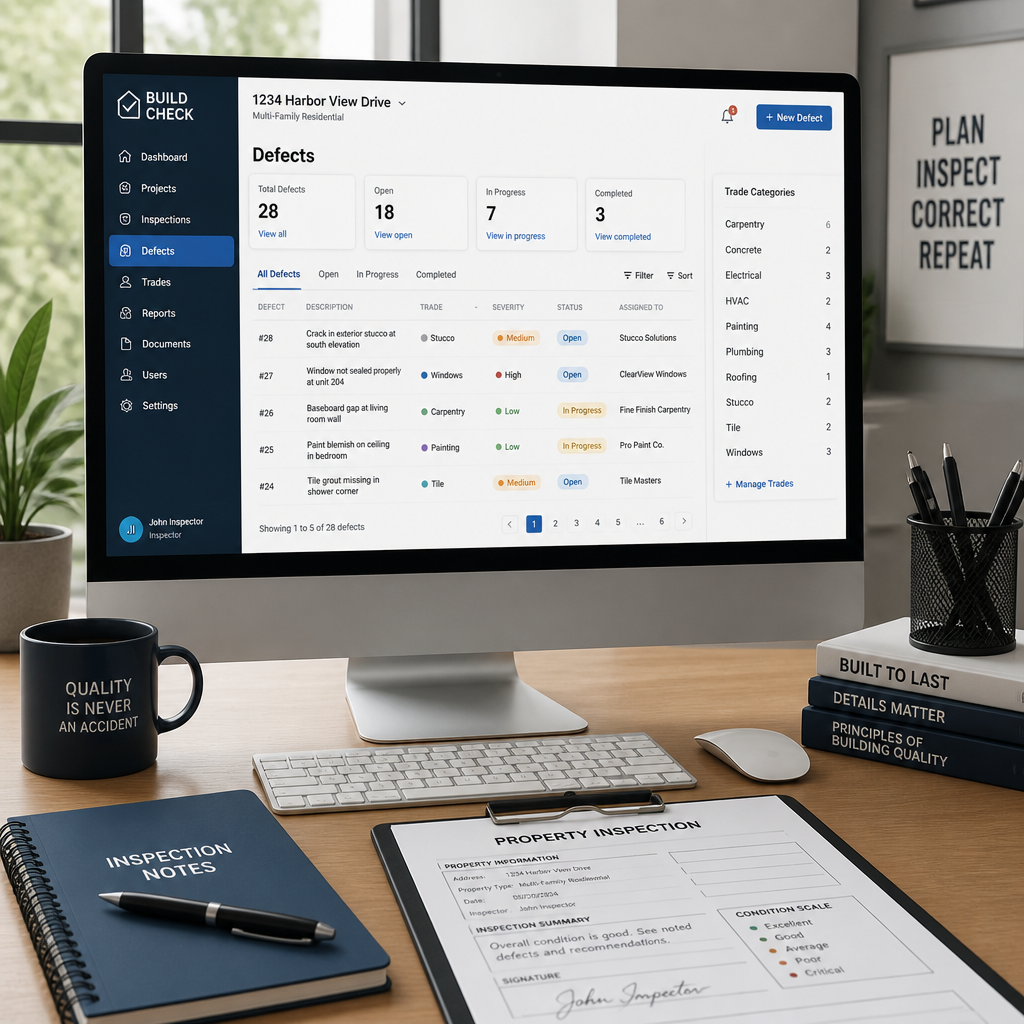
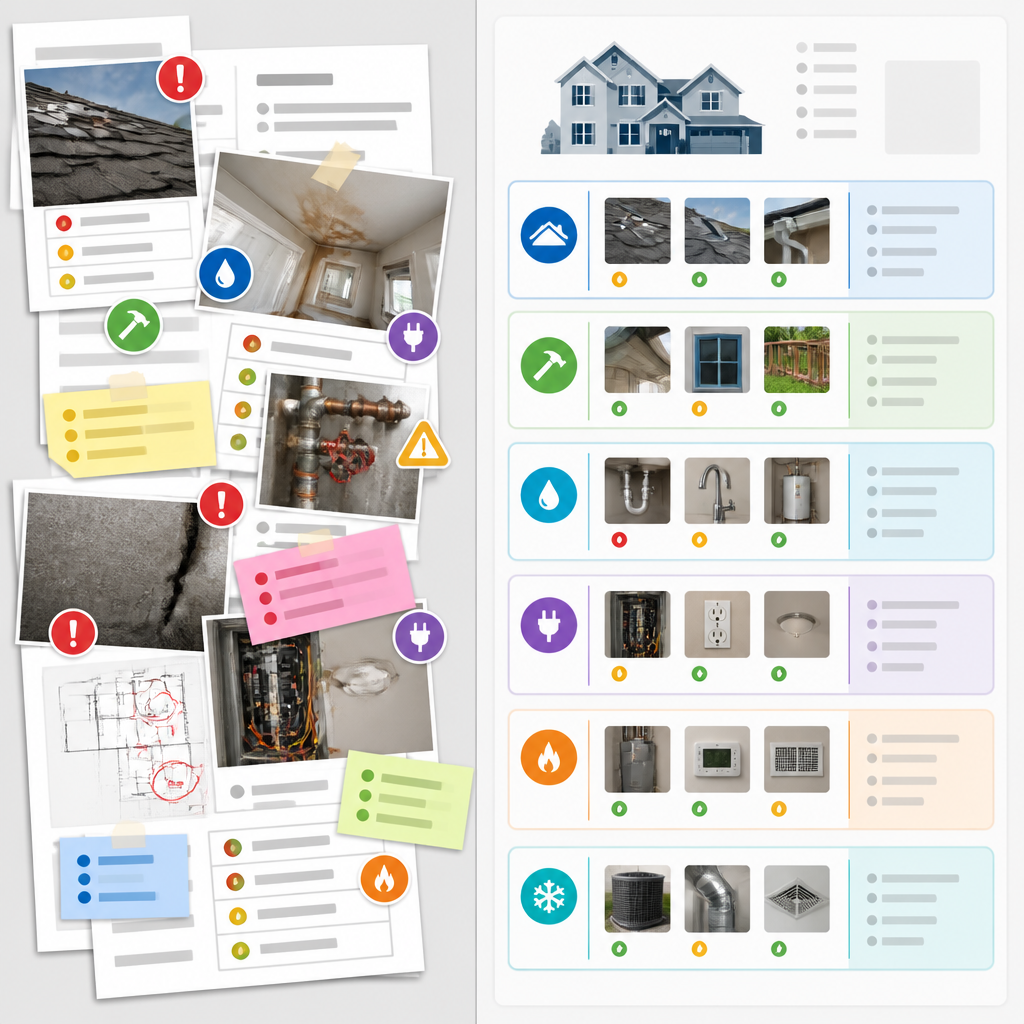
GoInspect uses a defined set of trade categories in its reports. Common categories include carpentry and joinery, painting, tiling, waterproofing, electrical, plumbing, rendering, concreting, and roofing. Each defect item in the report is tagged to one of these categories. When a builder receives the report, they can filter by trade and issue rectification instructions immediately.
This structure is particularly useful for volume builders managing multiple projects across Greater Brisbane. A site manager who receives a GoInspect report can forward the plumbing section directly to the plumber and the painting section directly to the painter without reading the entire document. That efficiency is not accidental. It is how the report is designed.
Photo-Enhanced Defect Reports and Why They Change Everything
Text-only defect reports create disputes. A description like “paint finish inconsistent in master bedroom” gives a painter room to argue about what inconsistent means, where exactly the issue is, and whether it was pre-existing. A photo of the specific wall panel with the roller marks visible leaves no room for that argument.
GoInspect’s photo-enhanced reports pair every defect with a photograph taken at the time of inspection. The photo is embedded directly in the report alongside the defect description and the trade assignment. This combination does three things that matter in practice. It removes ambiguity about the defect’s location. It documents the condition at the time of inspection. And it gives the trade a visual reference so they arrive on site knowing exactly what they are looking at.
“Defect documentation that includes both location and photographic evidence reduces the average time to first trade response by reducing back-and-forth clarification requests between builders and subcontractors.” Queensland Building and Construction Commission, Defect Management Guidance
For investors purchasing off-the-plan apartments in South East Queensland, this documentation is also legal protection. If a builder disputes whether a defect existed at handover, a time-stamped photo in a licensed inspector’s report is significantly more persuasive than a verbal account.
Pro tip: Request that your inspection report includes GPS-tagged or room-tagged photos. This makes it easier to match photos to floor plan locations on larger properties, and it matters for multi-level homes where similar defects can appear in different rooms.

The Building Defect Rectification Workflow GoInspect Uses
Most people think of an inspection as a one-time event. GoInspect treats the inspection as the starting point of a managed rectification workflow. The difference is significant for both homeowners and developers.
Step One: Inspection and Documentation
The licensed inspector conducts the on-site assessment, typically at the practical completion or pre-handover stage. Every defect is photographed, described, and assigned to a trade category on-site using GoInspect’s reporting system. This is not written up later from memory. The documentation happens in real time.
Step Two: Same-Day Report Delivery
The completed report is delivered the same day as the inspection. This is a deliberate operational choice. When a developer is managing settlement timelines, a report that arrives three days after the inspection costs three days of rectification time. Same-day delivery means the builder can schedule trades before the next business morning.
Step Three: Trade-Specific Distribution
Because each defect is already assigned to a trade, the report can be split and forwarded directly to each subcontractor. There is no need for a site manager to manually sort through a narrative document and work out who needs to do what. The structure of the GoInspect report does that sorting automatically.
Step Four: Re-Inspection and Verification
GoInspect also offers re-inspection services to verify that rectifications have been completed correctly. This closes the loop on the rectification process and provides documented confirmation that each defect has been resolved to the required standard before final settlement.
Comparing Defect Reporting Approaches
Not all inspection services approach defect reporting the same way. The differences between a trade-assigned, photo-enhanced report and a generic narrative report are significant in terms of practical outcomes. The table below compares three reporting approaches across the attributes that matter most during rectification.
| Reporting Approach | Trade Assignment | Rectification Speed |
|---|---|---|
| GoInspect Trade-Assigned Photo Report | Every defect tagged to a specific trade category with photo evidence. Builder can distribute directly to subcontractors without reprocessing the document. | Same-day report delivery enables next-business-day trade scheduling. Re-inspection option closes the loop with documented verification. |
| Generic Narrative Inspection Report | Defects described in prose without trade attribution. Builder must read the entire report and manually determine which trade is responsible for each item. | Report often delivered 2 to 5 days post-inspection. Builder processing time adds further delay before trades can be contacted. |
| Builder’s Internal Checklist | Trade assignment may exist informally but is typically not documented in a way that creates accountability or provides legal protection for the homeowner or investor. | Speed depends entirely on individual site manager capacity. No independent record exists to verify completion or dispute original condition at handover. |
Who Benefits Most from Accurate Trade Assignment
The immediate beneficiary of accurate defect trade assignment is usually the builder’s site manager. A well-structured GoInspect report removes hours of administrative sorting from their week. But the downstream benefits extend to every party involved in the project.
Homeowners benefit because their rectification timeline is shorter. When trades are correctly identified and contacted promptly, the defects are fixed before the homeowner moves in rather than after. For a family relocating to a new build in Logan or Ipswich, that difference is material.
Property investors benefit because accurate documentation protects their legal position. Queensland’s building defect warranty provisions require builders to rectify defects identified within the statutory warranty period. A dated, trade-assigned, photo-documented report from a licensed inspector is the strongest possible evidence if that obligation is disputed.
Developers benefit from reduced project holding costs. Every week a settlement is delayed because defect rectification is unresolved is a week of interest payments and project overhead. GoInspect’s same-day reports and customized formats for high-rise developments are specifically designed to compress that timeline.
Pro tip: If you are a developer managing multiple simultaneous handovers across a project stage, ask GoInspect about their customized report formats for multi-unit developments. A per-lot trade breakdown within a single master report is far more useful than forty separate inspection documents.
What a Builder Inspection Report in Brisbane Should Actually Include
A quality builder inspection report Brisbane property owners and investors should expect in 2024 is not the same document as the generic templates many services still use. Queensland’s building environment has specific regulatory requirements, local climate considerations, and construction practices that a thorough report must address.
Compliance Against Australian Standards
Every defect identified should be referenced against a specific standard or code. This includes AS 4349.1 for residential buildings and the National Construction Code. When a GoInspect report flags a defect, it does so with a compliance basis, not just an opinion. This matters if the builder disputes the finding.
Climate-Specific Defect Categories
Brisbane and South East Queensland’s subtropical climate means waterproofing failures, moisture ingress, and termite barrier continuity are higher-priority defect categories than they would be in a cooler climate. A generic template designed for Melbourne or Sydney may not weight these appropriately. GoInspect’s inspectors work in this region daily and know which defect categories carry the highest risk for local builds.
Clear Scope Boundaries
The report should clearly state what was inspected, what was accessible, and what was excluded. This is not a disclaimer exercise. It is a professional obligation that protects both the inspector and the client. Inspectors who skip this create ambiguity about what was covered and what was not.
GoInspect provides pre-handover, pre-settlement, and practical completion inspections across Brisbane, Gold Coast, Logan, Ipswich, and Redland Bay, starting from $550 including GST. That price point reflects a full licensed inspection with a same-day, trade-assigned, photo-enhanced report, not a cursory walk-through.
Frequently Asked Questions
What is defect trade assignment and why does it matter?
Defect trade assignment is the process of identifying which specific subcontractor or trade category is responsible for rectifying each defect found during a building inspection. It matters because sending the wrong trade to a site wastes time and money for both the builder and the homeowner. GoInspect includes trade assignment as a standard part of every inspection report rather than leaving that determination to the builder.
How does GoInspect identify which trade caused a specific defect?
GoInspect’s licensed inspectors assess each defect against Australian Standards and the National Construction Code to determine causation, not just the visible symptom. For example, a moisture stain on a ceiling could originate from plumbing, roofing, or waterproofing. The inspector traces the likely source and assigns the trade accordingly, using photo evidence to document both the symptom and the likely cause.
Can a builder dispute a defect listed in a GoInspect report?
A builder can always raise a dispute, but GoInspect reports are significantly harder to dispute than narrative-only reports. Each defect is documented with a photograph, a compliance reference, and a trade assignment. This combination provides a dated, licensed, visual record of the property’s condition at the time of inspection, which is strong evidentiary support if the dispute escalates to the Queensland Building and Construction Commission.
Does GoInspect provide inspections for apartment developments and high-rise projects?
Yes. GoInspect provides customized inspection reports for high-rise developments and multi-unit housing projects. These reports include per-lot trade breakdowns and are formatted to support the scale of defect management required on larger developments. Developers managing staged handovers across South East Queensland use GoInspect’s reporting structure to coordinate trades across multiple lots simultaneously.
What is the difference between a pre-handover inspection and a practical completion inspection?
A practical completion inspection is conducted at the builder’s declaration that construction is complete, often at the builder’s request or as a contractual milestone. A pre-handover inspection is conducted by the buyer or their representative before they formally accept the property. Both involve identifying defects and deficiencies, but the pre-handover inspection is specifically designed to protect the buyer’s interests before keys are exchanged. GoInspect performs both types across Brisbane, Gold Coast, Logan, Ipswich, and Redland Bay.
How quickly does GoInspect deliver its reports?
GoInspect delivers reports the same day as the inspection. This is a core part of the service model, not an optional upgrade. Same-day delivery means builders and developers can begin coordinating trade rectifications immediately, without losing days to report processing time. For projects with settlement deadlines, this speed has a direct financial value.
If you have managed a new home handover or a defect rectification process in South East Queensland, share your experience below. What made the biggest difference in how quickly your defects were resolved?
References
- Queensland Building and Construction Commission official guidance on defect warranties and rectification obligations for new homes
- Australian Building Codes Board resources on the National Construction Code standards applicable to new residential construction
- Standards Australia information on AS 4349 inspection of buildings and related residential construction standards
- Forbes coverage of construction project management and the financial impact of defect handling delays on property development timelines
- Statista data on residential construction activity and building defect rates across the Australian property market