

Most new home buyers assume a signed contract and a final walk-through are enough to protect their investment. They are not. A quality assurance certificate construction document is one of the most overlooked protections in a residential handover, and developers who skip it are setting themselves up for costly disputes, angry buyers, and delayed settlements. In Queensland alone, defect complaints to the Queensland Building and Construction Commission (QBCC) number in the thousands each year, and a significant portion stem from handovers where no formal quality sign-off existed.
Table of Contents
- Quick Takeaways
- What Is a Quality Assurance Certificate in Construction
- What a QA Certificate Must Include at Handover
- Why Developers Should Provide a QA Certificate at Handover
- Developer Handover Certificate vs Quality Assurance Certificate
- How a New Home Inspection in Brisbane Supports the QA Process
- Comparing QA Certificate Approaches for Developers
- What Happens When No QA Certificate Is Provided
- Frequently Asked Questions
- References
Quick Takeaways
| Key Insight | Explanation |
|---|---|
| A QA certificate is not the same as a certificate of occupancy | A certificate of occupancy confirms legal compliance. A quality assurance certificate documents build quality against a defined standard and assigns trade responsibility for any defects found. |
| Developers who provide QA certificates experience fewer post-settlement disputes | When defects are documented and attributed to specific trades before handover, there is a clear paper trail that protects both the developer and the buyer from drawn-out back-and-forth after settlement. |
| Queensland builders operate under strict QBCC statutory warranty obligations | Under the Queensland Building and Construction Commission Act 1991, builders must rectify structural defects for six years and non-structural defects for one year. A QA certificate helps establish the baseline condition at handover. |
| Photo-enhanced defect reports are the most defensible format | Written-only defect lists are routinely disputed. Photographic evidence time-stamped at inspection removes ambiguity and speeds up rectification because trades cannot claim the defect was pre-existing. |
| Same-day reporting directly impacts settlement timelines | Delays between inspection and report delivery give builders grounds to push back on settlement extensions. Reports delivered on inspection day keep the process moving. |
| High-rise and housing projects require different QA certificate formats | Apartment developments involve body corporate obligations and common area inspections that a standard single-dwelling checklist does not cover. Customised reports are not optional for developers managing multi-unit projects. |
| A QA certificate can be a competitive differentiator for developers | Buyers increasingly research builders before signing contracts. Offering a third-party verified QA certificate at handover signals confidence in build quality and reduces buyer anxiety before settlement. |
What Is a Quality Assurance Certificate in Construction
A quality assurance certificate in construction is a formal document that verifies a building or structure has been constructed in accordance with approved plans, relevant Australian Standards, and the specifications set out in the construction contract. It is produced either by an independent inspector or by the developer’s own quality management system, and it records the condition of the finished work at a specific point in time, typically at practical completion or immediately before handover.
The certificate is not a single-page sign-off. In practice, a meaningful QA certificate for a new residential build includes a systematic review of all trade disciplines, from concrete and framing through to painting, tiling, waterproofing, joinery, and fixtures. Each item is assessed, any defects are noted, photographic evidence is attached, and responsibility is assigned to the relevant trade or subcontractor. This structure is what makes a QA certificate useful rather than decorative.
Practical completion is the trigger point that most Queensland builders and developers use. Under a standard HIA or MBA contract, practical completion is defined as the stage at which the work is complete except for minor defects that do not prevent the building from being used for its intended purpose. The QA certificate documents what that condition actually looks like, not just what the contract says it should look like.

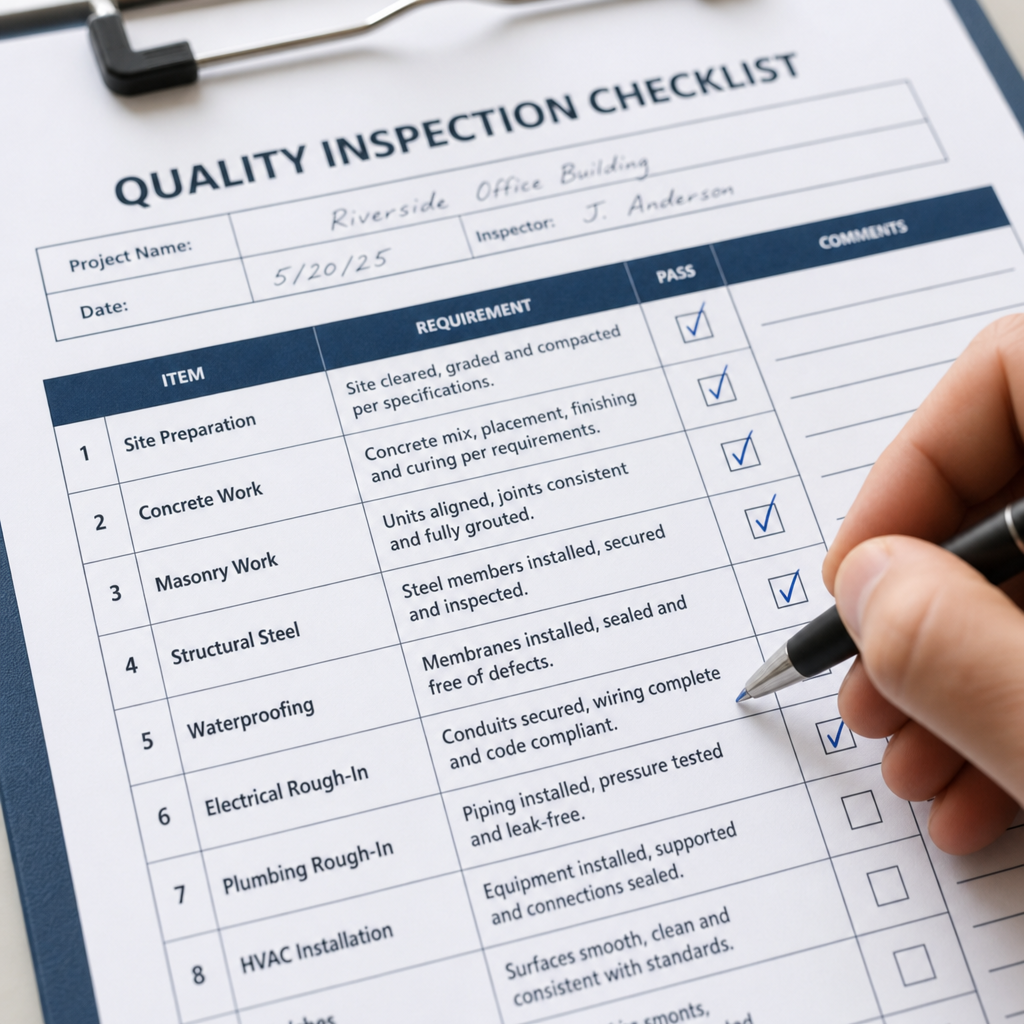
The Difference Between a QA Certificate and a Defect Report
A defect report identifies problems. A quality assurance certificate does that and more: it confirms what is acceptable, documents the standard achieved, and creates a verified record of the build condition at handover. A defect report without that baseline context is harder to act on because there is no agreed reference point for what “acceptable” looks like.
For developers managing multiple lots or stages, the QA certificate also serves an internal function. It lets project managers compare quality outcomes across different builders, subbies, or supervisors, which is data you cannot get from ad-hoc defect lists.
What a QA Certificate Must Include at Handover
A quality assurance certificate that genuinely protects both the developer and the buyer must contain specific elements. Vague statements like “the work has been inspected and found satisfactory” are legally weak and practically useless. Here is what a rigorous QA certificate for a Queensland new build should include.
Inspection Scope and Standards Referenced
The certificate must clearly state what was inspected and against what standard. For residential construction in Queensland, the primary reference is the National Construction Code (NCC) and relevant Australian Standards such as AS 4349.1 for pre-purchase inspection. The scope should list every trade area inspected and explicitly note any areas that were inaccessible or excluded.
Trade-Level Defect Attribution
Each defect recorded must be attributed to a specific trade. This matters enormously for developers because it determines which subcontractor is responsible for rectification and prevents the common problem of builders blaming buyers or other trades when defects emerge after settlement. In practice, a report that says “crack in wall” is far less useful than one that says “vertical shrinkage crack in plasterboard at internal doorway, attributable to plasterer, requires filling and repainting prior to handover.”
Photographic Evidence with Time and Location Stamps
Photos without context are not enough. The best QA certificates include images that show the location within the property, the specific defect, and the date of inspection. GoInspect’s photo-enhanced defect reports are built around this principle because disputes about whether a defect existed at handover are almost impossible to win without dated photographic evidence.
Inspector Credentials and Sign-Off
The certificate must identify the inspector by name and licence number. In Queensland, building inspectors must hold a QBCC licence. A report signed by an unlicensed inspector has no standing in a formal dispute and may not satisfy contractual handover requirements.
Pro tip: Ask your inspector to confirm their QBCC licence category before engaging them. A building inspection licence is not the same as a building designer or certifier licence. Only the correct licence category makes the report legally valid for handover purposes in Queensland.
Why Developers Should Provide a QA Certificate at Handover
Developers often view a quality assurance certificate as a cost rather than an asset. That framing is wrong, and the data from Queensland’s building dispute history makes that clear. The QBCC’s annual report consistently shows that the most common triggers for formal complaints are defects discovered after settlement, disputes about whether defects existed at handover, and disagreements about which party is responsible. A QA certificate directly addresses all three.
“The best time to document build quality is before the buyer takes possession, not after. Once the buyer moves in, every mark on a wall is a dispute waiting to happen.” – GoInspect, Pre-Handover Inspection Practice
Protecting the Developer’s Statutory Warranty Exposure
Under Queensland’s QBCC Act, builders and developers carry a statutory warranty on residential work. For structural defects, this extends to six years from practical completion. A QA certificate produced at handover establishes a clear baseline. If a buyer raises a warranty claim two years after settlement, the developer can demonstrate exactly what the condition was at handover and whether the claimed defect was pre-existing, new, or caused by the owner.
Speeding Up the Settlement Process
Buyers who receive a third-party QA certificate at handover are measurably less likely to raise objections that delay settlement. When a buyer sees documented evidence that an independent, licensed inspector has reviewed the property and confirmed it meets the required standard, the anxiety that drives last-minute disputes drops significantly. For developers managing staged releases on projects in Brisbane, Gold Coast, Logan, or Ipswich, settlement delays compound quickly across multiple lots.
Managing Subcontractor Accountability
A QA certificate that assigns defects to specific trades gives developers direct accountability over their supply chain. Subcontractors who know their work will be inspected and attributed in writing consistently produce better results than those working without that accountability. This is not speculation; it is a standard outcome in any quality management system where inspection results are fed back to the people whose work was assessed.

Pro tip: Build QA certificate costs into your project budget as a standard line item alongside surveying and certification fees. At a starting point of $550 including GST for a GoInspect pre-handover report, the cost is negligible compared to the legal fees and settlement delays that a single disputed defect can generate.
Developer Handover Certificate vs Quality Assurance Certificate
These two terms are sometimes used interchangeably, but they describe different things and understanding the difference matters for developers and buyers alike.
A developer handover certificate is typically an internal document issued by the developer confirming that the property has been completed and is ready for the buyer to take possession. It may reference the certificate of practical completion issued by the building certifier, but it does not independently assess or document build quality. It is essentially an administrative sign-off.
A quality assurance certificate goes further. It is produced by a licensed, independent inspector who has physically assessed the property against a defined standard. It documents both conforming and non-conforming work, assigns trade responsibility, and provides photographic evidence. The independence of the inspector is what gives the certificate its weight in a dispute.
A common mistake is for developers to present a developer handover certificate as though it carries the same weight as an independent QA certificate. Buyers and their solicitors increasingly recognise the difference, particularly in the Brisbane and Gold Coast markets where buyer sophistication has increased sharply over the past five years.
How a New Home Inspection in Brisbane Supports the QA Process
A new home inspection Brisbane conducted by a fully licensed inspector is the mechanism through which a quality assurance certificate gets its credibility. The inspection is not a box-ticking exercise. A thorough pre-handover inspection by GoInspect covers all internal and external elements of the build, reviews compliance with approved plans, identifies defects across all trade disciplines, and produces a same-day photo-enhanced report that can be used immediately in handover negotiations.
What Gets Inspected in a Pre-Handover Inspection
In a typical GoInspect pre-handover inspection, the inspector reviews the following areas: structural elements including slab, frame, and roof structure; external works including render, cladding, guttering, and drainage; waterproofing in wet areas; tiling, flooring, and joinery; plasterboard, painting, and finishing trades; fixtures and fittings; and site works including driveways, fencing, and landscaping where included in the contract.
Each area is assessed against AS 4349.1, the NCC, and the specific requirements of the construction contract. Defects are graded by severity and attributed to the relevant trade. The final report is delivered the same day, which keeps settlement timelines on track.
The Role of Same-Day Reporting in Handover Timelines
Settlement in Queensland is typically scheduled seven days after practical completion under a standard HIA contract. A report that takes three or four days to arrive wastes more than half that window. GoInspect’s same-day reporting model means developers and buyers both have the full seven-day period to address defects, negotiate rectification, or, where necessary, request a settlement extension with supporting documentation already in hand.
Comparing QA Certificate Approaches for Developers
Developers in Queensland have three main approaches available for generating a quality assurance certificate at handover. Each has different implications for cost, independence, and defensibility.
| Approach | How It Works | Strengths and Limitations |
|---|---|---|
| Builder’s Own QA Checklist | The builder’s site supervisor completes an internal checklist before handover, signing off that the work meets the required standard. | Low cost and easy to implement, but lacks independence. A builder signing off on their own work has an obvious conflict of interest. Rarely holds up in a QBCC dispute without corroborating third-party evidence. |
| Third-Party Independent Inspection (e.g., GoInspect) | A fully licensed independent inspector conducts a pre-handover inspection, produces a photo-enhanced defect report attributed by trade, and delivers a same-day QA certificate for the property. | Highest level of independence and defensibility. Photographic evidence with trade attribution is the most effective tool for managing subcontractor rectification and protecting against post-settlement warranty claims. Costs from $550 including GST. |
| Developer’s Internal QA Team | Larger developers maintain in-house inspectors who conduct inspections across their portfolio using standardised checklists and reporting systems. | Consistent standards across multiple projects and lower per-inspection cost at scale. Still carries some independence risk unless the internal team reports separately from the construction management function. Most effective when combined with periodic third-party audits. |
What Happens When No QA Certificate Is Provided
The absence of a quality assurance certificate at handover does not just create a paperwork gap. It creates a power imbalance. Without a documented baseline, every post-settlement defect becomes a dispute about whether the defect existed at handover or appeared afterward. Builders default to claiming defects are the result of the buyer’s use of the property. Buyers claim every defect was there from day one. Neither party has evidence, and the resolution process drags on for months.
For developers managing multiple lots in Brisbane, Logan, or the Gold Coast, this scenario multiplies across the portfolio. One disputed handover absorbs management time and legal resources. Ten disputed handovers can derail a development’s financial model entirely.
The QBCC’s dispute resolution process is available to buyers as a last resort, but it is slow, resource-intensive, and damages the developer’s reputation regardless of the outcome. A QA certificate produced by a licensed independent inspector at handover removes the ambiguity that feeds those disputes before they start.
For investors purchasing new builds in Ipswich, Redland Bay, or elsewhere in South East Queensland, the absence of a QA certificate also affects their ability to claim warranty repairs efficiently. Without a documented handover baseline, a property manager trying to get a defect rectified three months after settlement has no leverage in the conversation with the builder.
Frequently Asked Questions
What is the difference between a quality assurance certificate and a certificate of occupancy?
A certificate of occupancy, also called a certificate of classification in Queensland, is issued by a building certifier and confirms that the building complies with the Building Code of Australia and is legally approved for occupation. A quality assurance certificate is an independent assessment of build quality against the contract specifications and Australian Standards. Both documents are important at handover but they serve entirely different purposes. One is a legal compliance document. The other is a quality verification document.
Are developers legally required to provide a QA certificate at handover in Queensland?
There is no single piece of Queensland legislation that mandates a quality assurance certificate at handover by that specific name. However, developers and builders are bound by statutory warranty obligations under the QBCC Act, and a QA certificate is the most practical way to establish the condition of the property at the time those obligations begin. Many HIA and MBA contracts also include quality assurance provisions that effectively require this documentation. Given the legal exposure involved, treating a QA certificate as optional is a risk most experienced developers do not take.
How much does a pre-handover inspection cost in Brisbane?
GoInspect’s pre-handover inspections start from $550 including GST. The cost varies depending on the size of the property and the complexity of the project. High-rise apartment inspections and staged housing developments typically involve customised pricing because the scope of inspection is different from a standard single-dwelling new home. Compared to the legal costs associated with a single disputed defect, the inspection fee is a modest and well-justified investment.
Can a buyer request an independent inspection before handover even if the developer has provided their own QA documentation?
Yes, and buyers should. A developer’s own QA documentation reflects the developer’s assessment of their own work. An independent inspection by a fully licensed inspector such as GoInspect provides an objective second opinion. In practice, buyers who commission an independent pre-handover inspection consistently identify defects that internal QA processes missed. This is not a criticism of builders in general; it reflects the natural limitations of self-assessment in any complex process.
What Australian Standard applies to new home inspections at handover?
AS 4349.1 is the Australian Standard for inspection of buildings, and it is the primary reference used by licensed building inspectors in Queensland for pre-purchase and pre-handover inspections. For new residential construction, the National Construction Code (NCC) also provides the technical performance requirements that the building must meet. A quality assurance certificate that does not reference these standards does not meet the level of rigour expected by the QBCC or Queensland courts in a building dispute.
What should a buyer do if the developer refuses to allow an independent pre-handover inspection?
A buyer’s right to inspect a property before handover is generally supported by standard construction contracts and Queensland common law. If a developer refuses access for an independent inspector, the buyer should immediately consult their solicitor. Refusal to allow inspection is a significant red flag and may itself constitute grounds to delay settlement. Developers who are confident in their build quality have no reason to refuse an independent inspection, and those who do typically have something to hide.
Have you experienced a handover dispute that a proper quality assurance certificate could have prevented, or are you a developer who has already built QA inspection into your standard process? Share your experience below.
References
- Queensland Building and Construction Commission official site covering statutory warranty obligations and dispute resolution for Queensland builders and homeowners
- Australian Building Codes Board official site covering the National Construction Code and Australian building standards referenced in QA certificates
- Standards Australia official site covering AS 4349.1 and other Australian Standards relevant to building inspections and quality assurance in construction
- Forbes business and real estate coverage including insights on construction quality management, developer accountability, and property investment risk
- Statista data platform covering construction industry statistics, defect rates, and quality management trends relevant to residential development