
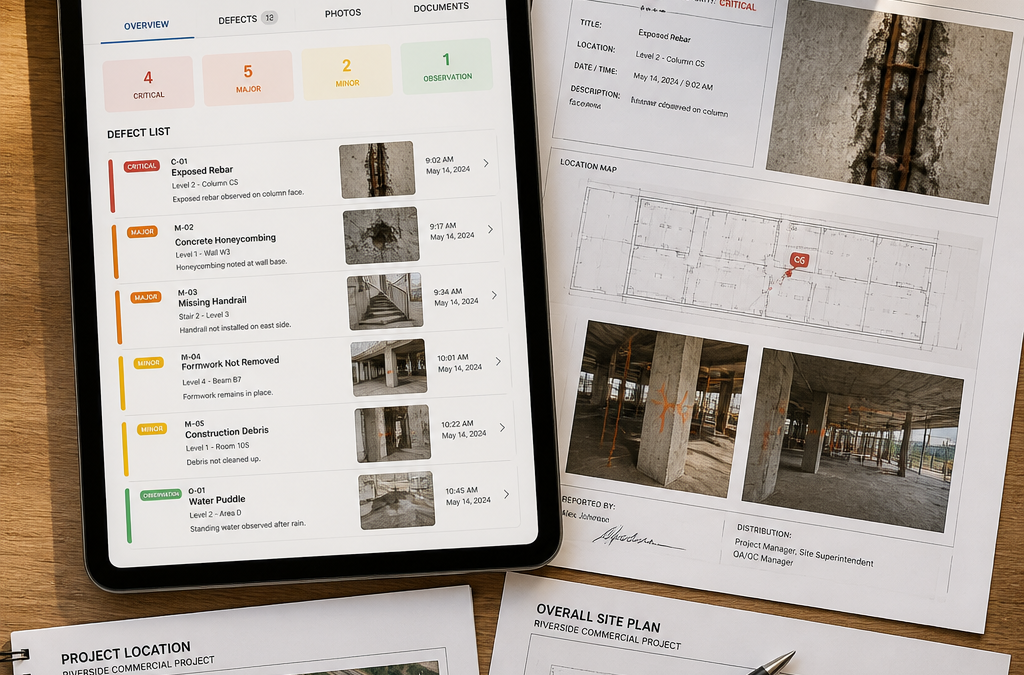
When a builder receives a defect list with no photographs and no trade attribution, the first thing that happens is a phone call. Then another. Then a site visit to verify whether the defect actually exists, followed by an argument about which subcontractor is responsible. That sequence can cost days on a single project. Multiply it across a development with dozens of units and the time and money lost to poorly documented photo defect reports becomes a serious operational problem. GoInspect’s approach to construction inspection reporting is built specifically to eliminate that waste, delivering same-day, photo-enhanced reports that assign every defect to the responsible trade from the moment the inspection is complete.
Table of Contents
- Quick Takeaways
- Why Report Format Determines Rectification Speed
- What a GoInspect Photo Defect Report Contains
- Trade-Specific Assignment: The Operational Difference
- Same-Day Reporting and What It Means for Project Timelines
- High-Rise and Multi-Lot Reporting for Developers and Builders
- How Photo Reports Protect Builders in QBCC Disputes
- Comparison: Report Formats and Their Real-World Impact
- Frequently Asked Questions
- References
Quick Takeaways
| Key Insight | Explanation |
|---|---|
| Photo evidence eliminates disputes | A timestamped photograph of a defect makes it substantially harder for a builder or subcontractor to dispute whether the defect exists, removing the most common source of rectification delays. |
| Trade attribution accelerates subcontractor coordination | When every defect is tagged to the responsible trade, the builder’s site manager can forward tasks directly without first diagnosing responsibility across multiple crews. |
| Same-day delivery starts the clock immediately | GoInspect delivers reports the same day as the inspection, so rectification scheduling can begin before subcontractors demobilise from site. |
| Builder defect rectification timelines are governed by QBCC rules | Under Queensland law, a Direction to Rectify for non-structural defects typically gives 35 days to complete the work. Starting the process fast matters legally, not just operationally. |
| Reports without photos carry less weight in formal disputes | A photographic report from a licensed inspector is the strongest starting point for any QBCC dispute resolution process. Written-only reports without trade identification are significantly less effective. |
| GoInspect pricing starts at $550 including GST | This covers the on-site inspection, fully licensed inspector attendance, and the complete photo-enhanced defect report with trade-specific assignments, delivered the same day. |
| High-rise and multi-lot reporting is customised | GoInspect provides customised reporting for large developments that integrates individual unit reports into a cohesive defect management framework for the builder’s trades team. |
Why Report Format Determines Rectification Speed
The biggest source of wasted time in builder defect rectification is not the volume of defects. It is the ambiguity in how those defects are communicated. A report that lists “paint defects throughout” gives a builder’s supervisor nothing actionable. They cannot order the painter back to site with confidence, they cannot brief the painter on scope, and they cannot confirm completion without another walkthrough.
A well-structured construction inspection report changes that dynamic entirely. When a report specifies the room, the surface, the nature of the defect, and includes a photograph, the supervisor can brief the subcontractor in a single conversation. That is not a small efficiency gain on large projects. It is the difference between a defect being rectified in one return visit and three.
The format problem is pervasive across the inspection industry. Many providers produce written-only reports or reports with low-resolution photographs that do not actually document the defect with enough clarity to be useful. GoInspect’s photo-enhanced model sets a higher standard: every identified defect is supported by site photography, and the report structure is designed to function as a live working document for the builder’s trades team, not just a record for the homeowner’s file.
When every defect is documented with a photograph, assigned to a specific trade, and delivered the same day the inspection occurs, the rectification conversation with the builder starts from a position of documented evidence rather than verbal dispute.
What a GoInspect Photo Defect Report Contains
A photo defect report from GoInspect is not a simple checklist. It is a structured document that a builder’s project manager can actually use to coordinate rectification across multiple subcontractors without conducting a second inspection of their own.
Defect Documentation with Site Photography
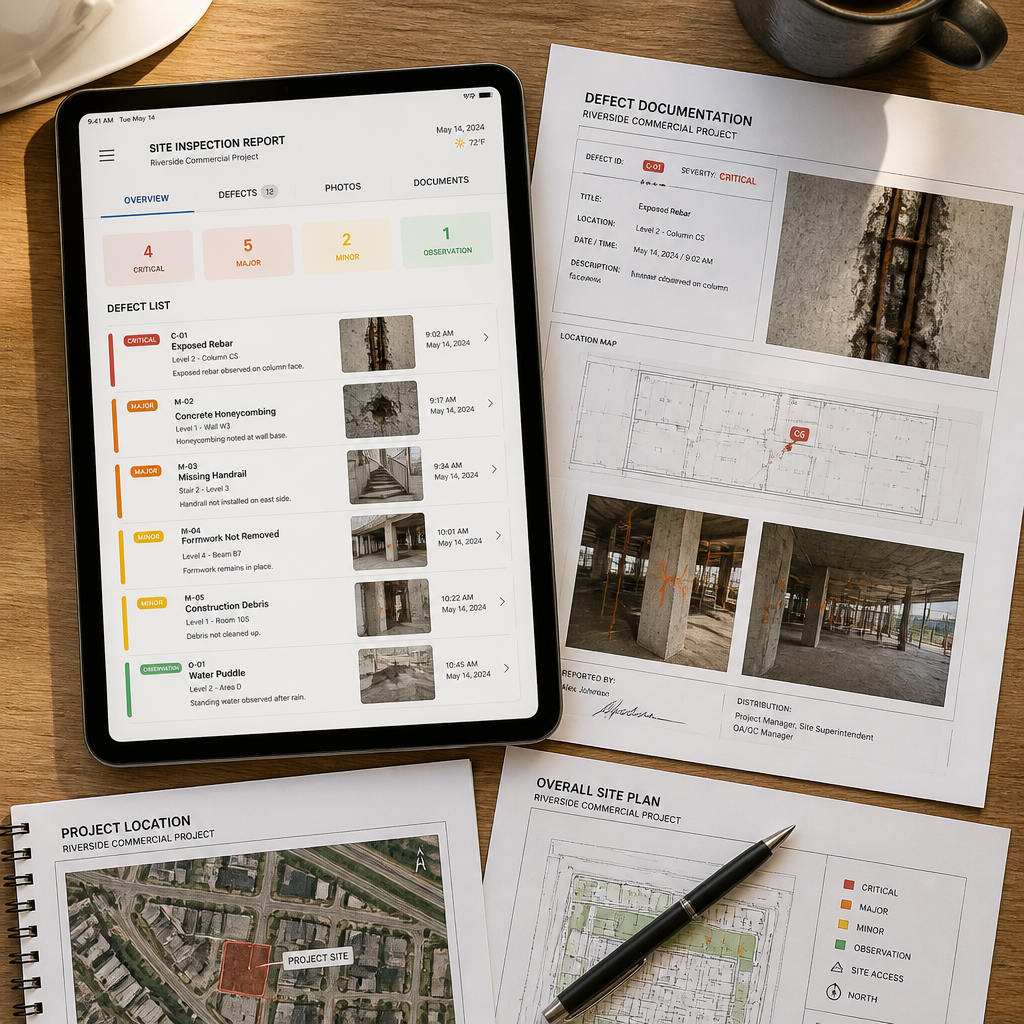
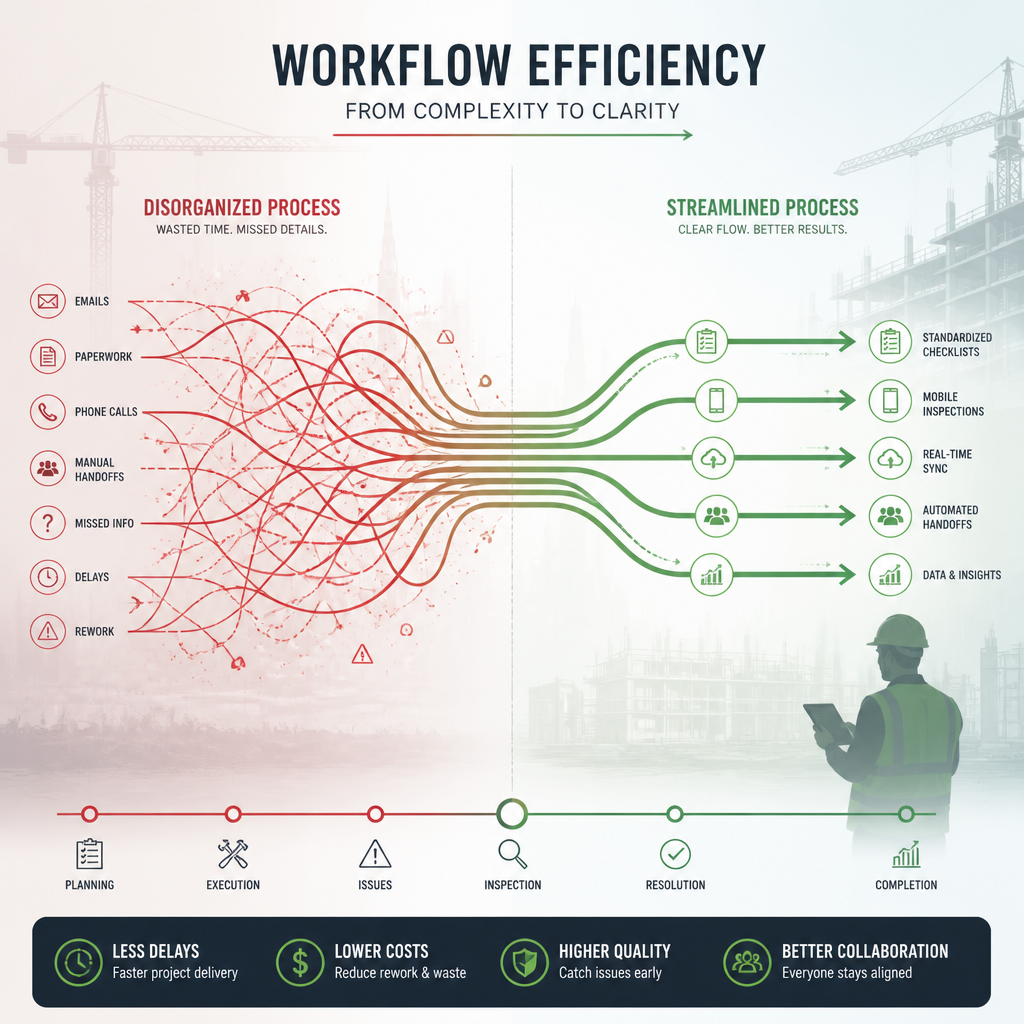
Every defect in a GoInspect report is paired with a photograph taken at the time of inspection. The photography is timestamped, which matters for two reasons. First, it establishes that the defect existed at the time of practical completion, before the builder can argue it was caused by the owner. Second, it removes any ambiguity about the location or nature of the defect that a written description alone might leave open.
GoInspect’s reports categorise defects by severity, typically separating urgent defects that pose safety risks, major defects affecting structural integrity or weatherproofing, and minor defects that are cosmetic or relate to incomplete finishing works. Each category carries different rectification timeframes under Queensland building law, and a properly structured report makes those distinctions clear to the builder from the start.
Assessment Against Australian Standards and Queensland Codes
A GoInspect inspector does not flag defects based on personal preference or general experience. Each item in the report is assessed against the National Construction Code and relevant Australian Standards, with Queensland building codes applied where they differ. This is operationally important for builders because it means the defect basis is defensible. When a subcontractor challenges a defect, the builder can point to the specific standard the work fails to meet, rather than relying on the inspector’s subjective view.
Pro tip: Always confirm that any construction inspection report you commission specifies which standard or code applies to each defect. A report that flags issues without citing the relevant standard gives subcontractors grounds to dispute findings and will not hold up in a QBCC complaint process.
Trade-Specific Assignment: The Operational Difference
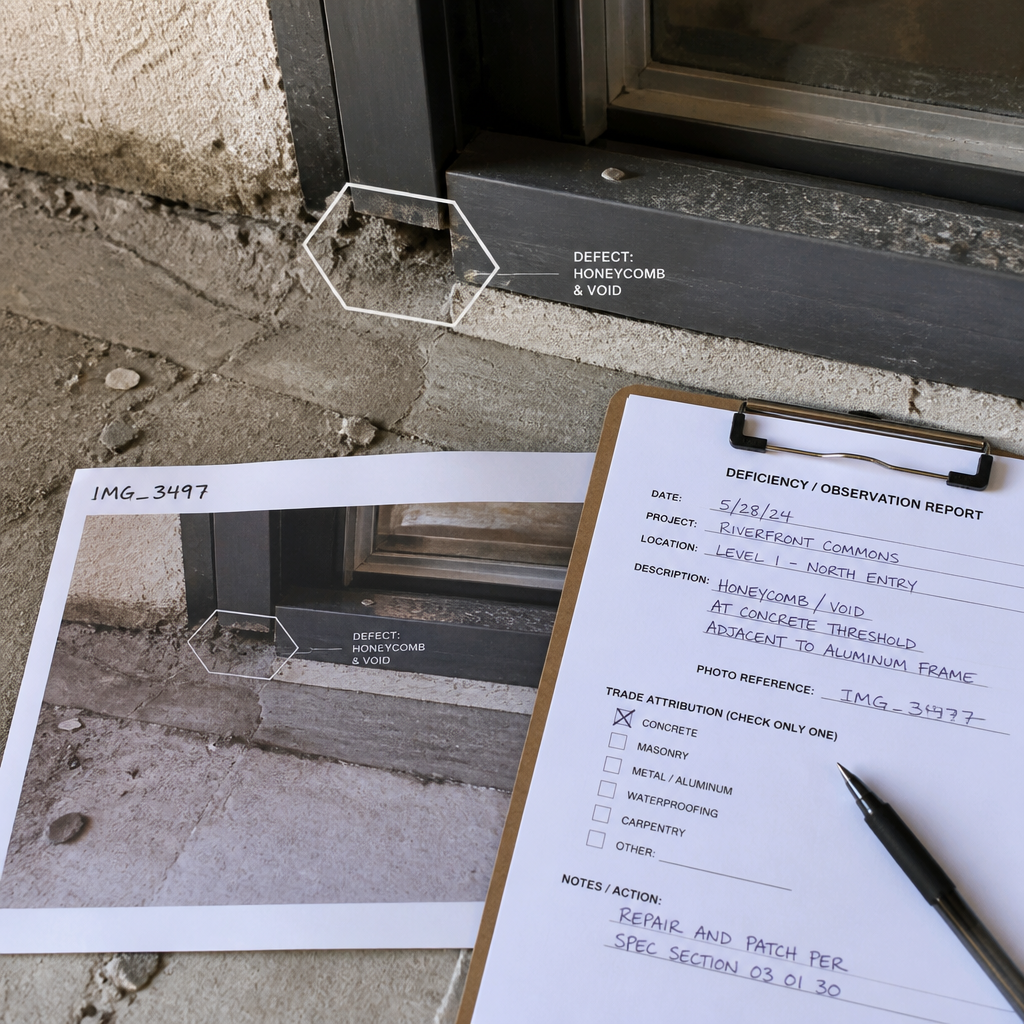
This is the feature of GoInspect’s reporting model that delivers the most direct time saving for builders, and it is the feature most commonly missing from competitor reports. Every defect in a GoInspect report is tagged to the responsible trade: painter, tiler, plumber, carpenter, or whichever subcontractor’s work is non-conforming.
Consider what this means in practice. When a builder receives a report with 47 defects, each photographed and each tagged to a specific trade, the rectification process is direct. There is no debate about whether a defect exists, because it is photographed. There is no delay caused by the builder trying to work out which subcontractor needs to return, because the report assigns it. The builder’s site manager can extract the painter’s defect list, brief the painter, confirm scope, and schedule a return visit in a single interaction.
Without trade-specific assignment, that same report becomes a coordination problem. The site manager reads through 47 items, mentally sorting them by trade, which takes time and introduces the risk of errors. Items get missed. Return visits happen in the wrong sequence. Subcontractors arrive on site without knowing what they are expected to fix. All of that friction is eliminated when the report does the sorting work up front.
Pro tip: If you are a builder evaluating inspection providers, ask to see a sample report before booking. A report that lists defects without trade attribution will cost your site manager hours of coordination time per project. The inspection fee is a small consideration compared to the supervision time lost to poorly structured reporting.
Same-Day Reporting and What It Means for Project Timelines
In residential construction, time between inspection and report delivery is rarely a neutral gap. Subcontractors demobilise. Site access windows close. Client settlement dates approach. Every day between the inspection and the builder receiving an actionable defect list is a day the rectification schedule cannot move forward.
GoInspect delivers reports the same day the inspection occurs. This is not simply a customer service feature. For builders, it is an operational advantage. When the report arrives the same day, the site manager can begin briefing subcontractors before the end of that working week. On projects with tight handover schedules, that timing difference is the margin between completing rectification before settlement and entering a dispute about incomplete works at handover.
What Delays in Report Delivery Actually Cost
A common pattern with slower reporting providers is a two to five business day turnaround. On a straightforward house with 20 to 30 defects, that delay means the painter, tiler, and carpenter are all off-site and may need to be rescheduled from a full book. The coordination cost of getting them back to site for a single return visit, rather than a combined defect-clearance session, is a real project cost. It does not show up on the inspection invoice, but it shows up in site supervision hours and subcontractor call-out fees.
Same-day delivery changes the calculus. When the report is in the builder’s hands on the day of inspection, the subcontractor coordination conversation can happen while crews are still in the area, or at minimum before the schedule has moved on. For developers managing multiple lots or stages, this efficiency compounds across the project.
High-Rise and Multi-Lot Reporting for Developers and Builders
The operational benefits of a well-structured photo defect report scale significantly on larger projects. For a builder or developer managing a high-rise apartment building or a staged housing release, defect management is not a one-off event. It is a recurring operational process across dozens or hundreds of units, each with its own trade coordination requirements.
GoInspect provides customised reporting for high-rise developments and larger housing projects, where defect volumes are higher and trade coordination is more complex. Rather than issuing individual unit reports in isolation, GoInspect integrates them into a cohesive defect management framework for the builder’s trades team. A project manager can view defect status across the entire development, assign rectification tasks by trade, and track clearance without manually consolidating data from dozens of separate documents.
Volume Inspections and Bulk Scheduling
Developers and project managers working on staged releases can arrange bulk inspection schedules with GoInspect. This means inspections are sequenced to match the builder’s practical completion milestones, and reporting is structured to support the defect management process at a project level rather than a unit level. For builders coordinating trades across a multi-stage development in Brisbane, Gold Coast, Logan, Ipswich, or Redland Bay, this kind of integrated reporting is a meaningful operational improvement over receiving disconnected individual reports from multiple inspectors.
Pricing for high-rise and multi-lot projects is customised based on the specific scope, number of lots, and reporting requirements. The base entry point for single-dwelling inspections starts at $550 including GST, and volume programs benefit from arrangements designed around the project’s actual needs.
How Photo Reports Protect Builders in QBCC Disputes
Builder defect rectification in Queensland operates within a regulatory framework managed by the Queensland Building and Construction Commission (QBCC). When defective work is identified, the QBCC can issue a Direction to Rectify (DTR) to the responsible licensed party. In most cases, the rectification period is 35 days. For non-structural defects, a DTR can be issued within 12 months of practical completion. For structural defects, the window extends to six years and six months.
In this regulatory environment, the quality of a construction inspection report directly affects how disputes are resolved. A photographic report from a fully licensed inspector carries significant weight in QBCC dispute resolution processes. If a builder or subcontractor disputes findings, the QBCC can conduct its own inspection. Reports that clearly document defects with dated photographs, trade attribution, and a licensed inspector’s signature are the strongest starting point for any formal dispute process.
Where Weak Reports Fail Builders
Reports without photographs, without trade identification, or produced by unlicensed operatives are significantly less effective in QBCC dispute contexts. A subcontractor who disputes a defect listed only in text can claim the description is ambiguous, that the defect did not exist at handover, or that the defect is outside their scope of work. Each of those objections is substantially harder to sustain when the defect is supported by a dated photograph and explicitly assigned to the subcontractor’s trade.
For builders who want to enforce rectification through their subcontract arrangements rather than through QBCC, the same principle applies. A photo-based report with trade attribution is a more defensible document in any dispute resolution setting, whether formal or informal. GoInspect’s reporting model is structured to give builders that defensibility from the start.
Comparison: Report Formats and Their Real-World Impact
Not all inspection reports deliver the same operational value. The table below compares the three main approaches to defect reporting that builders and developers encounter in the Brisbane and South East Queensland market.
| Report Format | Key Characteristics | Real-World Impact for Builders |
|---|---|---|
| Written-only report (no photos) | Text descriptions of defects, no photographic evidence, typically faster to produce but less detailed. Common from lower-cost or non-specialist providers. | High dispute rate. Subcontractors routinely challenge whether defects exist. Builder must conduct secondary walkthrough to verify each item. Ineffective in QBCC dispute processes. |
| Photo report without trade attribution | Defects are photographed but not assigned to specific trades. Builder or site manager must sort and allocate items manually before subcontractor briefing can begin. | Reduced dispute rate due to photographic evidence. However, coordination overhead remains significant. Site manager spends time sorting items by trade before rectification can be scheduled. |
| GoInspect photo defect report with trade attribution | Every defect photographed, timestamped, assessed against NCC and Australian Standards, and tagged to the responsible trade. Delivered same-day. Customised for high-rise and multi-lot projects. | Minimal disputes due to photographic evidence. No sorting overhead for the builder. Subcontractors can be briefed directly. Report holds up in QBCC dispute processes. Same-day delivery enables immediate rectification scheduling. |
Frequently Asked Questions
What does a GoInspect photo defect report cost for a Brisbane builder?
GoInspect’s inspections start from $550 including GST for single-dwelling new home inspections across Brisbane, Gold Coast, Logan, Ipswich, and Redland Bay. This price covers the on-site inspection, fully licensed inspector attendance, and the complete photo-enhanced defect report with trade-specific assignments delivered the same day. For high-rise developments and multi-lot housing projects, pricing is customised based on scope and reporting requirements.
How does trade-specific defect attribution save a builder time?
When every defect in a construction inspection report is tagged to the responsible trade, the builder’s site manager can extract each trade’s list and brief subcontractors directly, without first diagnosing which crew is responsible for each item. On a project with dozens of defects across multiple trades, this eliminates hours of manual sorting and reduces the risk of items being missed or incorrectly assigned during the coordination process.
Can a GoInspect photo defect report be used in a QBCC dispute?
Yes. A photographic report from a fully licensed inspector is the strongest starting point for QBCC dispute resolution. GoInspect’s reports document defects with dated photographs, trade attribution, and licensed inspector sign-off, all of which carry weight in formal QBCC processes. Reports without photos or trade identification are significantly less effective when a subcontractor disputes findings.
How quickly do Brisbane builders receive their defect report after inspection?
GoInspect delivers reports the same day as the inspection. This means rectification scheduling can begin immediately, before subcontractors demobilise from site, and before the project schedule moves on. For builders managing tight handover timelines, same-day delivery is an operational advantage over providers with multi-day reporting turnarounds.
Does GoInspect provide defect reports for high-rise developments and staged housing releases?
Yes. GoInspect provides customised reporting for high-rise developments and multi-lot housing projects. Individual unit reports are integrated into a cohesive defect management framework that gives the builder’s trades team a project-level view of defects, trade assignments, and rectification status. Bulk inspection scheduling is available to align with practical completion milestones across development stages.
What standards does GoInspect use when identifying defects in a construction inspection report?
GoInspect inspectors assess work against the National Construction Code and relevant Australian Standards, with Queensland building codes applied where applicable. This means every defect in the report has a defensible basis, and builders can reference the specific standard a subcontractor’s work fails to meet when managing rectification disputes.
If you are a builder, developer, or project manager in South East Queensland and you have experience with defect reporting that either cost you time or helped you resolve rectification faster, share what made the difference in your workflow.
We would love your feedback and any insights you would share with others. What perspective would you add?
References
- GoInspect Brisbane pre-handover inspection process and photo report explained
- GoInspect Queensland handover inspection cost and high-rise defect reporting overview
- QBCC defective work dispute resolution process and Direction to Rectify explained
- HIA guide to defective works obligations and QBCC Direction to Rectify for Queensland contractors
- QBCC 2025 Industry Snapshot on the most common reported building defects in Queensland