
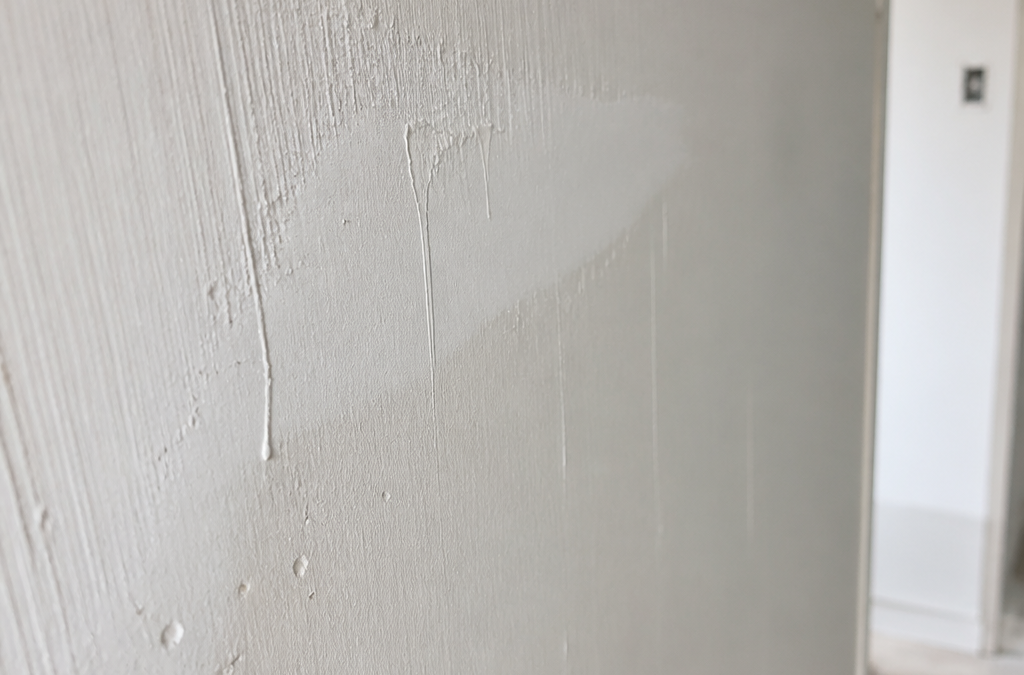
Paint defects in a new home are not cosmetic inconveniences you should accept and move on from. They are often the first visible sign that a builder’s finishing trades have cut corners, rushed the schedule, or failed to prepare surfaces properly. In Brisbane, Gold Coast, Logan, Ipswich, and Redland Bay, GoInspect inspectors find paint, plastering, and tiling defects in the majority of new home pre-handover inspections. These three trade categories consistently generate more defect line items than any other part of the build. Knowing what to look for, and who is responsible for fixing it, is the difference between signing off on a defective home and getting what you paid for.
Table of Contents
- Quick Takeaways
- Why Paint, Plaster, and Tiling Are the Top Defect Categories
- Paint Defects in New Homes: What Inspectors Actually Find
- Plastering Defects: The Hidden Layer Beneath the Paint
- Tiling Defects: When Floors and Walls Fail the Check
- Comparison of Defect Identification Methods
- How GoInspect Documents These Defects and Assigns Trade Responsibility
- What Builders Must Fix Versus What They Will Argue About
- Frequently Asked Questions
- References
Quick Takeaways
| Key Insight | Explanation |
|---|---|
| Paint defects are rarely just paint problems | Blistering, flaking, or uneven sheen usually signals incorrect surface preparation or plastering issues underneath, not just a bad coat of paint. |
| Plastering defects are often concealed at handover | Builders may apply heavy texture paint or compound skim coats to hide cornicing cracks, hollow walls, and joint telegraphing before your inspection date. |
| Tiling lippage standards are defined and enforceable | AS 3958.1 sets out maximum grout joint tolerances and lippage thresholds. Any deviation beyond these tolerances is a contractual defect, not a preference dispute. |
| Same-day photo reports shift the burden of proof | A photo-enhanced defect report dated on the day of inspection is significantly harder for builders to dispute than a verbal walk-through list prepared days later. |
| Grout cracking is often a substrate problem, not a tiler problem | When grout cracks appear within weeks of laying, the cause is frequently movement in the structural slab or insufficient flexible joint allowance, which is a different trade’s defect entirely. |
| Paint sheen inconsistency fails the 1-metre viewing rule | Under Queensland building standards, interior paint finishes are assessed at 1 metre in natural light. Variations in sheen, lap marks, and runs are clearly visible at this distance and are legitimate defects. |
| Hollow plaster is a functional defect, not a cosmetic one | Hollow or de-bonded plasterboard areas indicate inadequate fixing or substrate issues. They fail the performance standard regardless of whether they are visible on the surface. |
Why Paint, Plaster, and Tiling Are the Top Defect Categories
These three trade categories share one defining characteristic: they are the last significant work completed before handover. That timing creates enormous pressure. Builders and their subcontractors are rushing to hit settlement dates, tradespeople are often paid per square metre rather than per hour, and supervisors are stretched across multiple sites simultaneously.
The result is predictable. In practice, GoInspect inspectors working across South East Queensland find that finishing defects account for a disproportionately high share of all defect items raised in pre-handover reports. Paint, plastering, and tiling together typically represent more than half of all defect line items on a new build.
This is not a Queensland-specific problem. The Australian Building Codes Board has acknowledged that finishing trade standards are among the most commonly disputed areas in residential construction. What makes it particularly frustrating for homeowners is that these defects are the ones they see every single day once they move in.

Paint Defects in New Homes: What Inspectors Actually Find
Paint defects in a new home fall into two broad categories: application defects and preparation defects. Application defects are things the painter caused directly. Preparation defects are things the painter inherited from the plasterer or framer and failed to address before picking up a brush.
Common Application Defects Found at Pre-Handover
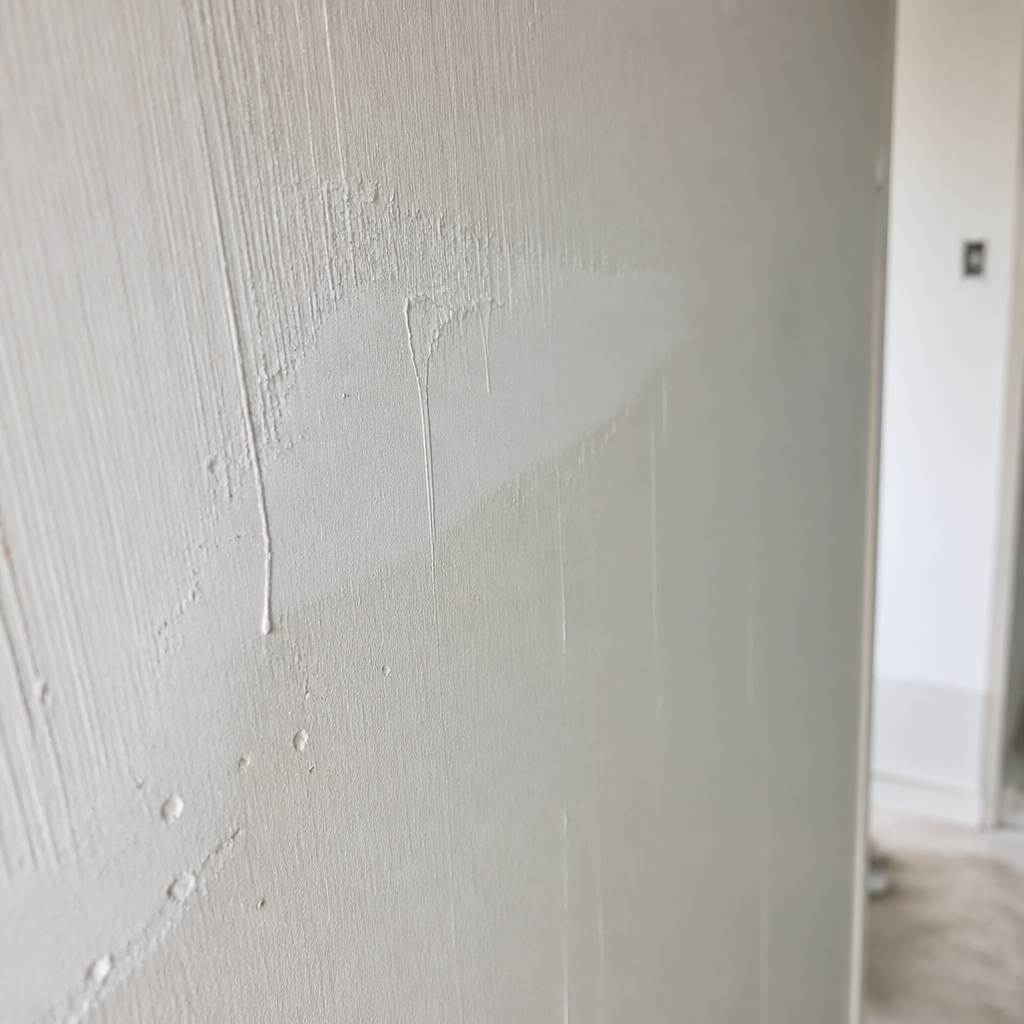
Runs and sags appear when paint is applied too thickly or in hot, direct sunlight that causes flash drying on the surface while the undercoat remains wet. They look exactly as the name suggests: vertical drips or sagging paint film that hardens before being levelled. On ceilings, runs are particularly common around cornice lines where painters overlap their roller strokes.
Lap marks are the result of joining wet and dry paint sections mid-wall. They create visible bands of darker or shinier paint that become obvious in raking light. Builders sometimes argue these are within tolerance, but under the Queensland Master Builders Association finish grading system, uniform sheen and colour across a wall surface is the minimum standard.
Paint omissions are exactly what they sound like: areas the painter missed entirely. Reveal edges behind door frames, the inside faces of window reveals, and the top surfaces of skirting boards are the most common missed zones. GoInspect inspectors check these specifically because builders rarely walk through a completed home with a torch at 45-degree angles to the wall.
Preparation Defects That Paint Cannot Hide
A common mistake is accepting a freshly painted wall as evidence that the surface beneath it is sound. Heavy-fill or texture paint can temporarily obscure plasterboard joint lines, nail pops, and cornicing gaps. These re-emerge within 6 to 12 months as the structure settles and the concealing paint film cracks or bridges.
Inspectors check for telegraphing, which is the visible outline of plasterboard joints or fixing points through the paint surface. This happens when the stopping compound was not feathered out far enough or was not sanded to a true flat before painting. The fix is to repaint, and it requires the plasterer to re-stop the surface first.
Pro tip: When examining painted walls for defects, use a torch held at a low, raking angle parallel to the surface. This technique immediately reveals surface irregularities that are invisible under overhead lighting and that a builder will not demonstrate during a standard walk-through.
Plastering Defects: The Hidden Layer Beneath the Paint
Plastering defects inspection is one of the most technically demanding components of a new home inspection because the worst defects are not always visible to the naked eye. Plastering in Australian residential construction primarily means plasterboard (also called gyprock or drywall) installation and finishing, not traditional wet plaster. The defects are different from those in heritage renovation work, and inspectors need to know which standard applies.
Plasterboard Installation Defects
Hollow wall sections occur when plasterboard is not fixed tightly to the framing behind it, either because fixings were missed, the framing was not straight, or the sheet was bowed before installation. To find them, an inspector uses the knuckle tap method: a systematic tapping across the wall surface to identify areas where the acoustic response changes from solid to hollow. This is not a cosmetic issue. A hollow plasterboard section is a structural fixing failure.
Cornice cracking is extremely common in new Queensland homes. Cornices are typically installed by a different subcontractor to the plasterboard fixer, and the joint between the cornice and the ceiling sheet is a natural movement point. Fine hairline cracking along this joint within the first year is not unusual, but cornice separation greater than 2mm or cracking that runs through the cornice body itself is a defect requiring rectification.
Stopping and Joint Finishing Defects
Joint banding is the most common plastering defect GoInspect records in new home reports. It appears as a slightly raised or shadowed band across the wall surface at the location of plasterboard sheet joins. The cause is stopping compound that was applied too thickly in the centre and not feathered sufficiently at the edges. When painted, the raised band creates a shadow in certain lighting conditions that the builder will initially claim is a painting issue. It is not. It is a stopping defect.
Nail pops and screw pops occur when fixings were driven too deeply, when the framing behind the sheet dried out and shrank after the sheet was fixed, or when the fixing was not into a stud at all. They appear as small raised circles through the paint film, typically 6 to 10 weeks after occupation when the house acclimatises to its first heating and cooling cycles.
Pro tip: Schedule your pre-handover plastering defects inspection no earlier than two weeks after the painter has finished. Paint applied over fresh stopping compound that has not fully cured will often look perfect on the day and show defects within 30 days. If possible, inspect in the morning when natural light enters windows at a low angle, as this is the most revealing lighting condition for surface irregularities.
Tiling Defects: When Floors and Walls Fail the Check
Tiling defects in a building inspection cover a broader scope than most homeowners realise. The common assumption is that tiling is about aesthetics: straight lines, consistent grout joints, matching colours. In practice, a tiling defects building inspection assesses structural adhesion, waterproofing integrity, lippage tolerance, substrate preparation, and movement joint provision, none of which are visible to someone doing a casual walk-through.
Hollow Tiles and Adhesion Failure
Hollow tiles are the single most consequential tiling defect. When ceramic, porcelain, or stone tiles are not fully bedded in adhesive, air pockets form beneath the tile. These hollow areas cause the tile to flex under foot traffic, eventually cracking the tile, the adhesive bond, or both. In wet areas like bathrooms and laundries, hollow tiles also allow water to migrate beneath the waterproofing membrane, potentially causing structural damage to the substrate.
The test is straightforward: tap each tile with a coin or a dedicated hollow tile hammer. A properly bonded tile produces a dense, flat sound. A hollow tile produces a hollow, resonant tick. Australian Standard AS 3958.1 specifies that hollow areas under individual tiles must not exceed defined thresholds depending on tile size and location. Inspectors who skip this test are not doing their job.
Lippage and Grout Joint Defects
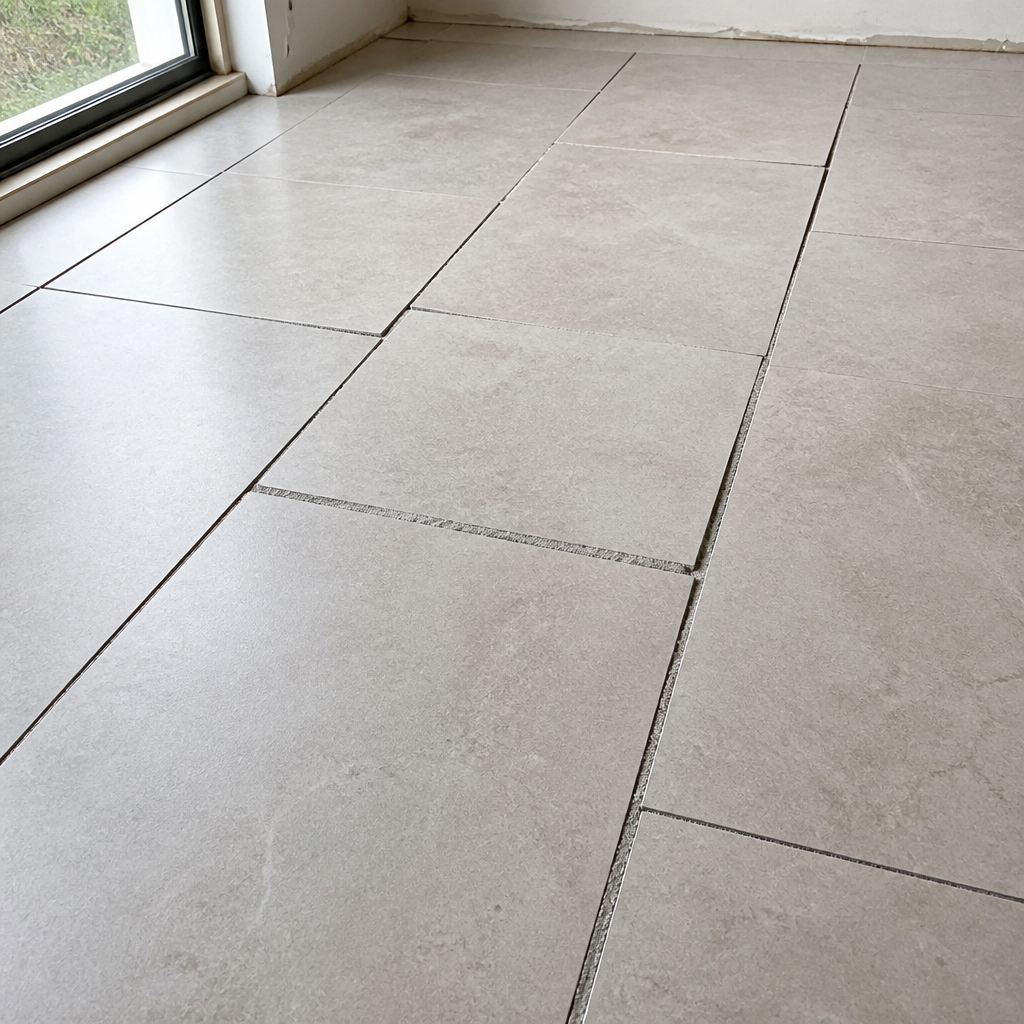
Lippage is the height difference between the edges of two adjacent tiles. Minor lippage is inherent in tiling because tiles themselves are not perfectly flat. However, excessive lippage above the tolerances set by AS 3958.1 creates a trip hazard, a cleaning problem, and a visual defect that worsens over time as the edges chip under foot traffic.
Grout joint width inconsistency is frequently dismissed by builders as a matter of opinion. It is not. Consistent joint widths are a workmanship standard, not a preference. Joints that vary significantly in width across a tiled area indicate that the tiler did not use spacers, did not follow a layout plan, or did not account for tile size variation by sorting the tiles before installation.
Missing or Incorrectly Placed Movement Joints
This is the defect that causes the most expensive downstream damage and is the one builders most aggressively resist rectifying. Movement joints, also called expansion joints, are required by AS 3958.1 at regular intervals in large tiled areas and at every change of plane, such as floor-to-wall junctions. They allow for the natural expansion and contraction of the tile and substrate system without the tiles cracking or de-bonding.
When movement joints are missing or filled with rigid grout instead of flexible sealant, cracking is not a question of if but when. In Queensland’s climate, where temperature differentials between summer and winter can cause significant slab movement, this defect typically manifests within 12 to 24 months of occupation.
Comparison of Defect Identification Methods
Not all inspection approaches produce the same quality of output. The method used to identify and document paint, plastering, and tiling defects determines how effectively a homeowner or developer can pursue rectification from the builder.
| Inspection Method | What It Captures | Limitation |
|---|---|---|
| Builder’s own walk-through checklist | Items the builder’s supervisor chooses to note, typically cosmetic and easily fixed items only | No independent verification, no photo documentation, no trade responsibility assignment, significant conflict of interest |
| Generic defect list without photos | A written list of defect descriptions covering visible items at the time of inspection | Easy for builders to dispute specific defect locations, no evidence of severity, and no date-stamped visual record that prevents builders from claiming defects appeared post-handover |
| Photo-enhanced defect report with trade assignment (GoInspect approach) | Every defect photographed in situ, geolocated within the building, described with reference to the applicable standard, and assigned to the responsible trade | Requires a fully licensed inspector with experience across all finishing trades, and a report system capable of same-day delivery, which rules out many sole-operator inspection businesses |
“A defect report without photographs is a list of opinions. A defect report with photographs, dates, and referenced standards is evidence.” This distinction matters enormously when a builder disputes rectification or a homeowner escalates to the Queensland Building and Construction Commission.
How GoInspect Documents These Defects and Assigns Trade Responsibility
GoInspect’s pre-handover inspection process is specifically designed around the problem that finishing trade defects are easy to dispute when documentation is poor. The photo-enhanced report format captures each paint defect, plastering issue, and tiling problem with a photograph taken at the time of inspection, a written description referencing the relevant Australian Standard or building code clause, and a specific trade assignment.
That last point, the trade assignment, is what separates a GoInspect report from a generic defect list. When a report says “crack in cornice,” a builder has room to argue about whether it requires action. When a report says “cornice separation greater than 2mm at junction of living room ceiling and east wall, attributable to inadequate adhesive contact by cornicing contractor, non-compliant with AS 2589,” that language closes down the argument before it starts.
Same-day reporting is equally important. A report delivered on the day of inspection, dated and time-stamped, establishes the condition of the property at the exact moment of the pre-handover walk. It prevents the scenario where a builder claims a crack or tile defect appeared after the inspection, which is a common tactic when reports are delivered days or weeks later.
GoInspect services new homes across Brisbane, Gold Coast, Logan, Ipswich, and Redland Bay, with inspections starting from $550 including GST. For high-rise developments and large housing projects, customised report formats are available to match developer and builder defect management workflows. Learn more about GoInspect’s pre-handover and practical completion inspection services.
What Builders Must Fix Versus What They Will Argue About
Understanding the difference between a genuine defect under Queensland law and a matter of personal preference will save you significant time and frustration. Builders and their lawyers are skilled at framing defects as subjective complaints. The way to counter this is to know the standards that apply.
Defects That Are Non-Negotiable Under Australian Standards
The following defects are defined failures under Australian Standards or the Queensland Building Act 1975 and cannot be dismissed as a matter of opinion. Hollow tiles failing the coin tap test beyond AS 3958.1 thresholds, plasterboard with measurable surface deviation outside the tolerances in AS 2589, paint finishes failing the 1-metre natural light assessment, missing movement joints in tiled areas, and cornices with separation gaps exceeding what is defined as acceptable movement must be rectified by the builder.
Items Builders Commonly Dispute
Builders will often argue that minor grout joint width variation, slight colour variation between paint batches, and hairline cracks at plasterboard corners are within acceptable tolerances. Some of these arguments have merit and some do not. The answer depends on whether the specific condition is addressed in an applicable standard and whether the inspector measured it correctly.
A common mistake is accepting a builder’s verbal assurance that something is “within tolerance” without asking them to reference the specific standard they are citing. If they cannot name the standard and the clause, the tolerance claim is not valid. A GoInspect report provides this standard referencing proactively so that homeowners are not left arguing from a position of incomplete information.
The Queensland Building and Construction Commission (QBCC) provides a complaints pathway for unresolved defect disputes. Having a licensed inspector’s report as supporting documentation is essential when lodging a QBCC complaint. A verbal walk-through list or a builder’s own sign-off sheet will not carry the same weight as an independent photo-enhanced inspection report.
Frequently Asked Questions
What are the most common paint defects found in new homes in Queensland?
The most common paint defects in new Queensland homes are runs and sags from over-application, lap marks from poor wet-edge technique, paint omissions in reveals and skirting top edges, telegraphing of plasterboard joints through the paint film, and inconsistent sheen caused by painting over incompletely dried stopping compound. Raking light inspection with a torch is the most reliable way to find these defects before handover.
How do inspectors test for hollow tiles during a building inspection?
Inspectors use a coin or a specialised hollow tile hammer to tap across the surface of each tile systematically. A properly bonded tile returns a dense, flat sound. A hollow tile returns a higher-pitched, resonant sound indicating that an air void exists between the tile and the substrate. Australian Standard AS 3958.1 sets thresholds for how much hollow area is permissible under a tile based on its size and the location in the home.
Can a builder refuse to fix plastering defects identified in a pre-handover inspection?
A builder can dispute a defect but cannot legally refuse to address items that are demonstrably non-compliant with Australian Standards or the National Construction Code. The Queensland Building and Construction Commission has jurisdiction over unresolved disputes between homeowners and licensed builders. An independent inspection report from a licensed inspector that references specific standards and includes photographic evidence is the strongest foundation for a QBCC complaint if the builder refuses to rectify.
What is the difference between a pre-handover inspection and a practical completion inspection?
These terms are sometimes used interchangeably but they can refer to different stages depending on the contract. A practical completion inspection typically occurs when the builder declares the home is substantially complete and ready for a defect walk. A pre-handover inspection is conducted before the keys are handed to the owner. In most cases, the intent is the same: to identify defects that must be rectified before the homeowner accepts the property and takes possession. GoInspect conducts both types of inspections across South East Queensland.
How soon after tiling should I expect grout cracking in a new home?
Grout cracking that appears within the first 12 months in a new home is almost never normal wear. It is a defect, and the cause is almost always either hollow tile areas, missing or improperly filled movement joints, or slab movement from a substrate that was not adequately cured before tiling commenced. Builders will sometimes attribute early grout cracking to settling, but if movement joints were correctly installed as required by AS 3958.1, normal slab movement is accommodated without cracking the grout.
Does a paint defect inspection require a licensed building inspector?
In Queensland, a person conducting a building inspection for the purpose of identifying defects and producing a report used in a handover or settlement process should hold a current Queensland building inspection licence. Unlicensed inspection reports carry less legal weight in QBCC disputes and in contract negotiation with builders. GoInspect employs fully licensed inspectors for all pre-handover and practical completion inspections across Brisbane, Gold Coast, Logan, Ipswich, and Redland Bay.
If you have had an experience with paint, plastering, or tiling defects in your new home, we would like to hear what the builder’s response was and whether an independent inspection report made a difference in getting the issues resolved.
References
- Australian Building Codes Board: national construction codes and building standards for residential compliance
- Queensland Building and Construction Commission: licensing requirements, defect dispute resolution, and homeowner warranty information
- Standards Australia: Australian Standards for tiling, plastering, and painting in residential construction
- Forbes: coverage of construction quality, homeowner rights, and the financial impact of building defects
- Statista: residential construction industry data and defect rate statistics across Australia and comparable markets