
Most Brisbane buyers spend months negotiating price, arranging finance, and choosing finishes. Then, when the builder declares practical completion, they walk through the property in twenty minutes with the site supervisor, sign a handover form, and assume anything wrong will be sorted out later. It rarely is. A pre-settlement inspection in Brisbane is your single best opportunity to catch construction defects, incomplete work, and code non-compliance while the builder is still legally and financially obligated to fix them, before you hand over the final payment and the property becomes entirely your problem.
Table of Contents
- What Is a Pre-Settlement Inspection for a New Brisbane Home?
- Why Brisbane Buyers Cannot Skip This Step
- What a Pre-Settlement Inspection Actually Checks
- The Most Common Defects Found in Brisbane New Builds
- Independent Inspection vs. Builder Walkthrough: A Direct Comparison
- Your Legal Rights Under Queensland Law
- How to Prepare for Your Pre-Settlement Inspection
- Frequently Asked Questions
- References
What Is a Pre-Settlement Inspection for a New Brisbane Home?
| Key Insight | Explanation |
|---|---|
| Timing determines your power | A pre-settlement inspection happens after the builder declares practical completion but before you make the final payment. Once you settle, your negotiating position changes entirely. |
| It is not the same as a standard building inspection | A pre-purchase building inspection checks an existing property. A pre-settlement inspection for a new build focuses on construction defects, code compliance, and unfinished work against the approved plans and specifications. |
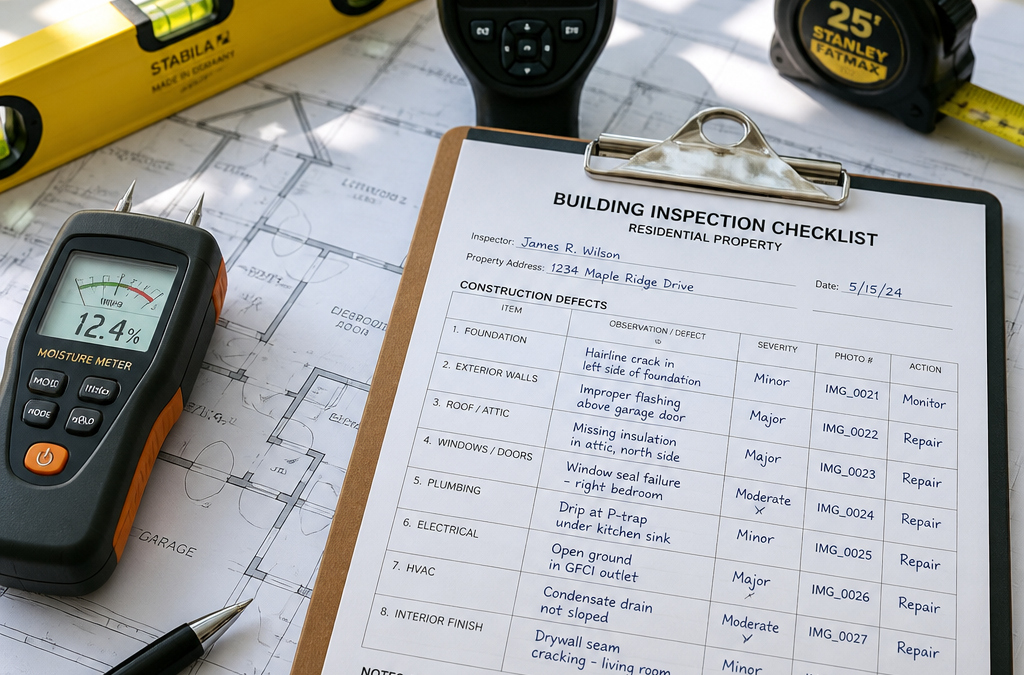
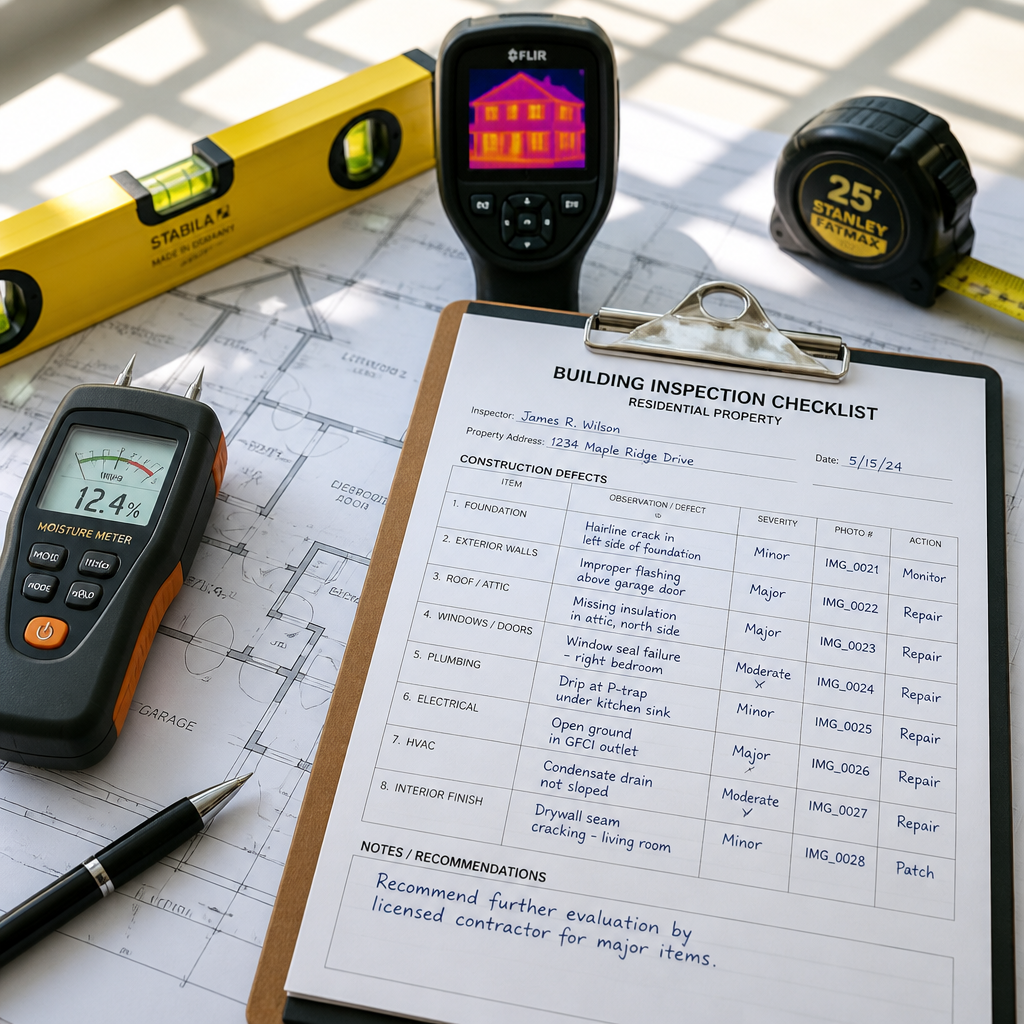
| The photo-enhanced report is the tool that creates accountability | A verbal list of concerns carries no weight. A photo-documented defect report that identifies each issue, assigns responsibility to the relevant trade, and references applicable standards is what builders respond to. |
| Your builder has a 12-month statutory defect liability period in Queensland | Under Queensland law, a contractor must repair any defects noticed at handover or within 12 months of when the work is finished. But finding defects before settlement puts you in the strongest possible position. |
| Finishing trades are the highest-risk phase | Painters, tilers, and joiners are the last to arrive and the first to be rushed. This is where the greatest concentration of visible and hidden defects occur on Brisbane new builds. |
| Rectification work can introduce new defects | When a trade returns to fix a defect, scuffs, adhesive residue, and damaged finishes are common byproducts. A re-inspection after rectification catches these before they become your problem. |
| Cost of inspection versus cost of a single missed defect | A GoInspect pre-settlement inspection starts from $550 including GST. A single wet area rectification job or structural repair discovered after settlement routinely costs several times that amount. |
A pre-settlement inspection, also called a practical completion inspection (PCI) or handover inspection, is a formal assessment of a newly constructed home carried out immediately before the builder hands the keys to the buyer. The inspector walks every accessible area of the property, documents every defect found, and produces a written report that becomes a legally referenced tool during the defect rectification process. This is not a casual walkthrough, and it is not the same as a standard building inspection on an existing property.
For off-the-plan purchases, the pre-settlement inspection occurs just before the final payment is made and title is transferred. For house-and-land packages, this moment aligns with the builder’s declaration of practical completion. Either way, the purpose is the same: to document construction defects, incomplete works, and code non-compliance that the builder is legally required to fix at no cost to you, before you become the legal owner.
Why Brisbane Buyers Cannot Skip This Step
Brisbane and South East Queensland have been through an extended construction boom. The pressure of project timelines, subcontractor shortages, and rapid delivery has created conditions where defects at handover are common, even on well-built homes from reputable builders. The Queensland Building and Construction Commission (QBCC) received more than 14,000 complaints from homeowners in the 2022-23 period, with defective building work consistently ranking as one of the top complaint categories. That number reflects what happens after settlement, when the process of getting defects fixed becomes significantly more resource-intensive for everyone involved.
Brisbane’s subtropical climate adds a layer of complexity that does not apply in cooler states. Thermal movement in roofing, the behaviour of moisture in wall cavities, and the performance of waterproofing membranes in high-humidity conditions all matter here in ways that a general national inspection standard does not always account for. An inspector who works specifically in South East Queensland new builds understands these failure patterns from direct site experience, not just from reading a checklist.
The building defect resolution process is most effective when independent evidence is gathered before title transfers. Post-settlement defect claims are significantly more resource-intensive for all parties.
The finishing trades, specifically painters, tilers, and joiners, are often the last to arrive on site and the first to be rushed because the builder is already preparing for the next practical completion payment. This is precisely why so many defects cluster in these areas. A buyer who walks through with the site supervisor and accepts a verbal assurance that issues will be fixed after settlement is relying on goodwill where a legal instrument, a formal defect report, would serve them far better.
Pro tip: Book your pre-settlement inspection at least five to seven days before your scheduled settlement date. This gives you time to review the report, formally notify the builder of defects in writing, and, if necessary, consult your solicitor before the financial transaction is completed.
What a Pre-Settlement Inspection Actually Checks
A thorough pre-settlement inspection in Brisbane covers the entire completed property, not just the areas that look visually obvious. The inspection is structured against the approved plans, the National Construction Code (NCC), and the QBCC Standards and Tolerances document, which is the benchmark builders in Queensland are assessed against.
Site and External Elements
The inspector assesses surface drainage, soil erosion, and seepage. Site improvements including stormwater pipes, driveways, retaining walls, and their location relative to the approved plans are checked. Brickwork is examined for chipped bricks, mortar strength, correct finish, and the presence of functioning weep holes. External cladding, fascias, soffits, and guttering are checked for installation quality and continuity.
Structural and Internal Fabric
Internal walls, ceilings, and floors are checked against the QBCC’s tolerance standards for cracking, unevenness, and finish quality. Door and window alignment, operation, and sealing are assessed, as gaps and binding are among the most common defects found. Floor coverings, including tiles and timber floors, are checked for hollow sections, lippage, and adhesion failures that indicate improper installation.
Wet Areas and Waterproofing
Wet areas, including bathrooms, laundries, and balconies, receive particular attention because waterproofing failures are one of the most expensive defects to rectify post-settlement. The inspector checks membrane continuity, penetration sealing, and grading. Ventilation openings in wet areas are verified against code requirements. All taps are run, toilets are flushed, and drains are checked for flow and gradient.
Mechanical and Electrical Services
Heating and cooling systems are tested to confirm they operate correctly. Common issues include units that do not turn on, inconsistent temperatures between zones, unusual noises, and systems that have not been properly commissioned. All light switches, power points, exhaust fans, and fixed appliances are tested. Hot water system commissioning is confirmed.

The Most Common Defects Found in Brisbane New Builds
In practice, certain defects appear repeatedly across Brisbane and South East Queensland new builds, regardless of builder or project size. Knowing what to expect helps you understand why an experienced inspector with local knowledge finds more than a general checklist approach will.
Waterproofing defects in wet areas are among the most frequent and costly hidden failures. A tiler finishing a bathroom after a plumber has roughed in creates the exact conditions for waterproofing membrane punctures, which only show up as water damage months after settlement. These are the defects that most commonly become five-figure rectification jobs when discovered post-settlement.
Cracking in render and plasterwork is widespread in Brisbane new builds. Some cracking is cosmetic and within tolerance. Some cracking indicates poor foundation work, inadequate materials, or failure to manage thermal movement. Distinguishing between the two requires an inspector who understands the QBCC tolerance standards, not just someone who can spot a crack.
Roofing and guttering faults, door and window alignment problems, drainage that has not been properly graded, and incomplete or missing finishes to agreed specifications round out the most common categories. Unfinished work is more common than most buyers expect, particularly on projects where the builder is managing multiple completions simultaneously across Brisbane, Logan, Ipswich, and the Gold Coast.
Pro tip: When reviewing your defect report, do not focus only on structural issues. Incomplete items, missing fixtures specified in your contract, and finishes that do not match the agreed selections are legitimate defects the builder is required to address before or promptly after handover.
Independent Inspection vs. Builder Walkthrough: A Direct Comparison
There are three approaches buyers typically take at pre-settlement. Understanding what each actually delivers, rather than what it claims to deliver, is essential before you choose.
| Approach | What You Get | Key Limitation |
|---|---|---|
| Builder’s own practical completion inspection | A handover defects list prepared by the builder or their representative. The builder formally declares the home complete and ready for settlement. | Structural conflict of interest: the builder’s inspector has a financial incentive to minimise the defect list. Buyers who rely solely on this consistently identify fewer defects at handover and spend more on post-settlement rectification. |
| DIY buyer walkthrough | A personal walk of the property, often using a general checklist. Suitable for confirming that obvious items (appliances, doors, agreed fittings) are present and operational. | Most buyers miss technical defects, code compliance issues, and hidden failures that require training and equipment to identify. An untrained eye looking at a bathroom will not detect a waterproofing membrane breach. |
| Independent licensed inspector (GoInspect) | A systematic, photo-enhanced defect report prepared by a fully licensed inspector. Every defect is documented with photographs, its location and likely cause identified, and responsibility assigned to the relevant trade. Delivered same day. | An upfront cost of $550 including GST for Brisbane properties. This is the approach that produces a formal legal instrument you can present to your builder and, if necessary, to the QBCC. |
The comparison is not close. The builder’s own inspection and a DIY walkthrough both fail to give you the documented independent evidence you need to compel rectification. A licensed independent inspector produces a report that assigns responsibility to specific trades and references applicable standards, which is exactly what a builder’s project manager responds to. Verbal concerns and informal lists do not carry the same weight.
Your Legal Rights Under Queensland Law
Queensland homeowners have specific statutory protections at and after handover that most buyers are not fully aware of. Under Queensland law, a contractor must repair any defects noticed at handover or within 12 months of when the work is finished. This 12-month statutory defect liability period runs from the date of practical completion and is separate from any defects list signed at handover.
This means that defects discovered after you move in are not immediately without recourse. However, the practical lesson is clear: defects identified and documented before settlement, when the builder still has a strong incentive to rectify before final payment is released, are resolved faster and with less friction than defects raised after you have already paid and taken possession.
If your builder refuses to rectify defects, you can lodge a formal complaint with the QBCC. The QBCC oversees building disputes in Queensland and has specific powers to direct rectification and discipline non-compliant builders. A formal, photo-documented inspection report from a licensed inspector significantly strengthens any complaint you make.
Buyers should also be aware that a later claim may be affected by what happened before settlement. If a buyer had the opportunity to obtain independent inspections but did not, that may become relevant in a dispute. Independent inspection before settlement is not just commercially sensible, it is part of a sound legal position.
Pro tip: Put a calendar reminder 30 days before your statutory defect liability period expires. Defects that have developed during occupation, particularly moisture-related and movement-related ones, need to be formally documented and notified before that window closes, or rectification costs fall entirely to you.
How to Prepare for Your Pre-Settlement Inspection
Arriving at your pre-settlement inspection without preparation means you will spend time confirming obvious things and miss the window to ask the right questions. Here is what experienced buyers do before the inspection begins.
Gather Your Contractual Documents
Bring the full construction contract, the approved plans, your selections list, and any variation orders. The inspector will check the property against what was agreed on paper, and you need to be able to confirm what finishes, fixtures, and specifications were part of the contract. Items that are missing from the agreed specification are defects even if they look finished.
Do Not Rush the Inspection
For a standard single dwelling, a thorough on-site inspection takes between two and four hours depending on the size and complexity of the home. A townhouse or unit in a multi-dwelling development takes less time per unit but still requires systematic coverage. Resist any pressure from the builder’s representative to speed through the process. The inspection is your right, and the time spent is directly proportional to the quality of the defect list.
Understand the Report Before Signing the Handover Form
GoInspect delivers same-day photo-enhanced reports, which means you receive your defect documentation before settlement pressure peaks. Read the report in full before signing any handover form. Where defects are identified, submit them to your builder formally in writing, referencing the report. Your solicitor should be aware of any significant defects before settlement proceeds.
Consider a Re-Inspection After Rectification
When a trade returns to site to fix a defect, they bring tools, materials, and other workers. Scuffs, dents, adhesive residue, and damaged finishes are common byproducts of rectification activity. A follow-up inspection after the builder has addressed the initial defect list confirms that the rectification was actually completed correctly and that no new damage was introduced. Without a re-inspection, these second-round issues become your problem after settlement.
Frequently Asked Questions
Is a pre-settlement inspection mandatory in Brisbane?
It is not legally mandatory, but it is strongly advisable for any new build purchase. Without an independent inspection, you are relying entirely on the builder’s own assessment of the property’s condition. Given the scale of defect complaints lodged with the QBCC each year, that is a significant risk to take with what is typically the largest financial transaction of a person’s life.
What is the difference between a pre-settlement inspection and a practical completion inspection?
In Queensland new build contexts, the two terms often describe the same moment in the process. A practical completion inspection (PCI) occurs when the builder declares the construction complete. A pre-settlement inspection is the buyer’s independent check before final payment. For house-and-land packages, these often occur within the same 24 to 48-hour window. For off-the-plan apartments, the pre-settlement inspection may occur slightly before the formal PCI. Always confirm the scope of the inspection with your inspector rather than relying on the label alone.
Can I bring my own building inspector to the pre-settlement inspection?
Yes. In Queensland, you are entitled to have a licensed building inspector attend with you. Standard contracts typically allow for one pre-settlement inspection at a reasonable time before settlement. GoInspect’s inspectors are fully licensed and operate across Brisbane, Gold Coast, Logan, Ipswich, and Redland Bay. Booking through an established inspection company rather than attending alone gives you a formal, photo-documented report that carries legal weight in any subsequent dispute.
What happens if the builder refuses to fix defects identified in the pre-settlement inspection?
First, ensure all defects are formally submitted to the builder in writing, referencing the inspection report. If the builder disputes the defects or refuses to rectify them, you can lodge a complaint with the QBCC. The QBCC has powers to direct rectification and discipline non-compliant builders. A photo-documented inspection report from a licensed inspector is the most effective evidence to support a QBCC complaint. Your solicitor can also advise on whether withholding any portion of the final settlement payment is available as a remedy under your specific contract.
How long does a pre-settlement inspection take in Brisbane?
For a standard single dwelling in Brisbane or the surrounding regions, expect the on-site inspection to take between two and four hours depending on the size and complexity of the property. GoInspect delivers same-day photo-enhanced reports, so you receive your defect documentation on the day of inspection, not days later when settlement pressure may already be intense.
Do investors as well as owner-occupiers need pre-settlement inspections?
Yes, and arguably the case is even stronger for investors. An investment property with unresolved defects cannot be tenanted effectively, and post-settlement defect disputes with a builder are costly and time-consuming. At $550 including GST for a GoInspect pre-handover inspection, the cost is negligible against the rental income lost during a protracted defect rectification period or the cost of a single structural repair discovered after title has transferred.
Does a new home builder’s warranty replace the need for an inspection?
No. A builder’s warranty covers certain defects that emerge during the warranty period, but making a successful claim after settlement requires you to prove the defect existed at the time of handover and was not caused by your own actions or maintenance failures. An independent pre-settlement inspection report with dated photographs creates that proof. Without it, warranty disputes become genuinely contested, and the burden of evidence sits with you as the owner.
Have you recently completed a pre-settlement inspection on a Brisbane new build, and were there defects you were surprised to find? Share your experience in the comments, as your insight might help another buyer know exactly what to look for.
References
- QBCC guidance on practical completion inspections and builder defect obligations in Queensland
- Pre-settlement defect inspection process and buyer rights in Australia explained
- Common issues found during pre-settlement inspections including HVAC, wet areas, and fixtures
- Understanding pre-settlement inspection rights and procedures under Queensland contracts
- Legal considerations for building defects in new Queensland homes before and after settlement