
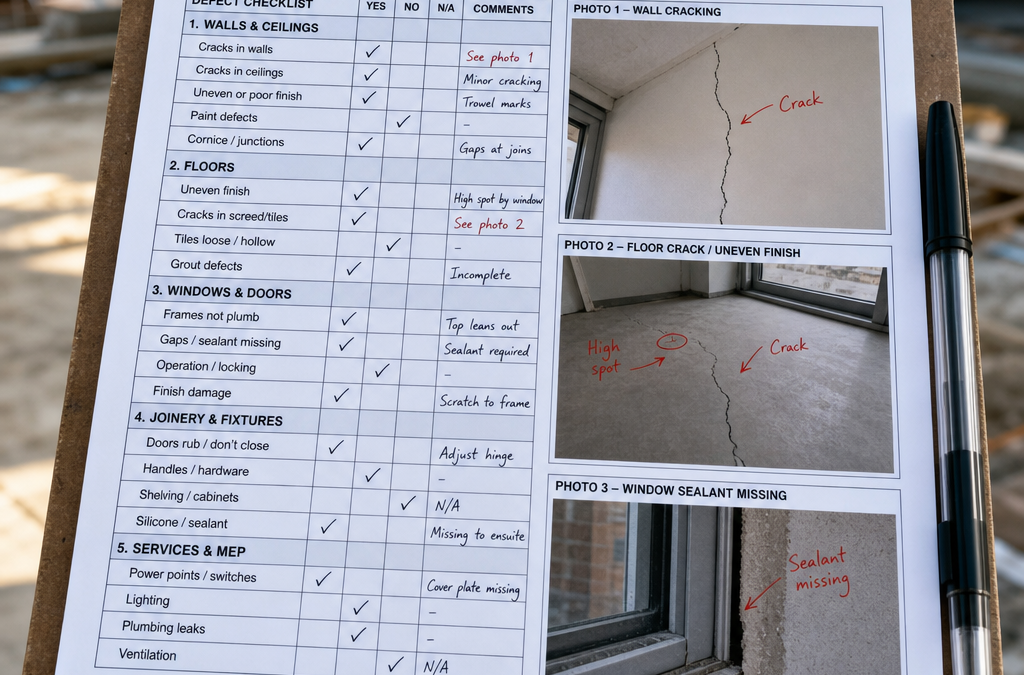
Most builders treat defect reports as paperwork generated at the end of a project. That is a costly mistake. A well-structured builder defect report is one of the most powerful tools available for identifying which trades consistently underperform, where rework costs are bleeding the schedule, and how to hold subcontractors accountable with documented evidence. The Queensland construction sector loses millions annually to defect rectification, and a significant portion of that is preventable when builders actively use inspection data to manage trade performance rather than simply react to complaints at handover.
Table of Contents
- Quick Takeaways
- Why Defect Reports Matter for Trade Accountability
- What a Useful Builder Defect Report Actually Contains
- Using Trade Performance Reports to Identify Repeat Offenders
- Comparing Defect Reporting Approaches for Builders
- Construction Quality Assurance Through Staged Inspections
- Turning Defect Data into Subcontractor Conversations That Work
- Frequently Asked Questions
- References
Quick Takeaways
| Key Insight | Explanation |
|---|---|
| Trade-specific defect attribution matters | Assigning each defect to the responsible trade in the report eliminates ambiguity and prevents subcontractors from deflecting responsibility onto others. |
| Photo evidence changes the conversation | Photographic documentation makes defects undeniable. Subcontractors who might dispute a written description rarely dispute a timestamped photograph. |
| Same-day reports preserve evidence | Defects documented on the day of inspection reflect the actual condition of the work. Delays allow opportunistic repairs that mask systemic problems. |
| Frequency data reveals systemic failures | A single defect is human error. Three defects of the same type from the same trade across multiple sites is a process problem requiring a serious performance conversation. |
| Pre-handover inspections reduce developer liability | Builders who commission independent inspections before handover reduce the risk of statutory warranty claims, which in Queensland can extend up to six years for major defects. |
| Report structure determines actionability | A defect list without trade attribution, location references, and priority classifications is nearly useless for managing subcontractor performance systematically. |
| Independent inspectors carry more authority | Subcontractors take defect findings more seriously when the source is a licensed third-party inspector rather than the builder’s site supervisor, reducing pushback and delay. |
Why Defect Reports Matter for Trade Accountability
Subcontractor management in residential construction is largely relationship-based, which is fine when trades deliver quality work consistently. The problem is that relationships without documented performance data give underperforming trades cover. When a plasterer delivers poor corner finishing on three consecutive homes and the only record is a verbal complaint from the site supervisor, nothing changes.
A structured builder defect report creates an objective, time-stamped record that sits outside of personal relationships. It converts subjective assessments like “the tiling looks off” into specific, documented findings like “grout lines inconsistent at bathroom wet area, measured deviation of 3mm, attributed to tiling contractor, photographed at practical completion.” That specificity is what drives accountability.
In practice, builders who systematically collect and review defect data across projects start to see patterns within six to twelve months. Those patterns tell you which trades are consistent performers and which ones are generating most of your rework costs. That information is far more valuable than gut feel when renewing subcontractor agreements or pricing future projects.

What a Useful Builder Defect Report Actually Contains
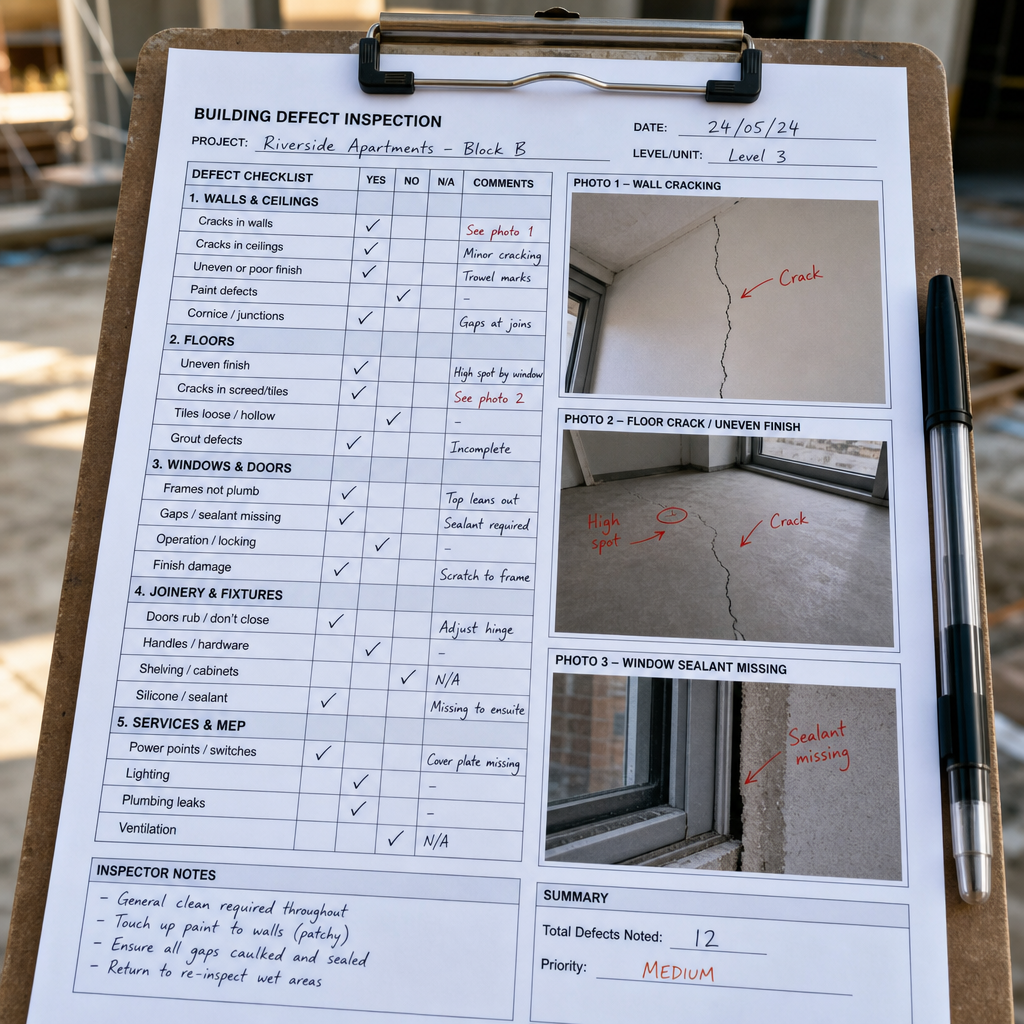
Not all defect reports are equally useful for managing trade performance. A generic checklist that records defects without trade attribution or location specifics is adequate for a homeowner but nearly useless as a management tool for a builder running multiple projects across Brisbane, Gold Coast, or Ipswich simultaneously.
Trade Attribution as a Non-Negotiable Element
Every defect in a useful report must be assigned to a specific trade. This means the inspection process itself requires someone who understands the construction sequence well enough to identify which subcontractor is responsible for each element. A crack in the cornice could be the plasterer, the framer, or a settlement issue. Documenting it simply as “cornice crack” gives you nothing useful for performance management.
GoInspect’s reporting approach explicitly assigns defects to responsible trades, which means builders receive a document they can use directly in subcontractor performance conversations without doing additional attribution work themselves.
Photo Documentation with Location Context
Photographs must be tied to a specific location within the dwelling. A photo of a defective waterproofing application is meaningless for rectification if the inspector hasn’t noted that it is the ensuite shower base on level two of a high-rise unit. Location context is what converts a photo into an actionable instruction.
Pro tip: Request that your inspection provider include floor plan references or location tags in their photo documentation, not just sequential photo numbering. This cuts the time your site supervisor spends locating defects during rectification by a significant margin.
Priority Classification
Defects need to be classified by severity so trades understand what requires immediate rectification before handover and what constitutes a warranty item. Mixing structural concerns with cosmetic imperfections in an undifferentiated list causes trades to address easy items first and delay the serious ones.
Using Trade Performance Reports to Identify Repeat Offenders
A single pre-handover inspection gives you a snapshot. A trade performance report built from data across multiple inspections gives you a trend. This distinction matters enormously for builders managing volume construction across Southeast Queensland.
The method is straightforward. After each practical completion inspection, extract the defects attributed to each trade and log them in a simple spreadsheet or project management system. Track defect type, frequency, location in the build, and resolution time. After six projects you will have enough data to identify which trades consistently generate defects and what types of defects they generate.
“Construction rework costs typically account for between 5% and 15% of total project costs in residential building. The majority of that rework traces back to a minority of trades.” Source: Construction Industry Institute research on rework in construction projects.
In practice, the pattern is almost always asymmetric. Roughly 20% of your subcontractors generate 80% of your defect rectification costs. Once you have identified those trades with documented evidence, you have three options: increase supervision during their work phases, require them to attend a pre-work quality briefing specific to the defect types they generate, or replace them. Each of those decisions is defensible when backed by a documented defect history. None of them is defensible based on a site supervisor’s memory alone.
Pro tip: Run a quarterly trade performance review using your defect data before contract renewal conversations. Trades that know you track performance data across projects tend to self-regulate more effectively than those who believe each job is assessed independently.
Comparing Defect Reporting Approaches for Builders
Builders operating across multiple sites have three realistic options for defect reporting. Each has different implications for how useful the data is for trade performance management.
| Approach | Strengths for Trade Performance Management | Weaknesses |
|---|---|---|
| Internal site supervisor checklists | Immediate access, no additional cost, supervisor knows the project | Subjective, relationship-influenced, rarely trade-attributed consistently, no independent authority for subcontractor disputes |
| Third-party licensed inspection (e.g., GoInspect) | Objective, photo-documented, trade-attributed, same-day reporting, legally defensible, carries authority with subcontractors | Direct cost per inspection, requires scheduling coordination with project timeline |
| Developer or owner-commissioned inspection at handover | Independent perspective, catches issues the builder’s team may have normalised | Occurs after the builder’s opportunity to manage trades proactively, creates adversarial dynamic rather than constructive one |
The data consistently shows that third-party inspections commissioned by the builder before handover produce the best outcome for trade performance management. They carry the authority of independence without the adversarial dynamic that occurs when a client commissions an inspection against the builder. GoInspect’s practical completion inspections, starting from $550 including GST, are structured specifically to serve this function across Brisbane, Gold Coast, Logan, Ipswich, and Redland Bay projects.
Construction Quality Assurance Through Staged Inspections
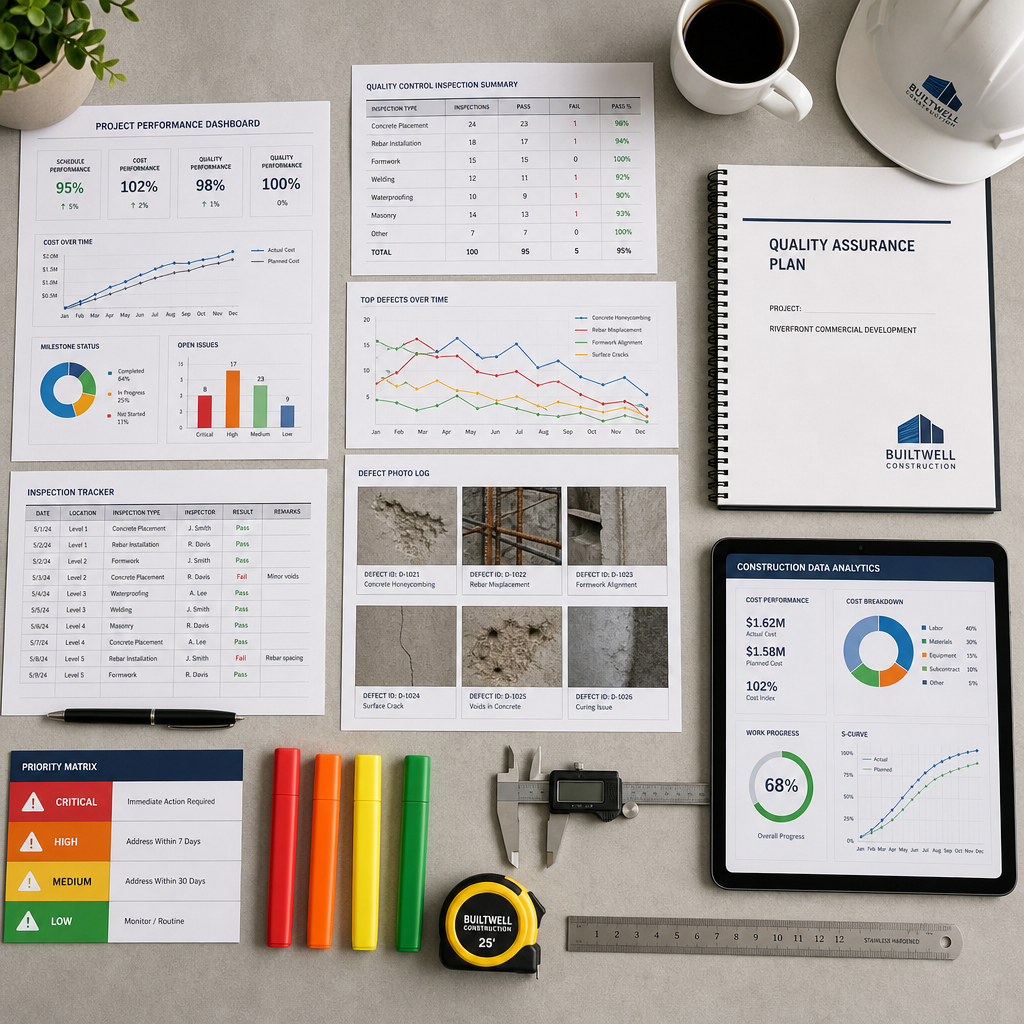
The most common mistake builders make with defect reporting is treating it as a single event at practical completion. By that point, many defects have already been concealed by subsequent trades, and the cost of rectification is significantly higher than it would have been if caught at the stage where the defect occurred.
Effective construction quality assurance for trade performance uses staged inspections tied to the construction sequence. This means inspecting framing before lining, inspecting waterproofing before tiling, and inspecting linings before painting. Each stage inspection creates a documented checkpoint that catches defects while the responsible trade is still on site and rectification is simple.
Pre-Lining Inspections for Framing and Rough-In Trades
Framing defects, incorrect rough-in locations, and substandard insulation installation are all invisible once wall linings are complete. Builders who inspect at the pre-lining stage not only catch these defects early but also create a documented record that framing and rough-in trades were performing to standard at that point, which protects the builder if issues emerge later.
Pre-Tile Waterproofing Inspections
Waterproofing is the single highest-risk element in a residential build from a warranty liability perspective. A failed waterproofing membrane that is only discovered after tiling requires tile removal, membrane replacement, and re-tiling. The cost escalation is typically three to five times what early detection would have cost. Inspection at this stage directly protects both the builder’s margin and their warranty exposure.
Builders using GoInspect’s inspection services across high-rise and housing projects in Southeast Queensland can structure staged inspections that feed into a cumulative trade performance record, rather than receiving a single end-of-project defect list that is too late to inform subcontractor management on that project.
Turning Defect Data into Subcontractor Conversations That Work
Having good defect data is necessary but not sufficient. The data has to be used in structured performance conversations to change subcontractor behaviour. A common mistake is presenting a defect report to a trade as a list of failures without context, which generates defensiveness rather than commitment to improvement.
The most effective approach is to present defect data comparatively. Show the trade their defect frequency relative to the same trade type across your projects. Most subcontractors are competitive and respond to evidence that they are performing below the standard of comparable trades. This reframes the conversation from accusation to performance benchmarking.
For trades with persistent defect patterns, incorporate defect expectations directly into their contract scope. Specify maximum acceptable defect rates per project and link them to payment terms. This is only possible when you have documented defect history to establish what a reasonable benchmark looks like. Without that data, any performance clause in a subcontract is unenforceable in practice because neither party has an agreed baseline.
Builders in Queensland should also be aware that under the Queensland Building and Construction Commission Act 1991, they carry primary responsibility for defect rectification regardless of which subcontractor caused the defect. This makes proactive trade performance management through documented defect reporting a direct financial protection measure, not simply an administrative exercise.
Pro tip: Share anonymised defect benchmarking data with your trades at the start of each project. Letting a plastering contractor know that the top-performing plasterers across your projects average fewer than three defects per dwelling at practical completion sets an expectation before work begins rather than after.
Frequently Asked Questions
What should a builder defect report include to be useful for managing subcontractors?
A builder defect report useful for subcontractor management must include trade attribution for every defect, photographic evidence tied to specific locations, defect severity classification, and a date stamp. Reports that list defects without identifying the responsible trade are nearly impossible to use for performance management because subcontractors will dispute responsibility without documented evidence.
How often should builders commission independent defect inspections?
At a minimum, builders should commission an independent inspection at practical completion before client handover on every project. For high-risk or high-value projects, staged inspections at pre-lining and pre-tile stages are worth the additional investment. Builders running volume construction across Southeast Queensland benefit most from a consistent inspection schedule that builds comparable performance data across projects.
Can defect reports be used in subcontractor contract disputes?
Yes, and this is one of their most valuable functions. A defect report produced by a licensed independent inspector with photographic documentation, trade attribution, and a date stamp is significantly more defensible in a dispute than a site supervisor’s verbal account or an internal checklist. In Queensland, where QBCC complaints and QCAT disputes are relatively common, documented independent inspection reports carry substantial weight.
What is the difference between a pre-handover inspection and a practical completion inspection?
In practice, these terms are often used interchangeably, but there is a useful distinction. A practical completion inspection is typically conducted at the point the builder declares the work substantially complete. A pre-handover inspection may occur slightly later, immediately before the client takes possession. For trade performance management, the earlier inspection is more useful because the responsible trades are more likely to still be engaged with the project and available for rectification.
How do builders use defect frequency data to benchmark subcontractor performance?
By extracting defect counts attributed to each trade across multiple inspection reports and organising them by trade type, project stage, and defect category, builders can identify which trades consistently exceed acceptable defect rates. This data supports direct performance conversations, informs contract renewal decisions, and helps site supervisors prioritise supervision time on trades with documented quality issues. GoInspect’s trade-attributed reporting makes this data extraction straightforward compared to unstructured defect lists.
Does using an independent inspector rather than an internal supervisor produce better defect data?
Yes, for two reasons. First, independent inspectors have no personal relationship with the trades they are assessing, which eliminates the tendency to downplay defects to maintain working relationships. Second, subcontractors treat findings from a licensed third-party inspector as more authoritative and are less likely to dispute them, which shortens the rectification cycle and reduces the builder’s administrative burden.
If you manage subcontractors across multiple projects in Southeast Queensland, share how you currently use defect data to drive trade accountability. Practical approaches from working builders are always worth discussing.
References
- Statista: Construction industry statistics on rework costs and defect rates in residential building projects
- Queensland Building and Construction Commission: Licensing, statutory warranties, and defect rectification obligations for Queensland builders
- Forbes: Expert analysis on construction project management and subcontractor performance accountability
- McKinsey and Company: Research on productivity, rework costs, and quality management in the global construction sector
- Australian Building Codes Board: National Construction Code compliance standards relevant to defect identification and construction quality assurance